Speaking to Viet Nam News Agency correspondents in Paris ahead of General Secretary of the Communist Party of Viet Nam Central Committee and President To Lam’s visit to France, Bonassi said the upgrade of bilateral ties to a Comprehensive Strategic Partnership reflects their shared desire to deepen and broaden cooperation, with technological autonomy, resilience and human resources development assuming increasingly important roles.
    |
 |
|
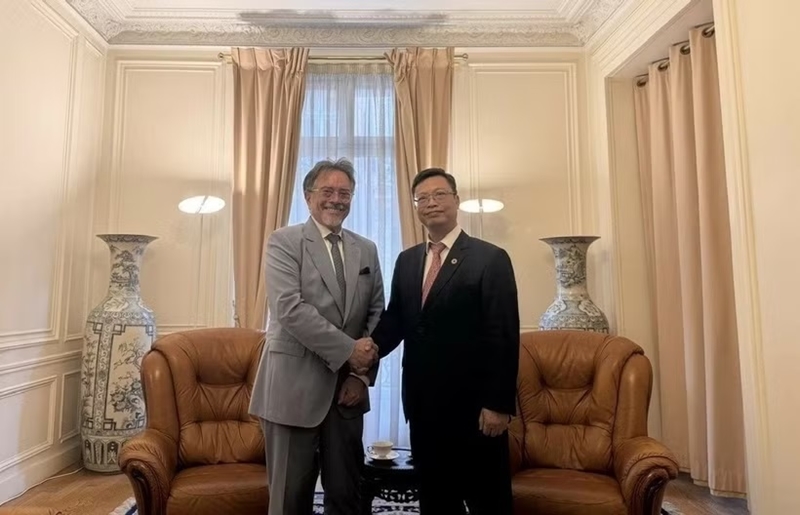
Senior Vice-President of Latin America and Asia at Thales Group Guy Bonassi (left) at a meeting with Vietnamese Ambassador to France Trinh Duc Hai |
For Thales, he said, this opens opportunities to strengthen partnerships with Viet Nam in aviation, space, security, cybersecurity and AI applications in critical systems.
Bonassi said cooperation between Thales and its Vietnamese partners has been built step by step over more than 30 years and has become solid, diverse and increasingly strategic, spanning aviation, space, security, digital technology and cybersecurity.
Thales currently works with a wide range of Vietnamese partners in both the public and private sectors, including Viet Nam Airlines, Vietjet, VNPT, Viettel, GTEL and MobiFone, as well as regulatory agencies and organizations in relevant fields.
In aviation, amid strong growth in Viet Nam’s air traffic, Thales has for years worked with the Civil Aviation Authority of Viet Nam (CAAV) and the Viet Nam Air Traffic Management Corporation (VATM) to modernize the country’s airspace through air traffic control centers, radar and surveillance systems, navigation aids and maintenance services, helping improve operational efficiency and safety.
Viet Nam is undergoing rapid digital transformation with ambitions to become an important country in Southeast Asia, while the Viet Nam–France Comprehensive Strategic Partnership provides favorable conditions for sustainable cooperation in these strategic fields, he said.
Bonassi highlighted effective cooperation areas between the firm and Vietnamese partners, including AI, cybersecurity, civil aviation, and space.
He said that Thales wants to develop long-term cooperation with Viet Nam, focusing on innovation, skills development and greater technological autonomy, he added.
One specific area highlighted by Bonassi is the management of unmanned aerial vehicles (UAVs) and low-altitude airspace.
He said incidents involving UAVs in Vietnamese airspace in 2025 and since the beginning of 2026 have seriously affected hundreds of flights, creating risks to aviation safety, flight delays and significant economic losses. Thales is working with Vietnamese partners to propose comprehensive solutions to ensure the safety of low-altitude airspace, he added
Alongside technological and industrial cooperation, Bonassi stressed Thales’ desire to support the development of Viet Nam’s human resources in STEM fields – science, technology, engineering and mathematics.
Thales hopes to continue supporting young Vietnamese talents in their studies and career development, he said.
Finally, Bonassi stressed that combining industrial projects, innovation and training would help strengthen Viet Nam–France cooperation over the long term.
This is also the approach Thales is pursuing in its partnership with Viet Nam, with a view to building sustainable technology partnerships while contributing to Viet Nam’s goals of technological autonomy and development.
Source: VNA