The visit from October 11 to 15 will be made at the invitation of Zhao Leji, Chairman of the Standing Committee of the NPC.
Significant achievements in bilateral ties
Viet Nam and China established diplomatic relations on January 18, 1950. Over more than 75 years, peace, friendship and cooperation for development have remained the mainstream of bilateral relations.
    |
 |
|
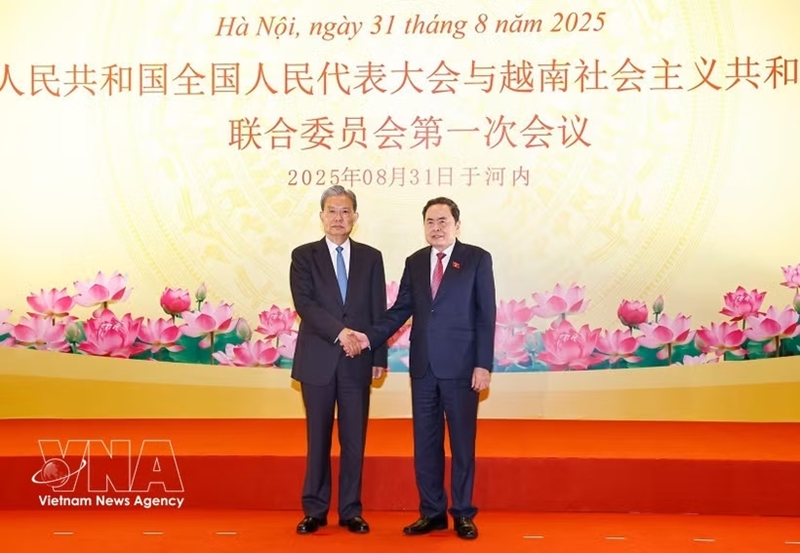
President of the National Assembly Tran Thanh Man (right) and Chairman of the Standing Committee of the National People’s Congress of China Zhao Leji at the first session of the Cooperation Committee between the two legislative bodies in Hanoi on August 31, 2025 |
The traditional “camaraderie plus brotherhood”, founded by President Ho Chi Minh and Chairman Mao Zedong and nurtured by generations of leaders from both countries, is a valuable asset of the two peoples. The legacy of solidarity between revolutionary leaders of the two countries has laid a firm foundation for bilateral ties to develop in an increasingly substantive and effective manner.
Building on this foundation, Viet Nam and China have made significant progress in bilateral cooperation in recent years. During the state visit to Viet Nam by General Secretary of the Communist Party of China (CPC) Central Committee and President of China Xi Jinping in December 2023, the two sides agreed to elevate their relations to a Comprehensive Strategic Cooperative Partnership and build a Viet Nam–China community with a shared future that carries strategic significance.
In April 2025, the two sides reaffirmed their commitment to implementing the high-level common perceptions and deepening bilateral ties in line with the “six major orientations", namely higher political trust, more substantive security and defence cooperation, more practical and deeper cooperation, more solid social foundations, closer multilateral coordination, and better control and settlement of differences. These are major orientations and an important strategic framework for bilateral relations in the new period.
The state visit to China by General Secretary of the Communist Party of Viet Nam Central Committee and President To Lam in April 2026 further advanced bilateral connections. The two sides issued a joint statement on deepening their Comprehensive Strategic Cooperative Partnership and promoting the building of a Viet Nam–China community with a shared future that carries strategic significance at a higher level in the new era. They also signed 32 cooperation documents covering Party affairs, public security, justice, the economy, production and supply chains, customs, science and technology, people’s livelihoods, human resources training, communications and local-level cooperation.
The two countries have continued to effectively maintain cooperation mechanisms, including the Steering Committee for Bilateral Cooperation and the ministerial-level “3+3” strategic dialogue on foreign affairs, defense and public security.
Positive political and diplomatic ties have provided a stepping stone for expanding collaboration in other fields, with economic and trade ties remaining a major highlight.
China has been Viet Nam’s largest trading partner for more than 20 consecutive years, while Viet Nam has remained China’s biggest trading partner in ASEAN for 10 straight years. In 2024 and 2025, Viet Nam was also China’s fourth-largest trading partner worldwide. Bilateral trade reached 256.4 billion USD in 2025, up 24.8% year on year, and totaled 216.1 billion USD in the first eight months of 2026, an increase of 35.2% from the same period last year.
China’s investment in Viet Nam has continued to grow. In the first seven months of 2026, Chinese investors registered nearly 3.7 billion USD, up 31.5%, and led the number of newly registered projects with 849. By the end of July, China had more than 7,000 valid investment projects worth nearly 37 billion USD in Viet Nam, ranking sixth among 153 countries and territories investing in the Southeast Asian country.
The two sides are also promoting transport, logistics and railway connectivity, as well as smart border-gate models, to improve customs clearance, reduce logistics costs and strengthen supply-chain links.
According to Vietnamese Ambassador to China Pham Thanh Binh, cooperation is expanding into areas central to the two countries’ future development, including science – technology, innovation, the digital economy, green transition, clean energy and human resources training. Both sides are also seeking to connect production and supply chains, strengthen industrial capacity and ensure the safe and effective application of technology.
Cultural, educational, tourism and people-to-people exchanges have also been flourishing. In the first eight months of 2026, Viet Nam welcomed around 3.54 million Chinese visitors, up 100.3% year on year, making China its largest source of international tourists.
The two countries are also implementing the Viet Nam–China Tourism Cooperation Year 2026–2027 and the “Red journey” program for young people, helping foster mutual understanding and friendship and strengthen the social foundation of bilateral relations.
At multilateral forums, the two countries have enhanced coordination within international mechanisms such as the United Nations and the Asia-Pacific Economic Cooperation (APEC) forum, as well as regional frameworks such as the Greater Mekong Subregion.
Parliamentary cooperation to be further promoted
Cooperation between the Vietnamese N.A. and the Chinese NPC is an important pillar of bilateral ties. Alongside Party, State and people-to-people diplomacy, parliamentary diplomacy helps build political trust and create favourable legal frameworks for cooperation, helping translate common perceptions and high-level agreements into policies, cooperation programs and tangible benefits.
The cooperation agreement signed by the two legislative bodies in 2024 has been implemented smoothly, with increased sharing of experience among specialized committees, parliamentary friendship groups and local-level legislative bodies.
High-level exchanges have also been maintained. In August 2025, Zhao Leji paid an official visit to Viet Nam and co-chaired the first session of the Cooperation Committee.
Against this backdrop, N.A. President Man’s visit and co-chairmanship of the committee’s second session are expected to give fresh impetus to parliamentary cooperation.
Standing Deputy Minister of Foreign Affairs Nguyen Minh Vu said the visit is a highly important diplomatic event that will help implement the foreign policy set out at the 14th National Party Congress, further consolidate Viet Nam–China relations and bolster cooperation between the two legislatures. It will also affirm the role of parliamentary cooperation as a key pillar of the two countries’ Comprehensive Strategic Cooperative Partnership.
The second session of the Cooperation Committee is the central activity of the visit. Established in 2024, the mechanism is among the few highest-level inter-parliamentary cooperation arrangements that the two countries have established with foreign partners.
The session will provide an opportunity for both sides to discuss and translate the shared orientations into concrete measures, further improve the legal framework for bilateral cooperation, and promote the implementation of the high-level common perceptions and agreements reached at various levels, particularly those made during General Secretary and President Lam’s state visit to China in April 2026.
Vu said the trip will also promote closer cooperation between the two legislative bodies at all levels, including between specialized committees, parliamentary friendship groups and local people’s councils, thus contributing to the development of the Viet Nam–China community with a shared future that carries strategic significance at a higher level.
With the determination of the two countries’ leaders and close coordination between their legislative bodies, the visit is expected to mark further progress in cooperation between the two Parties and countries, as well as between their parliaments, helping to further develop the Comprehensive Strategic Cooperative Partnership and the Viet Nam–China community with a shared future that carries strategic significance.
Source: VNA