Speaking to Viet Nam News Agency correspondents in Beijing ahead of the visit, Duong Cam Vinh, a Vietnamese engineer who earned a doctorate in mechanical engineering from Tsinghua University and now serves as general director of a smart technology company in China, said he was pleased to learn of the planned visit, noting that high-level exchanges provide fresh momentum for relations between the neighboring countries.
    |
 |
|
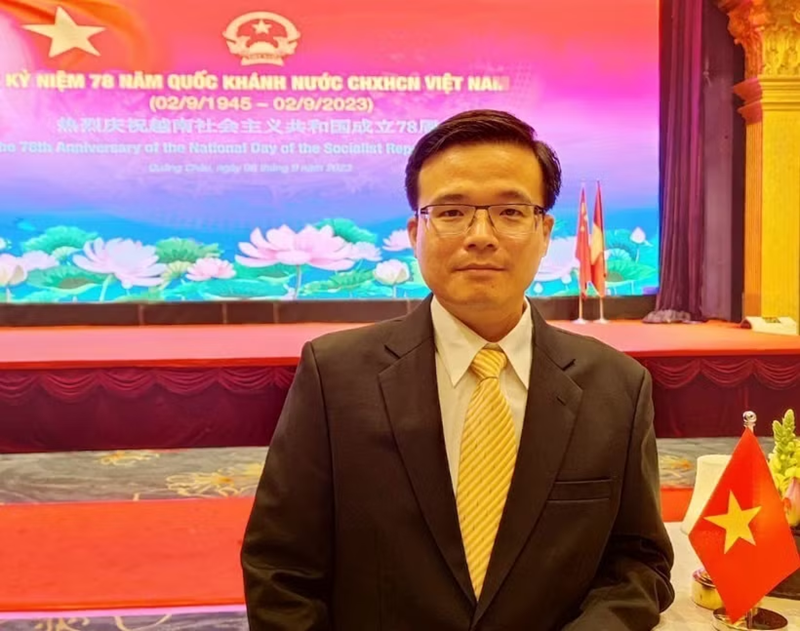
Duong Cam Vinh, a Vietnamese engineer who earned a doctorate in mechanical engineering from Tsinghua University and now serves as general director of a smart technology company in China |
From a technical perspective, he outlined four areas in which he hoped the visit would deliver progress.
First, he hoped the two countries’ legislative bodies would strengthen exchanges to share experience and improve the legal and policy framework for cooperation in science, technology, education and talent exchanges. Clear and favorable regulations would help universities, research institutes, businesses and experts build long-term partnerships, he said.
Second, he hoped scientific research cooperation and exchanges among experts would become more intensive and regular. China has strong universities and research institutes in automation, artificial intelligence (AI) and smart manufacturing. More exchange programs for lecturers, doctoral students and engineers, along with joint research projects, would give Vietnamese institutions more opportunities to work with Chinese partners.
Third, he called for more practical technical cooperation between businesses, focusing on specific needs. China has considerable experience in digital transformation in manufacturing, automation, industrial machine vision and the application of large models and industrial AI, while Viet Nam has strong demand for improvements in productivity and product quality.
The visit is expected to facilitate business partnerships based on actual needs, starting with pilot projects and including training for Vietnamese engineers to ensure that the country could effectively apply and develop the technologies.
Fourth, he stressed the need for better information and networking channels for Vietnamese students, professionals and entrepreneurs in China, as well as more favorable conditions for travel and people-to-people exchanges.
Many Vietnamese experts and engineers in China are eager to contribute to their homeland but lack information about suitable projects and contacts, he said. A dedicated focal point that regularly updates information could help better mobilize the community’s expertise.
Vinh affirmed his willingness to contribute through online technical exchanges, engineer training and business connections between the two countries. He expressed his belief that every Vietnamese living abroad could make a meaningful contribution to bilateral friendship and national development through practical action.
Nguyen Quoc Hung, an associate professor at the Academy of Mathematics and Systems Science under the Chinese Academy of Sciences, also expressed wish that the visit would expand cooperation in education and scientific research.
He said Viet Nam could learn from China’s experience in developing research universities, attracting talent, ensuring long-term research funding and connecting universities and research institutes with businesses. China’s development of high-tech zones linked to research and training institutions, as well as policies to attract international experts, could also offer useful lessons for Viet Nam.
Hung called for greater legislative exchanges on mechanisms to facilitate scientific work, including research funding management and travel procedures for academic cooperation.
He also urged the two sides to expand practical initiatives such as scholarships, exchanges for doctoral students and postdoctoral researchers, joint supervision and joint research teams.
“I particularly hope to see more long-term programs in basic sciences and AI, with clearly designated coordinating bodies and resources,” he said.
Hung expected that the cooperation priorities emerging from the visit would create more opportunities for universities, research institutes and Vietnamese intellectuals in China to contribute to the country's development, strengthen research capacity, train young talent and gradually master key technologies.
Source: VNA