As a neutral country and a center of multilateral diplomacy and U.N. organizations, Austria has actively contributed to U.N. peacekeeping operations since 1960, deploying more than 100,000 military personnel, police officers, and civilian staff to over 100 missions, mainly in Africa, the Middle East, and Europe.
    |
 |
|
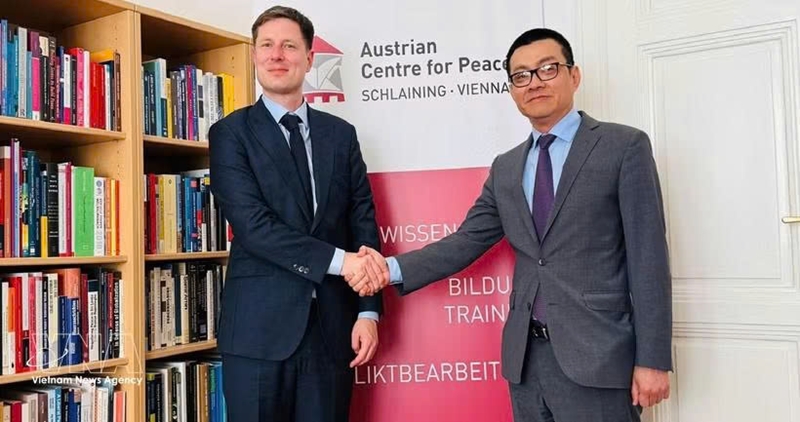
Vietnamese Ambassador to Austria Vu Le Thai Hoang (R) and Tobias Lang, Director of the Austrian Center for Peace (ACP) at their working session in Vienna on April 23 |
At the meeting, Hoang stressed that Vietnam consistently pursues a foreign policy of independence, self-reliance, peace, cooperation, and development, diversification and multilateralization of external relations, proactive and active international integration, stronger defense and security diplomacy, and active, effective participation in U.N. peacekeeping activities.
Vietnamese military officers began joining U.N. peacekeeping missions in 2014, while police officers started participating in 2022 in areas such as Abyei, the Central African Republic, and South Sudan. Vietnam’s law on participation in U.N. peacekeeping forces officially came into effect on January 1, 2026.
The ambassador noted that Vietnam highly values international cooperation in general, and cooperation with Austria in particular, in training and improving peacekeeping capacity, especially in foreign languages, operational skills, specialized peacekeeping knowledge, understanding of international law and culture, and the application of technology to meet U.N. standards.
For his part, Tobias Lang expressed his strong impression of Vietnam’s sound policy direction, remarkable efforts, and encouraging achievements in participating in peacekeeping operations, which have helped enhance its image and reputation as a peace-loving country and a responsible member of the international community.
With its extensive experience and strong network of respected experts and trainers, the ACP is ready to cooperate with and support Vietnam in organizing tailored training and capacity-building courses. These may include survival skills, climate adaptation, strengthening capacities for female officers, and the use of technology in peacekeeping operations, as well as courses and seminars on mediation and conflict resolution in international disputes.
He expressed confidence that bilateral cooperation in U.N. peacekeeping holds significant potential and should be advanced in a practical and substantive manner, thereby contributing positively to global peace, stability, and sustainable development.
Source: VNA