Although the figure falls short of the 48 billion USD target, it still represents a year-on-year increase of 5.6% and helps the country maintain its position among the world’s top three textile and garment exporters. This result is seen as an important milestone, creating momentum for the industry to achieve future goals in the face of mounting pressure for deep restructuring to meet increasingly stringent green standards in export markets.
    |
 |
|
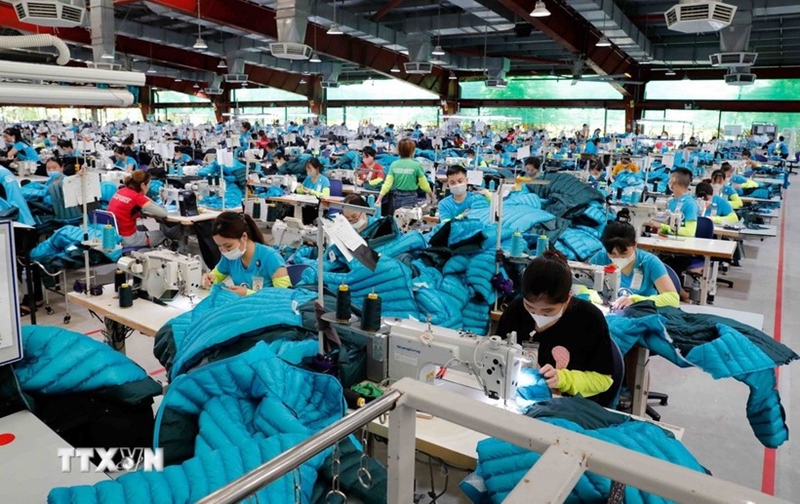
Garment production for export to the U.S. and E.U. markets at the Maxport garment company |
Vu Duc Giang, Chairman of the Vietnam Textile and Apparel Association (VITAS), noted a shortfall of 2 billion USD in export turnover is inevitable as the industry experienced market fluctuations and international policy changes in 2025, especially the escalated U.S. - China trade tension, complex geopolitical developments, and weakened consumer demand in major markets such as the U.S. and the E.U.
Free trade agreements such as the E.U. - Vietnam Free Trade Agreement (EVFTA) will only become real opportunities if enterprises are capable of meeting new standards and increasing the rate of local materials, he stressed.
Cao Huu Hieu, General Director of the Vietnam National Textile and Garment Group (Vinatex), noted that while the industry remains one of the country’s key foreign currency earners, ranking third nationwide in export value, it is confronting growing challenges due to intensifying competition and increasingly strict requirements from major import markets.
At present, the industry remains heavily dependent on imported raw materials, posing significant risks if the U.S. applies tariff regulations to products with a high proportion of third-country origin.
In addition, it largely operates at the manufacturing stage and has yet to make strong advances in higher value-added segments such as design, branding, and distribution. Low labor cost is also no longer an advantage of Vietnam compared to many other exporting countries.
By 2030, with the orientation of sustainable development and circular economy, the sector aims to earn 64.5 billion USD in export turnover, with average annual growth of 6.5% - 7%, while expanding the domestic market to a size of 8-9 billion USD. Strategic priorities include greening, digitalization, raising the rate of local materials to over 60%, and building strong fashion brands.
To that end, Giang said, enterprises must accelerate market, product, and customer diversification while boosting investment attraction to the supply segments Vietnam still faces shortages in, and developing human resources in parallel with science and technology promotion.
Above all, he added, they need to nurture the aspiration to bring Vietnamese brands to the global market.
With a sustainability and circular-economy-oriented approach, Vietnam’s garment-textile industry is shifting strongly toward FOB (Free on Board) and ODM (Original Design Manufacturing) models to take greater control over design, raw materials, logistics, and warehouse management in importing countries, aiming to master production rather than merely engaging in processing.
Source: VNA