In the minds of many, traditional crafts are often associated with elderly artisans, gray hair, and hands worn by years of labor. Few would expect that within today’s dynamic younger generation, there are individuals choosing to return to ancestral trades, quietly renewing traditional values through technology.
“Bridge” for craft village
In Hong Son commune, Hanoi, mention of sericulture and silk weaving immediately brings to mind Phan Thi Thuan, Director of My Duc Mulberry Silk Company Limited.
    |
 |
|
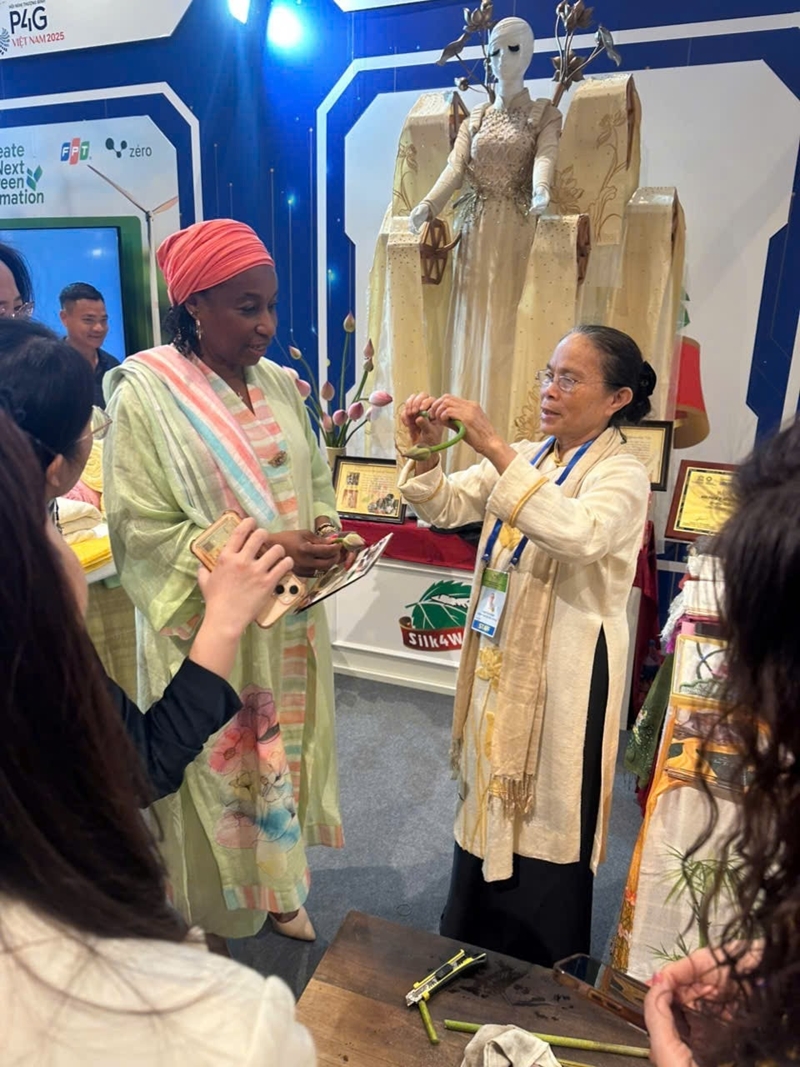
Phan Thi Thuan introduces lotus silk materials to foreign visitors. |
Coming from a family with generations devoted to mulberry cultivation, silkworm rearing, silk reeling, and weaving, Phan Thi Thuan established a closed-loop production model, from clean raw material areas to finished products. Several product lines have achieved 4- to 5-star OCOP certification, including silk duvets, mulberry silk fabrics, and lotus silk scarves, reinforcing the craft village’s reputation.
However, when transitioning into the digital environment, the artisan acknowledged difficulty keeping pace. “At my age, accessing technology or handling online customer service is slow. We must rely on the younger generation,” she shared. From that gap, younger family members stepped in. Her successor is her granddaughter, Phan Thuy Trang.
If Phan Thi Thuan represents the generation preserving the craft through skilled hands and inherited experience, Trang introduces a new approach: bringing products to social media and telling the craft village’s story through images, videos, and digital platforms.
Having previously worked as a restaurant chain manager in the city with a stable income, Trang decided to pivot and return home to support the traditional trade. “I want the essence of the craft village not to remain within the workshop, but to reach the world, told through the authentic voice of insiders,” Trang said.
|
|
 |
|
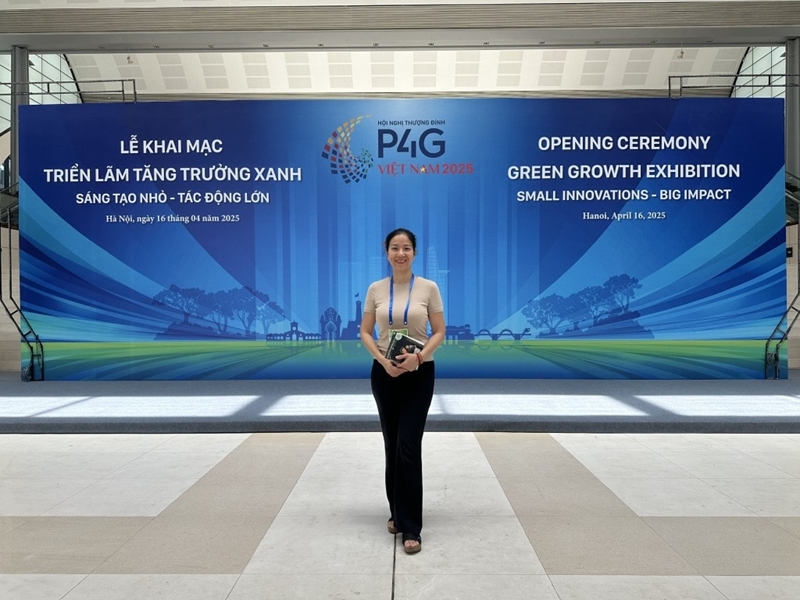
Trang continues efforts to bring craft village products into the digital space for promotion and marketing. |
Unlike the past model, which relied mainly on traders, trade fairs, or tourists, Trang now places products on social media and e-commerce platforms. For her, the digital space serves not only as a sales channel, but also as a platform to connect with younger customers accustomed to online shopping and concerned about product origin.
Multi-channel sales to sustain the craft
For Trang, the objective goes beyond revenue growth. “Vietnamese craft villages have unique advantages. If we do not leverage technology to tell that story, we limit ourselves,” she noted.
Instead of posting standalone product images, Trang develops content around storytelling, from silkworms feeding on mulberry leaves, silk being reeled from cocoons, to the steady rhythm of looms in the workshop. Short videos documenting each meticulous manual stage are shared on Facebook and TikTok, helping viewers understand that producing a silk piece requires dozens of careful steps.
Fully aware that silk is a selective product, particularly in online sales, Trang does not pursue high order volumes. Instead, she focuses on building a sustainable brand. The family has invested in a QR-code traceability system for each product. With a simple scan, customers can follow the entire production process, from mulberry cultivation and silkworm rearing to weaving, along with quality certification information.
|
|
 |
|
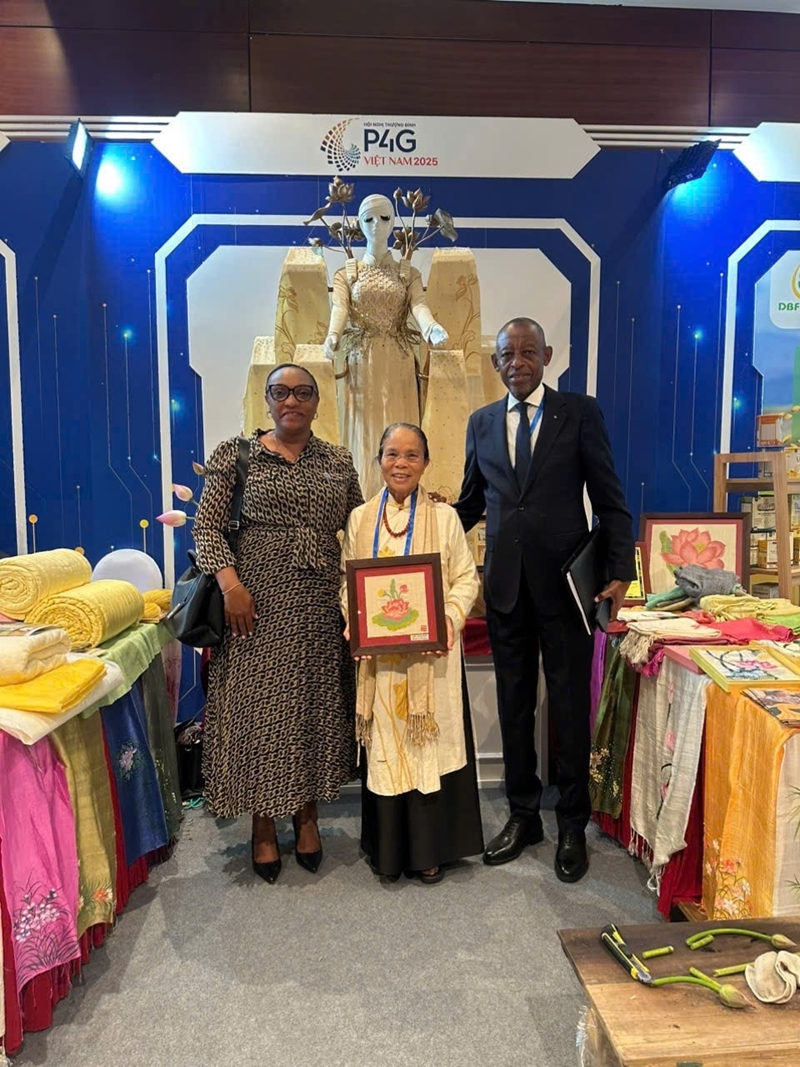
Foreign visitors show strong interest in products made from mulberry silk and lotus silk. |
This data transparency not only combats counterfeiting, but also enhances the value of handcrafted products, which have long relied primarily on traditional reputation as their guarantee.
Trang said that although the family has not yet expanded across all digital sales channels, their structured presence on social media has reshaped how customers approach the silk workshop. When buyers clearly understand the process and the story behind each product, they are willing to accept higher prices compared to industrial alternatives.
From suburban craft villages of Hanoi, traditional products are gradually expanding into broader markets, preserving their identity while achieving clearer brand recognition in the digital era.
Source: hanoimoi.vn
Translated by Mai Huong