The Van Phong Economic Zone (EZ), where strategic vision aligns with strong natural advantages, is steadily rising as a key pillar of Vietnam’s maritime economy.
The master plan for the EZ through 2040, with a vision to 2050, sets out a dual development model: The northern area will become a modern coastal tourism city with international-standard services and a duty-free zone, while the southern corridor will evolve into a hub for industry, energy, logistics, and deep-water ports, complemented by a chain of sustainable coastal urban areas.
    |
 |
|
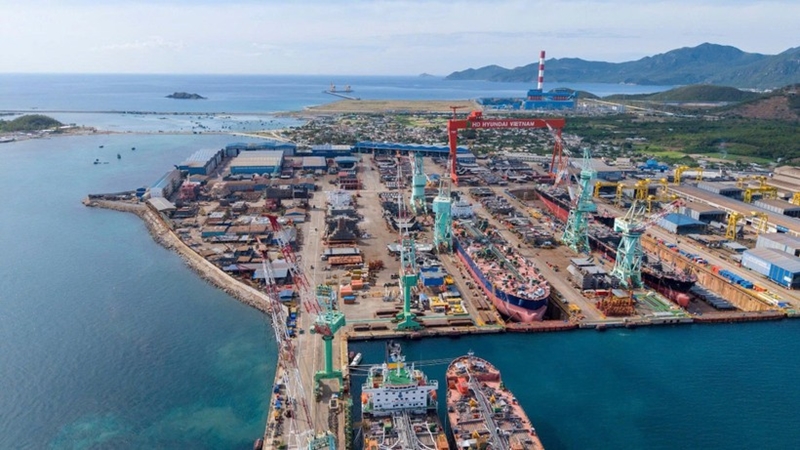
HD Hyundai Vietnam’s shipyard is promoting the development of a logistics and support-service value chain around Van Phong area. (Photo: nhandan.vn) |
To realize this vision, Khanh Hoa is accelerating investment in regional and port-linking infrastructure. Major projects, including the Van Phong - Nha Trang expressway section, the Van Gia - Tu Bong - Dam Mon coastal road, upgrades to National Route 1A, and improvements to the North-South railway, will form an integrated transport network that strengthens logistics capacity and investment appeal.
According to provincial leaders, infrastructure remains the decisive factor enabling Van Phong International Port to serve as a gateway connecting Vietnam’s maritime trade with global markets.
Utilities and urban infrastructure across the EZ are being planned in parallel. The province is also promoting public-private partnerships to mobilize resources for ports, renewable energy, and resettlement areas. Key subzone plans are expected to be completed by 2026, creating a strong legal foundation and a supply of clean, well-located land for strategic investors. The planned addition of Van Phong Airport is expected to accelerate development.
The latest planning framework aims to build a modern, green, and integrated economic zone capable of attracting major investors in ports, logistics, and heavy industry, while also developing international-standard tourism and coastal urban centers.
Van Phong EZ has so far attracted more than 150 projects with a total registered capital of approximately 5.4 billion USD. Many large-scale investments are already operational, including the Van Phong 1 Thermal Power Plant (2.58 billion USD), HD Hyundai Vietnam Shipyard ( 350 million USD), and Australis Vietnam Limited ( 68.19 million USD). These projects generate economic value, create jobs, and stimulate logistics and service chains around the zone.
In 2025, two major urban developments will give Van Phong additional momentum, including the Tu Bong high-end urban area (over 43 trillion VND - 1.63 million USD), envisioned as the northern coastal city center, and the Dam Mon high-end urban area (over 25.6 trillion VND), designed as a core urban hub for commerce, tourism, and international finance. A series of large tourism and service projects, such as Hon Ngang Ecotourism, Co Ma Urban Area, and Doc Let - Phuong Mai Resort, are also being advanced, forming a modern and cohesive coastal urban chain.
Backed by national-level resolutions granting special mechanisms in finance, investment, land management, and decentralization, Khanh Hoa is prioritizing three breakthrough areas: development of strategic infrastructure; administrative reform and digital transformation to streamline licensing; and faster land clearance to prepare clean land for large projects, particularly in clean industry, high technology, green energy, and ecotourism.
Local authorities emphasized that boosting the investment climate, enhancing the competitiveness index, and providing transparent, timely support for investors are key priorities. Sustainability is also a major focus, with plans incorporating green economy initiatives, climate adaptation strategies, circular economy models, and clean energy into the overall development approach.
By 2030, Van Phong aims to rank among Vietnam’s top three economic zones, contributing significantly to provincial and regional GRDP. By 2050, it is envisioned as an international maritime economic center and a leading driver of Khanh Hoa’s long-term development.
Source: VNA