The event, held under the direction of the Ministry of Culture, Sports and Tourism and organized by the Sports Authority of Vietnam, the Vietnam Olympic Committee and VietContent - a leading producer and distributor of entertainment and sports in Vietnam. Participants included representatives of management agencies, sports organizations and businesses, along with investors and experts.
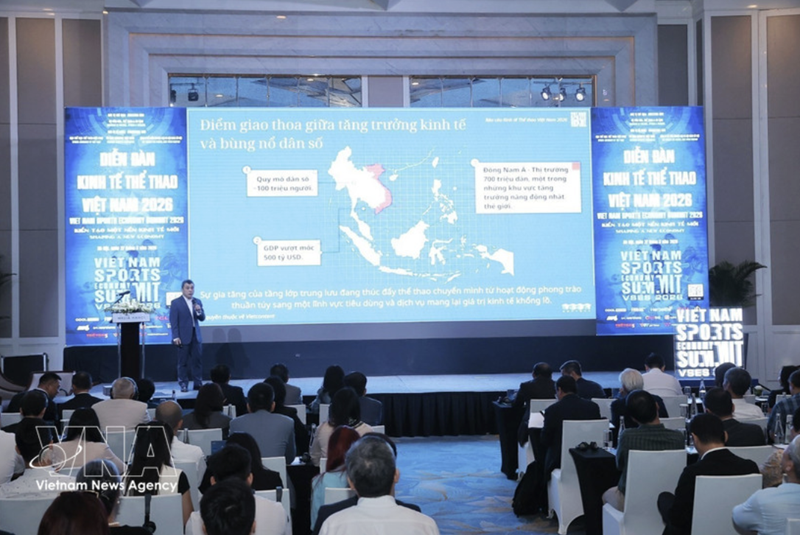
The summit, themed “Shaping a New Economy,” served as a platform to connect perspectives from governance, business and academia, both domestic and international. It aims to clarify the role of sports not only as a social activity but also as a sector capable of generating economic value, attracting investment and creating new growth momentum.
    |
 |
|
The Vietnam Sports Economy Summit 2026 (VSES 2026) opens in Hanoi on March 27. |
The forum coincided with the 80th anniversary of the traditional day of Vietnam’s sports sector (March 27, 1946–2026), and was built on previous editions held in 2023 and 2024. This year’s program delved deeper into the sports economy, focusing on data, markets, investment and development foundations.
Opening the event, Minister of Culture, Sports and Tourism Nguyen Van Hung noted that while the development of a sports economy has been reflected in Party resolutions and sectoral strategies, there is now a pressing need to recognize sports as a fully-fledged economic sector with a clear legal and institutional framework, capable of contributing to national growth.
Sports not only contributes to comprehensive human development but also offers significant economic potential, he said, adding that many countries have successfully harnessed the dual value of sports for both social and economic benefits.
Drawing from international experience, the minister highlighted the importance of hosting large-scale sporting events, which can generate substantial revenue and contribute directly to GDP. This, he said, requires Vietnam to adopt a new development mindset to narrow the gap with more advanced countries and seize opportunities in a new stage of national development.
For years, sports in Vietnam has been viewed mainly through the lens of elite performance and mass participation. However, global trends show that sports has evolved into a large-scale economic sector linked with media, tourism, sponsorship, event organization, technology and consumer markets.
Although the domestic sports market is still emerging, foundational conditions for a sports economy are becoming increasingly evident. The summit therefore served as a specialized platform to connect stakeholders, enhance awareness and promote cooperation opportunities.
A key highlight of this year’s event was the debut of the Vietnam Sports Economy Report 2026, which provides initial data and analysis on the sector’s scale, structure, growth drivers and development models.
Following the report’s release, the forum featured five thematic sessions covering global perspectives on sports as an economic sector, lessons from the Republic of Korea’s sports economy model, market and revenue structures, international development experiences, and policies and strategies for building Vietnam’s sports economy.
Source: VNA