According to the Plant Production and Protection Department under the Ministry of Agriculture and Environment, the 2025–2026 Winter–Spring crop in the Mekong Delta is expected to produce nearly 11 million tons of paddy, with March accounting for about 5.5 million tons. Total exportable paddy output in 2026 is projected at roughly 15.46 million tons, equivalent to 7.73 million tons of rice, creating significant pressure on consumption and exports amid unstable market conditions.
    |
 |
|
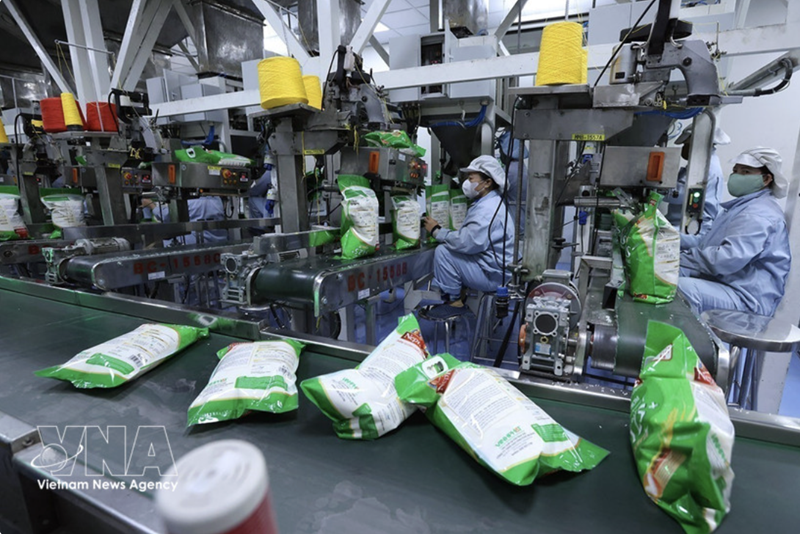
Rice packaged for exports at the factory of Vinh Phat Wilmar Rice Co., Ltd. in Binh Duc ward, An Giang province |
In the first months of 2026, Vietnam’s rice exports recorded growth in volume but a decline in value. Nguyen Anh Son, Director General of the Agency of Foreign Trade under the Ministry of Industry and Trade (MoIT), said exports had reached around 1.74 million tons worth more than 826 million USD by mid-March, up 2.3% in volume but down 8.7% in value year-on-year. The average export price dropped 10.7% to 477.6 USD per ton, underscoring rising competitive pressures in global markets.
Export markets have also shown clear divergence. The Philippines remained Vietnam’s largest buyer, accounting for over 55% of total shipments and maintaining steady growth. Exports to China, Malaysia, and Australia increased, while several African markets saw notable declines.
Do Ha Nam, Chairman of the Vietnam Food Association (VFA), said global rice demand remains strong but uneven across regions. To capitalize on opportunities, the sector must further diversify markets, enhance product quality, strengthen trade promotion, and apply more flexible export management policies.
China has emerged as a bright spot in Asia’s rice trade. Vietnam is now China’s second-largest supplier, exporting roughly 700,000 tons, more than double the previous year’s level.
Beyond traditional markets, Japan and the Republic of Korea are emerging as promising destinations for Vietnam’s premium rice products. Initial shipments branded as “low-emission green Vietnamese rice” have successfully entered the Japanese market, marking progress in brand development and penetration of high-end segments.
Africa is also viewed as a key pillar in Vietnam’s export diversification strategy. According to the Vietnam Trade Office in Algeria, which also oversees Senegal, the country imports about 1 million tons of rice annually, mainly low-priced broken rice. In 2025, Vietnam’s rice exports to Senegal surpassed 168,000 tons worth 52.57 million USD, nearly 30 times higher than the previous year.
During National Assembly Chairman Tran Thanh Man’s official visit to Senegal in July last year, the two countries signed a memorandum of understanding on rice trade, under which Vietnam aims to export around 100,000 tons annually. The agreement contributes to Senegal’s food security while opening new opportunities to expand Vietnam’s footprint in African markets.
Looking ahead, rice export prospects for 2026 are expected to face stronger headwinds as global supply recovers. The VFA forecasts export volumes will likely remain around 7 million tons rather than achieving rapid growth as seen in previous years.
The MoIT has directed relevant agencies and Vietnam’s overseas trade offices to closely monitor supply–demand trends, price movements, and import policies in key markets, while providing timely information, risk alerts, and support to businesses in addressing emerging trade challenges.
Meanwhile, the Vietnam Trade Promotion Agency is stepping up international promotion of Vietnamese rice through diversified programs combining both in-person and online activities to widen market access.
Effective utilization of free trade agreements (FTAs) has also been identified as a key solution to expand export markets. Authorities are incorporating rice into support roadmaps helping enterprises maximize FTA benefits while accelerating negotiations to expand tariff quotas with partners such as the EU and the UK.
Nguyen Quoc Manh, Deputy Director General of the Plant Production and Protection Department, recommended that localities adopt flexible cropping calendars and proactively manage water resources to mitigate saltwater intrusion and climate risks. He also called for continued restructuring towards higher proportions of high-quality, fragrant, and specialty rice varieties, which now account for about 75% of total cultivation.
At the same time, the implementation of the one-million-hectare high-quality, low-emission rice program linked to green growth is helping raise the value of Vietnamese rice through lower production costs, higher farmer profits, and compliance with international sustainability standards.
Source: VNA