“There’s something highly appealing about the curving shape of the sampan, the traditional boat that plies the waters of the Mekong River. The distinctive upward curve of its bow, painted with stylized eyes to ward off evil spirits, gives this boat a jaunty sense of personality as it transports people along this mighty waterway,” Tim Richards wrote.
    |
 |
|
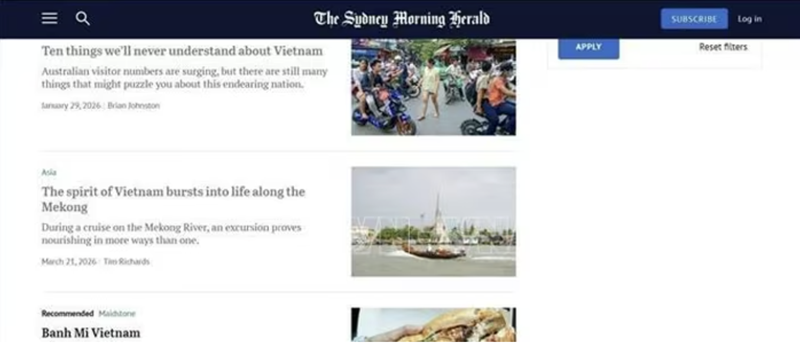
The article titled “The Spirit of Vietnam bursts into life a long the Mekong” by travel writer Tim Richards on Australian website The Sydney Morning Herald. (Screen capture) |
It also provides a water-level view as we passengers embark on an excursion from the Mekong Serenity, the APT vessel that takes travelers on a week-long cruise along the river from Vietnam to Cambodia, he added.
The ship is a comfortable place on which to relax, with its sizable cabins and common areas, including a sprawling lounge bar with views across the river. But there’s something to be said for boarding a smaller craft for a while, and exploring close-up our neighborhood here in the Mekong Delta region of southern Vietnam.
The article describes that passing floating clumps of the ever-present water hyacinth, and locals driving narrow boats with long propeller drive shafts, we approach waterside houses and an unmissable landmark: the Catholic church of Cai Be.
Built in the Romanesque style in the early 1930s when Vietnam was part of the French colonial empire, its belltower is equipped with four bells that were cast in France in 1931. The height of the spire makes this place of worship stand out among the low-lying buildings of the area, lending the structure a graceful slenderness. And this might just be my fancy, but the delicate decoration on the arches and window frames makes the facade resemble a stylized wedding cake.
“Stepping inside the church, we admire its numerous curved arches and a large stained-glass window glowing with light on this bright tropical day,” the author noted.
“We re-board the sampan, wedged as it is against the nearby riverbank, then head across the water to our next stop; being less about spiritual nourishment this time, and more about food itself. A short walk along the shoreline takes us to a long, low building that is home to artisanal manufacturers of traditional Vietnamese foods. Here, rice is transformed by hand into sheets of rice paper, for example, to be used in spring rolls.”
Other ingredients in the process of becoming new foodstuffs include coconut, pandan leaf and condensed milk. This last item eventually becomes tasty squares with added flavors that are wrapped in rice paper and sold as sweet snacks.
According to the writer, in another room is a large metal pan, shaped like a wok, that is heated by a fire beneath. To this, a young man adds a large quantity of rice, which pops spectacularly as a volunteer from our group stirs it with a long metal pole.
“A similar treatment is given to dry noodles, with the resulting cooked masses sweetened and crafted into individual treats. We try samples of each, which are crunchy, tasty and distinctly Vietnamese,” he wrote.
“Returning to the front of the complex, we have a chance to taste snake wine – marinated with real snakes – and other edible and drinkable items before returning to the ship.”
It’s been interesting to spend a little time on shore, seeing traditional crafts in action and sampling the output. Life in the Mekong Delta is sweet, it seems – as sweet as a snack made from condensed milk, Tim Richards concluded.
Source: VNA