The Mekong Delta, the country’s main rice-growing region, is currently entering the peak harvest period for the winter–spring crop. In this context, authorities and businesses are urged to accelerate rice procurement to stabilize prices, ensure profits for farmers, and promote sustainable rice exports.
    |
 |
|
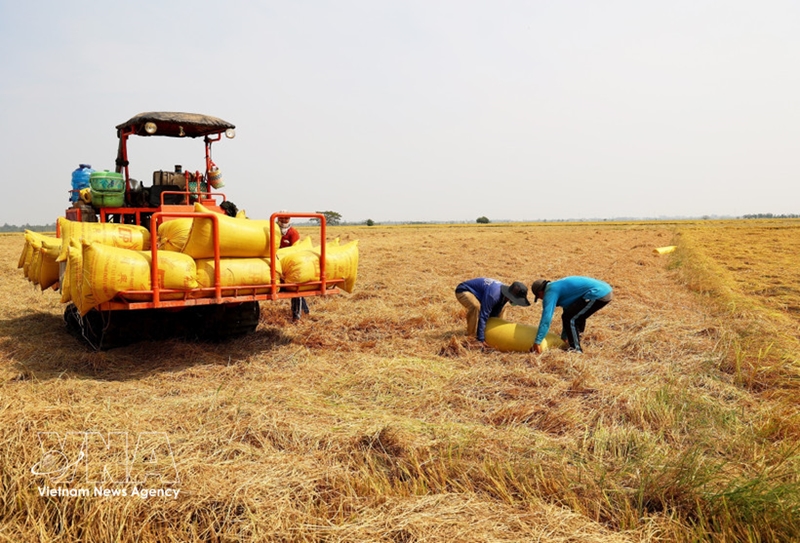
Farmers harvest rice in An Giang province. |
From the beginning of the year to mid-March, Vietnam exported approximately 1.74 million tons of rice worth 826.2 million USD, with an average export price of 477.6 USD per ton, down 10.7% year-on-year.
The decline reflected abundant supply both domestically and globally, while demand from several traditional import markets has weakened. Major buyers such as Indonesia, Malaysia and the Philippines have reduced imports as they have increased domestic reserves and food security. Indonesia is even considering gradually re-entering the regional rice export market as its domestic production improves.
Geopolitical factors have also affected exports. Conflicts in the Middle East have disrupted shipping routes and increased logistics costs, affecting shipments not only to the region but also to European markets.
Vietnam currently cultivates more than 7 million hectares of paddy annually, producing an estimated 43.6 million tons. Of this, about 15.46 million tons of paddy – equivalent to 7.73 million tons of rice – are available for export.
In the short term, the government has instructed local authorities to coordinate with businesses and cooperatives to ensure timely procurement of rice during the peak harvest season, preventing situations where harvested rice cannot be sold. Enterprises are also encouraged to increase purchases and temporarily store rice to fulfil signed export contracts and prepare for future demand.
Experts emphasized that businesses need access to affordable credit to expand procurement capacity during harvest periods, especially those with large storage systems. Preferential credit policies could help enterprises increase temporary stockpiles and stabilize the domestic market.
In the long term, restructuring rice production toward higher-quality and specialty varieties is seen as the key to improving competitiveness. Currently, high-quality and aromatic rice varieties account for about 75% of the winter–spring crop structure, reflecting a positive shift in production orientation.
Vietnam is also expected to better utilize opportunities from free trade agreements. Under the E.U. - Vietnam Free Trade Agreement (EVFTA), the European Union grants Vietnam a tariff-free quota of 80,000 tons of rice annually. Similar preferential quotas are offered under the U.K. - Vietnam Free Trade Agreement (UKVFTA), while some markets under the Comprehensive and Progressive Agreement for Trans-Pacific Partnership (CPTPP) also apply zero tariffs.
However, Vietnam’s rice market share in these markets remains relatively modest, suggesting significant room for growth if exporters improve product quality, origin certification and compliance with technical standards. Expanding market access through FTAs is expected to help diversify export destinations and reduce reliance on traditional markets amid intensifying global competition.
Source: VNA