Passenger cars accounted for the lion’s share of the gain, with 26,102 units sold. Commercial vehicles contributed 10,312 units, while special-purpose vehicles totaled 461 units.
    |
 |
|
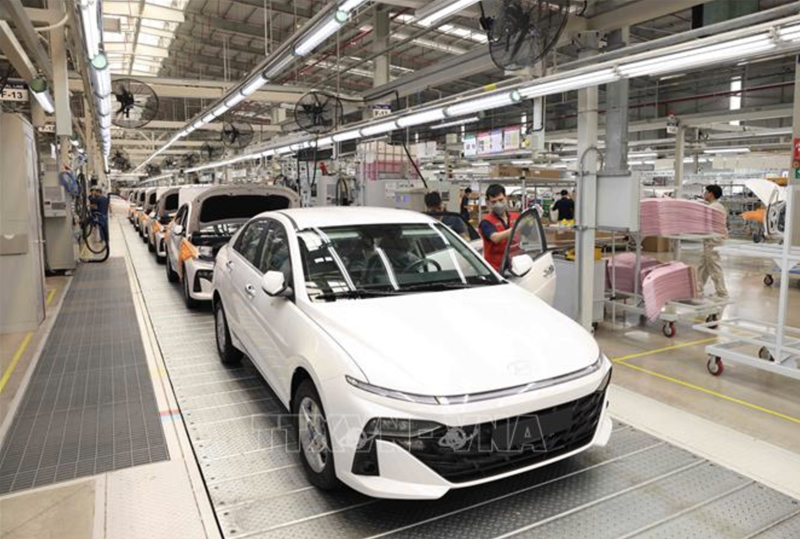
Hyundai Thanh Cong automobile manufacturing and assembly plant in Ninh Binh province. |
Analysts pointed to a low-base effect as a key factor behind the strong showing. In January 2025, the second half of the month coincided with pre-Lunar New Year (Tet) preparations, when Vietnamese consumers typically rein in spending on big-ticket items like automobiles.
The recovery proved evenly distributed between domestic assembly and imports. Locally produced completely knocked-down (CKD) vehicles recorded 18,034 units, up 98% year on year, while fully built-up (CBU) imports reached 18,841, rising 93%. The close balance between the two channels signals a solid revival in both local manufacturing and imported vehicle supply.
Ford Vietnam claimed the top spot among VAMA brands with 5,121 units sold, edging out Mitsubishi’s 5,039 and Toyota Vietnam’s 4,852. THACO-distributed brands rounded out the top five, with THACO Mazda at 3,515 units and THACO Kia at 3,487. The frontrunners drew strength from strong lineups in SUV, crossover, MPV and pickup segments.
Top-selling models highlighted sustained consumer appetite for high-ground-clearance and multi-purpose vehicles. The Mazda CX-5 led with 2,104 units, followed by Mitsubishi Xforce at 1,666. Ford's pickup and SUV lineup held firm momentum, including the Ranger at 1,520, Territory 1,545 and Everest 1,390.
The sales mix indicates ongoing preference for high-ground-clearance vehicles offering ample interior space suited to family use and multi-purpose needs. The dominance of Japanese and US brands in the top ranks points to heightened competition in Vietnam's mid-to-upper mass-market segments.
VAMA data, however, captures only a part of the overall market. Several non-member brands, including Audi, BYD, Jaguar Land Rover, Geely, GAC, Lynk & Co, Omoda & Jaecoo, Mercedes-Benz, Nissan, Subaru, Volkswagen and Volvo, do not release public sales figures. Hyundai Thanh Cong separately reported 5,872 units on February 10, while VinFast, a dominant player in electric vehicles, has yet to disclose January data, leaving the full market picture incomplete.
Even so, the steep year-over-year growth posted by VAMA members points to improving market conditions, buoyed by steadier consumer confidence, a pickup in travel and logistics activity, and a more supportive economic environment.
Early 2026 data suggest that while seasonal factors may cause monthly swings, the underlying trajectory indicates recovery, aided by last year's low base and firm domestic demand.
Source: VNA