With a coastline stretching nearly 3,300 kilometers and an exclusive economic zone of around 1 million square kilometers, strategically located along key international shipping routes in the Asia-Pacific, Vietnam is well positioned to harness its maritime advantages and develop a comprehensive national maritime industrial ecosystem over the long term.
The 12th Party Central Committee's Resolution No.36-NQ/TW, adopted on October 22, 2018, on the strategy for sustainable marine economic development, underscores the need for the coordinated development of related industries, including marine transport, shipbuilding, logistics services and seaport infrastructure.
A new engine of industrial growth
Shipbuilding is increasingly viewed as an important component of Vietnam's marine economy. More than simply a manufacturing sector, it forms part of an integrated industrial ecosystem closely linked with metallurgy, mechanical engineering, electrical and electronic industries, automation, information technology and maritime logistics.
    |
 |
|
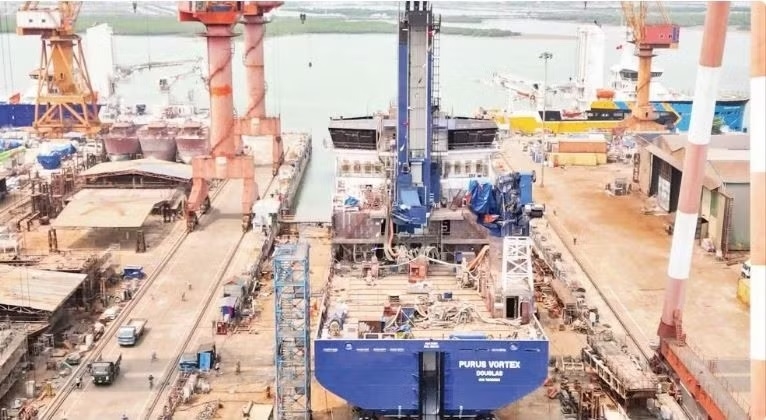
A modern commissioning service operation vessel for the offshore wind industry under construction at Ha Long shipyard (Photo: nhandan.vn) |
According to the Vietnam Maritime and Waterway Administration, the country is home to nearly 90 ocean-going shipbuilding enterprises and more than 400 inland watercraft manufacturers, with a combined newbuilding capacity of around 3.5 million deadweight tons (DWT). Nearly 120 facilities are capable of building and repairing vessels exceeding 1,000 tons.
Vietnam has steadily established itself as a competitive player in several shipbuilding segments, particularly medium-sized commercial vessels. The country also benefits from a sizeable skilled workforce, labor costs that remain competitive within the region, and government policies aimed at supporting the industry's development through international partnerships, infrastructure investment and technological modernization.
Despite these advantages, the sector continues to face challenges, particularly in technology, production capability and global competitiveness. Vietnam currently captures only around 20–30% of the overall shipbuilding value chain.
Maritime experts believe that if supported by a well-developed domestic supply chain together with stronger design capabilities and financial capacity, shipbuilding could emerge as a new industrial growth engine, contributing an estimated 2.2-4% of the country's GDP and supporting Vietnam's ambition of achieving double-digit economic growth.
Building an integrated ecosystem
Dr. Pham Hoai Chung, Chairman of the Members' Council of the Shipbuilding Industry Corporation (SBIC) and Vice Chairman of the Vietnam Shipbuilding Industry Association (VISIA), said Vietnam has established a clear long-term direction for developing the industry through an ecosystem approach.
Rather than developing individual shipyards, localities or isolated product lines, he said, the strategy focuses on integrating shipbuilding with the merchant fleet, inland waterway transport, port infrastructure, logistics, supporting industries and services throughout a vessel's entire lifecycle.
He added that the industry's development should not be pursued through isolated shipyards, individual localities or standalone product lines. Instead, planning and policymaking must foster an integrated value chain, ensure stable market demand, and promote an efficient division and overall performance.
SBIC's shipbuilding subsidiaries are currently pursuing a dual mission: maintaining production, safeguarding jobs and incomes for workers, while simultaneously implementing corporate restructuring in line with Government resolutions. Many shipyards have already secured order books through the end of 2028, while several have signed newbuilding contracts extending to 2030. These companies are also working to accelerate production schedules, reduce costs and improve profit margins.
SBIC General Director Tran Manh Ha said that despite facing considerable challenges in recent years, the corporation's member companies have largely succeeded in retaining their workforce while continuing to train managers and technical specialists, preserving the industry's core human resources for future development.
Ha called on the Government to introduce a comprehensive development strategy with breakthroughs in institutional reform, industrial finance, technology, supporting industries and workforce development. Such measures would provide the foundation for building a modern, environmentally sustainable and internationally competitive shipbuilding industry in the years ahead.
Source: VNA