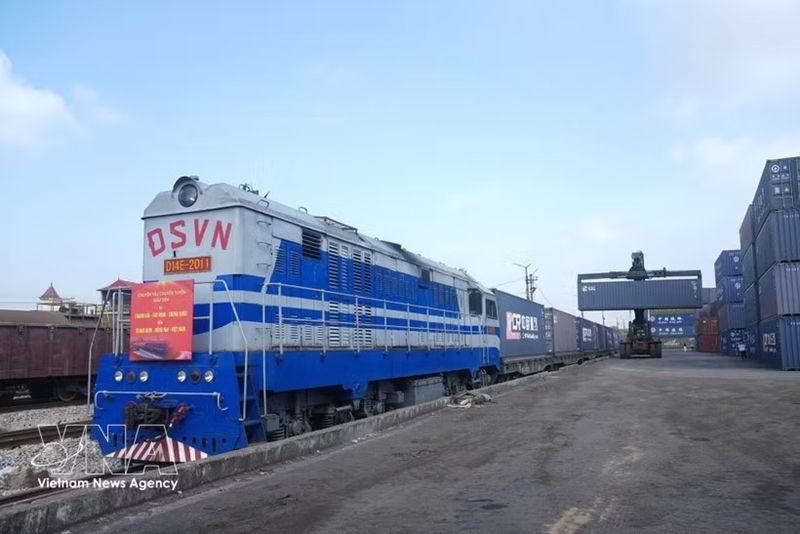
The Qinghai (China)-Dong Nai (Viet Nam) route, one of the new international intermodal container rail services launched by Viet Nam’s railway sector, is a case in point. The new route spans nearly 4,000 km, including nearly 2,200 km across China and over 1,700 km through Viet Nam.
    |
 |
|
Qinghai (China) - Dong Nai (Viet Nam) is one of the new international intermodal container transport routes put into operation by the Vietnamese railway industry. |
Thanks to direct, continuous train operations, the total journey from Qinghai to Trang Bom station has been reduced to about seven days, including customs clearance, from 12-15 days previously.
International intermodal rail freight has recorded strong growth in recent years. In 2024, freight volume reached 1.15 million tons, up 43% year-on-year. The figure exceeded 1.4 million tons in 2025, up 23%, with exports rising 2.7% and imports 51%.
Nguyen Hoang Thanh, Deputy General Director of the Railway Transport and Trade JSC, said that under the railway sector’s policy of bringing border-gate functions deeper into the hinterland, trains departing from inland Chinese locations such as Qinghai, Nanning and Suzhou can run directly into Viet Nam’s interior.
Instead of concentrating cargo at border hubs, the international rail network can carry goods closer to production and consumption centers, giving businesses more options for organizing transport chains, particularly for large consignments requiring stable delivery schedules.
However, expanding similar routes will depend on establishing stable cargo sources and ensuring efficient operations. A key challenge is to prevent freight flows from developing in only one direction.
Thanh said Viet Nam’s railway sector is working to develop two-way services. In addition to receiving cargo from China, it is developing plans to transport Vietnamese goods to China, helping avoid empty return trips and improve operational efficiency.
Stable cargo flows in both directions would enable better use of train capacity while allowing businesses to develop long-term logistics plans.
More broadly, Viet Nam’s advantage lies in connecting its railway network with seaports and domestic economic and production centers. With synchronous investment, goods from China could be transported to Vietnamese logistics hubs and seaports for onward shipment to other markets, while Vietnamese goods would gain an additional means for access to the Chinese market and markets further north.
Several major infrastructure projects are being implemented to realize this potential. The 360km Lao Cai-Hanoi - Hai Phong railway has a total investment of over 289 trillion VND (over 11 billion USD) and is expected to form a standard-gauge rail axis linking Viet Nam’s railway network with China.
Meanwhile, the Hanoi - Dong Dang and Hai Phong - Ha Long - Mong Cai railway projects are being studied for investment. Once completed, the lines are expected to form an integrated network linking northern seaports with the Chinese border.
Nguyen Chinh Nam, Deputy General Director of Viet Nam Railways, said the rail lines would not only support bilateral trade but also provide a foundation for a trans-ASEAN rail transport corridor connecting Viet Nam with China, Central Asia and Europe.
To support international intermodal rail transport with China, the Ministry of Construction recently adjusted the railway network master plan for 2021-2030, with a vision to 2050. The revised plan envisages trans-Asian and Asia-Europe connections through China at the Huu Nghi, Lao Cai and Mong Cai border gates, and connections with ASEAN’s network via Laos at Mu Gia and Lao Bao, and via Cambodia at Moc Bai and Loc Ninh. The plan also prioritizes new railway lines connecting with China both before and after 2030.
The Qinghai-Dong Nai route demonstrates a new direction for international intermodal rail transport, featuring deeper connectivity with hinterlands, shorter transit times and expanded two-way operations. With infrastructure, cargo sources and logistics networks developed in a coordinated manner, such services could become important links in the transport network connecting Viet Nam with China, ASEAN and more distant markets.
Source: VNA