Shortage of specialized personnel
Decision No.1012/QD-TTg on training and developing human resources for nuclear power development sets a requirement for around 1,920 personnel for the Ninh Thuan 1 nuclear power plant and around 1,980 for Ninh Thuan 2 by 2033 and 2035.
    |
 |
|
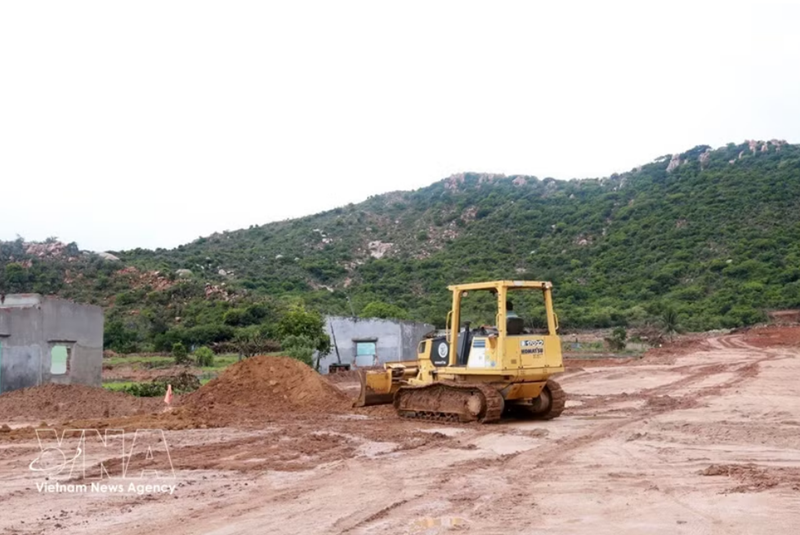
Construction is underway on the resettlement area serving the Ninh Thuan 2 nuclear power plant project. |
Decision No.893/QD-TTg focuses on training, developing, and improving human resources for state management, research, application, and technical support in atomic energy. The goal is that by 2030, all central and local state management staff will be fully trained to carry out their roles. Additionally, at least 50% of personnel at the national radiation and nuclear safety regulatory agency should be able to contribute to drafting legislation, inspecting, and overseeing safety and security at nuclear power plants.
Duong Thanh Tung, head of the Training, Research and Deployment Division at the Nuclear Training Center under the Viet Nam Atomic Energy Institute, said the Government has issued human resource development schemes for different groups, reflecting growing training needs. However, specialized nuclear power training faces major challenges, particularly in terms of lecturers and facilities.
The Viet Nam Atomic Energy Institute currently has only around 10 nuclear power experts and specialists in related fields who can teach, most of whom are approaching retirement age, he said.
The Nuclear Training Center, which previously provided short-term training for personnel for the Ninh Thuan nuclear power project, is now expanding its programs to help prepare personnel for future plant operations. It has organized nuclear power courses for Petrovietnam officials and trained doctoral students in fields directly linked to nuclear power workforce needs.
Regarding long-term human resources for the nuclear power program, Nguyen Hoang Linh, Director General of the Department of Radiation and Nuclear Safety, also pointed to the shortage of specialized nuclear power lecturers. Viet Nam needs to develop a domestic pool of lecturers and experts, but this remains challenging due to the nature of specialized training and limited numbers of experts.
In particular, as Viet Nam’s nuclear power program is being revived, the requirement is not only to meet the country’s workforce needs but also to ensure that personnel meet standards set by the International Atomic Energy Agency (IAEA). This is an important foundation for Viet Nam to implement its nuclear power program safely and effectively.
|
|
 |
|
The construction site for the Ninh Thuan 1 Nuclear Power Plant, located in Phuoc Dinh commune, Khanh Hoa province |
Promoting international cooperation to build specialized expertise
As the focal agency for implementing Decision No.893/QD-TTg, the Department of Radiation and Nuclear Safety is coordinating with relevant agencies to develop an overall plan and carry out tasks according to the roadmap. Initial priorities include assessing workforce needs and developing training plans and curricula for specialized fields.
Given the limited domestic resources, international cooperation is an important solution to gradually address human resource shortages. Long-term investment and appropriate mechanisms are needed to develop and retain a pool of experts.
The department will negotiate and sign agreements and send personnel for training and internships at reputable nuclear facilities abroad. It will also continue to strengthen cooperation with the IAEA and countries with developed nuclear industries to implement training, professional development and expert exchange programs, helping prepare human resources for nuclear power development.
Xavier Perrette, Vice President for International Relations at France's National Institute of Nuclear Sciences and Technologies (INSTN), also stressed the need to build human resource capacity for the nuclear program.
Drawing on experience in implementing nuclear power training programs in Asia, the Middle East, Africa and Europe, Xavier Perrette said human resources training should begin early, follow a long-term plan and be aligned with each stage of the program, from management, design and construction to operation, safety supervision and radioactive waste management.
Pham Tuan Hiep, Secretary General of VietNuc - Viet Nam Nuclear Professional Network with around 200 members, has provided training support for nuclear power project managers and State officials working in technical safety and institutional management. Its experts, who have direct experience in the nuclear industry in countries with developed nuclear power sectors, can also share lessons from nuclear programs around the world.
The VietNuc expert network can help supplement practical experience among domestic personnel and serve as a bridge enabling Vietnamese experts abroad and international specialists to contribute their knowledge and experience to Viet Nam’s nuclear power program, gradually building a pool of specialized experts.
According to Hiep, to develop research experts capable of building and leading strong specialist teams, scientists have proposed that Viet Nam link long-term training with major nuclear research institutions around the world.
At the same time, domestic university-level training should be strengthened, with curricula based on actual workforce needs and the competency requirements of individual positions. As an immediate priority, Viet Nam should develop several core nuclear power training programs meeting international standards, providing a foundation for graduates to pursue specialized training tailored to specific positions.
Source: VNA