In this period, the sector posted a trade surplus of 4.78 billion USD, representing a 12% increase, said Tran Gia Long, Deputy Director of the Planning and Finance Department.
    |
 |
|
Agro-forestry-fishery exports are estimated at 6.02 billion USD in March, marking a sharp 47.8% increase compared to the previous month. |
In March alone, export turnover was estimated at 6.02 billion USD, marking a sharp 47.8% increase compared to the previous month, though slightly down 1.5% year-on-year.
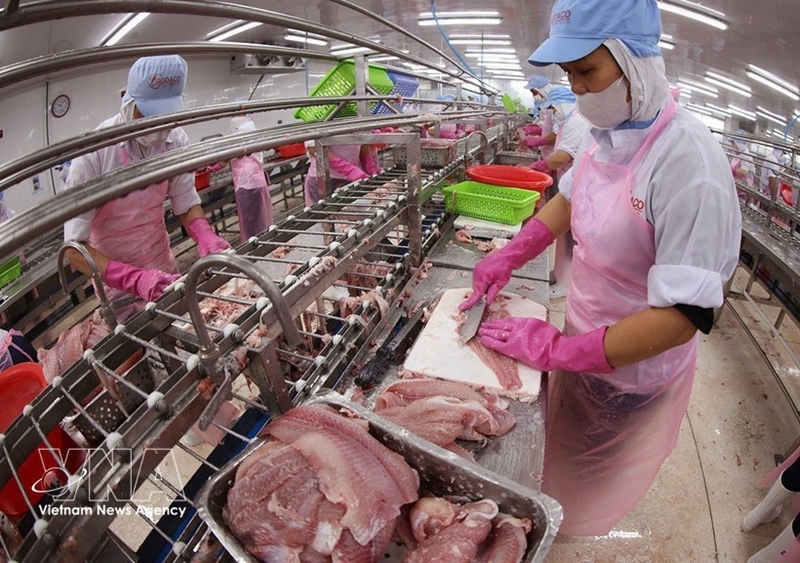
By category, during the January-March period, agricultural products accounted for 8.93 billion USD, up 4.1%; fisheries reached 2.62 billion USD, up 13.3%; livestock products totaled 197.7 million USD, surging 54.3%; while forestry products recorded 4.11 billion USD, down 2.4%.
In terms of markets, Asia remained the largest destination for Vietnam’s agro-forestry-fishery exports, accounting for 45.1% of total export value. It was followed by the Americas (20.7%) and Europe (16.2%), while Africa and Oceania represented smaller shares at 2.1% and 1.4%, respectively. Compared to the same period last year, exports to Asia rose 15.3%, to Europe 4.8%, and to Oceania 20.1%, whereas exports to the Americas declined 3.4% and those to Africa dropped sharply by 29%.
At the country level, China continued to be Vietnam’s largest export market, holding a 22.1% share, followed by the U.S. (18.3%) and Japan (7.1%). In Q1, exports to China surged by 37.6%, exports to Japan edged up 0.7%, while shipments to the US fell 5.2% year-on-year.
Several commodities posted strong growth, helping to support overall export performance. Pepper stood out as a bright spot, with export volume reaching 64,600 tonnes and turnover totaling 417.5 million USD, up 36.8% in volume and 28.8% in value, despite a 5.9% decline in average export prices.
Rubber also maintained growth momentum, with exports of 411,200 tons valued at 751.8 million USD, up 8% in volume and 2.4% in value. Notably, shipments to markets such as Indonesia and India rose sharply, by 93.2% and 24.6%, respectively, offsetting declines in the key Chinese market.
Fruit and vegetable exports continued to expand robustly, reaching 1.54 billion USD, up 32.1% year-on-year. China remained the dominant market, accounting for 54% of total exports in this category, with an impressive growth rate of 76.2%.
However, several major export items recorded declines in value, largely due to falling prices. Coffee exports reached 577,300 tons, generating 2.71 billion USD, up 12.6% in volume but down 6.4% in value, as average export prices dropped significantly by 16.9%. While exports to markets such as Germany and Spain increased, shipments to Italy and the Philippines declined sharply.
Rice exports totaled 2.3 million tons, equivalent to 1.11 billion USD, remaining almost unchanged in volume (up 0.2%) but decreasing 7.8% in value due to an 8% fall in average export prices. The Philippines continued to account for more than half of total rice exports, while exports to China rose significantly, offsetting declines in several African markets.
Meanwhile, total imports of agro-forestry-fishery products in Q1 were estimated at 11.91 billion USD, up 3.6% year-on-year. Agricultural imports accounted for the largest share at 7.62 billion USD, increasing 6.3%. Imports of livestock products reached 1.16 billion USD, up 10%, while forestry imports totaled 786.8 million USD, rising 16.1%. In contrast, aquatic product imports declined slightly by 1.8% to 746.8 million USD.
Source: VNA