    |
 |
|
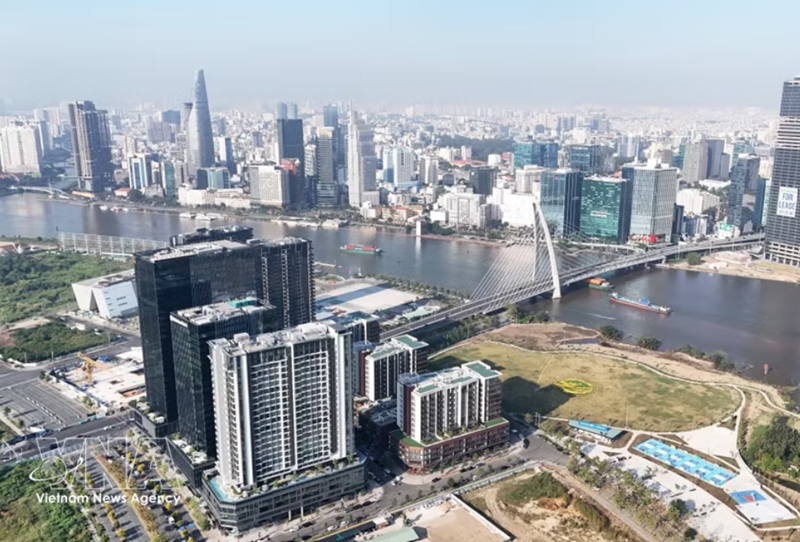
The core area of the Viet Nam International Financial Center in Ho Chi Minh City |
Ho Chi Minh City is entering a phase of breakthrough development, with substantial demand for investment in technical and social infrastructure. According to the municipal People’s Committee, the city needs more than 3.2 quadrillion VND (123.3 billion USD) in total investment across society during 2026–2030, while its budget is capable of supplying only around 1.2 quadrillion VND.
Large-scale projects such as urban railways, seaports, logistics infrastructure and energy transition projects require substantial medium- and long-term capital. Great reliance on the state budget and conventional bank lending could put considerable pressure on the financial system, making it necessary to develop new and sustainable sources of funding from both domestic and international capital markets.
Against this backdrop, the VIFC-HCMC Executive Authority has consulted stakeholders on a draft resolution of the municipal People’s Council on the issuance of municipal and project bonds.
The establishment of a specialized bond financing channel at VIFC-HCMC is seen as being in line with practices adopted by major international financial centers. The consultation involved representatives of central and local authorities, financial institutions, commercial banks, securities companies and economists.
Assoc. Prof., Dr Nguyen Huu Huan, Vice Chairman of the VIFC-HCMC Executive Authority, said the mechanism aims to establish a new capital mobilization channel, directly connecting the city’s substantial infrastructure financing needs with long-term domestic and international capital flows.
Funds raised through municipal and project bonds are set to focus on key projects with strong spillover effects, he stressed, noting that VIFC-HCMC is currently preparing a portfolio of more than 21 infrastructure projects, from which five to seven highly feasible, large-scale projects will be selected to attract strategic investors to.
Linking bond issuance to specific projects is expected to enhance transparency and enable investors to better assess project efficiency and risks, Huan added.
Experts stressed that a comprehensive legal framework and modern technical infrastructure are essential for municipal and project bonds to prove effective.
Key issues under discussion include the legal framework, inter-agency coordination, bond structures, currencies, maturities, interest rates, credit ratings, risk management and trading infrastructure. The development of green and sustainable bonds is also being considered.
The mechanism is expected not only to address Ho Chi Minh City’s immediate infrastructure financing needs but also to support its long-term development. As a hub for global investment funds, investment banks, asset management firms and fintech companies, VIFC-HCMC could help channel long-term capital into major infrastructure projects.
Beyond financial resources, experts noted that international issuance and trading through VIFC-HCMC could bring advanced financial technologies, modern management practices, international transparency standards, data systems and global expert networks. These resources will help strengthen national competitiveness and enable Vietnamese businesses to access international capital at reasonable costs while supporting their deeper integration into global value chains.
Source: VNA