Reporter: As the Country Programming Framework (CPF) for Vietnam for the period 2022–2026 nears completion, how would you assess the collaboration between the Food and Agriculture Organization (FAO) and the Ministry of Agriculture and Rural Development, now the Ministry of Agriculture and Environment, and the key outcomes achieved under this framework?
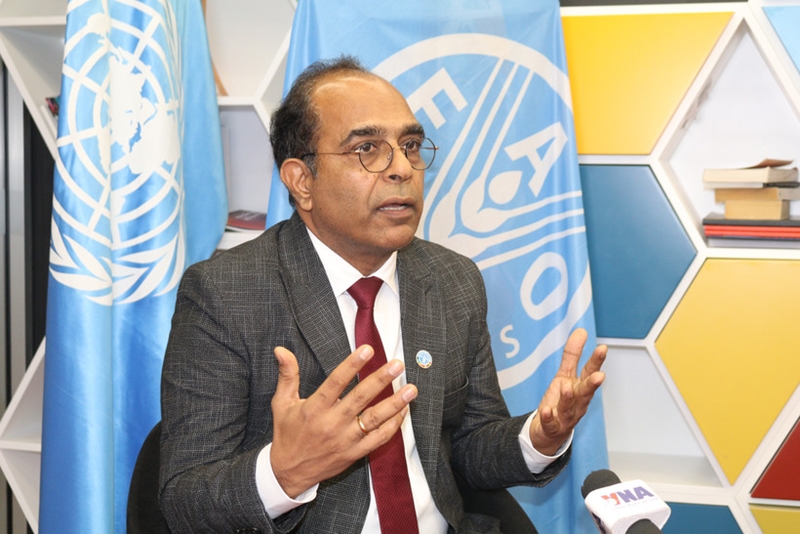
Mr. Vinod Ahuja, FAO Representative for Vietnam: Our collaboration with the ministry has been very close, very practical, and very results-focused. What I value most is how the partnership has evolved. It is no longer only about individual projects. It is increasingly about systems change.
    |
 |
|
Mr. Vinod Ahuja, Food and Agriculture Organization of the United Nations Representative for Vietnam. |
A good example is food systems transformation
In 2023, Vietnam approved its national action plan. In 2024, we moved further with the Food Systems Transformation Partnership Agreement. It brings together key ministries and more than 45 national and international partners. And it is now driving implementation across agroecology, nutrition, and reducing food loss and waste.
At the same time, the CPF has delivered very tangible results. FAO has mobilized almost 40 million USD. But more important than funding is impact.
On One Health, we worked closely with the ministry to reduce endemic zoonotic diseases. We helped manage major risks such as African Swine Fever and avian influenza. And we addressed antimicrobial resistance and pesticide misuse. We also strengthened animal disease surveillance and the national veterinary management scheme.
On climate, environment, and natural resources, we worked towards strengthened capacity at both national and local levels. From forest governance and land-law revision to water accounting in the Mekong Delta, Red River Delta, and Central Highlands.
Through the Forest and Farm Facility, we supported more than 50 producer organizations and over 2,200 farming households in the Northern Mountains.
These are just a few examples. But today, the CPF is not just about projects. It is about systems change. And strong national ownership.
Reporter: Vietnam is pursuing a more sustainable agricultural pathway under its “Sustainable Agriculture and Rural Development Strategy 2021–2030,” which emphasizes low-emission rice cultivation. How do you evaluate Vietnam’s progress to date, and what recommendations would you make to further strengthen the effectiveness of this strategy?
Mr. Vinod Ahuja, FAO Representative for Vietnam: Vietnam has made real and encouraging progress under its Sustainable Agriculture and Rural Development Strategy, especially on low-emission rice.
But the context is very challenging. Climate change is already affecting farmers. In the Mekong Delta, land is sinking, salinity is increasing, and natural resources are under pressure. Some rice-growing areas today may no longer be suitable in the future.
That is why the One Million Hectares of High-Quality, Low-Emission Rice Scheme, is so important. It marks a clear shift: from quantity to quality and from higher emissions to lower emissions, with stronger resilience. Early pilots are promising. The key challenge now is scaling up.
Looking ahead, I would highlight four priorities. First, keep farmers at the centre. Incentives must be clear at farm level. Lower costs. Lower risks. Better returns for quality rice. Second, low-emission rice must be rewarded across the value chain. This means traceability, strong quality standards, and buyer commitments. Third, we need simple and credible systems to measure emissions and water productivity. Finally, finance is critical. Public funding alone will not be enough. Blended and private finance will be essential.
If we do this well, low-emission rice is not just good for the climate. It becomes the smart economic choice for Vietnam.
Reporter: What measures should Vietnam prioritize to enhance its food security and increase its meaningful contributions to the global food supply chain, particularly in the context of intensifying climate change impacts and global economic uncertainties?
Mr. Vinod Ahuja, FAO Representative for Vietnam: Vietnam is already a major contributor to global food markets. To protect that role, and to strengthen food security at home, I would mention a few priority areas.
First, we need to invest much more in climate resilience, anticipatory action, and shock-responsive social protection. Climate shocks are hitting harder and more often. Last year’s Typhoon Yagi and this year’s multiple storms and tropical depressions caused widespread damage to agriculture, infrastructure, and livelihoods, especially in the north and center. The lesson is simple: preparedness, early action, and resilient livelihoods are no longer optional. They are at the heart of food security.
Second, plant and animal health must be protected through stronger, integrated One Health systems. Disease risks, including antimicrobial resistance, can disrupt production, trade, and livelihoods very quickly if we are not ahead of them.
Third, Viet Nam needs to compete in global markets on quality and sustainability. That means better standards, stronger traceability, greener value chains, and practical support for smallholders. This also means need for more investment in digital traceability, harmonized food safety and phytosanitary measures. And equally important cooperatives and small enterprises need training, technology, and access to finance to make green and low-carbon agriculture work in practice.
Finally, digital tools, including artificial intelligence, can be real game changers across agriculture and the food system. But they only work if they are human centered, built into strong institutions, and backed by capacity and infrastructure.
Taken together, these steps will help Vietnam remain a trusted global supplier of safe, traceable, and green food.
Thank you for your insights.
Source: VNA