According to the GOE Alliance, the IFC represents more than an organizational step, laying the foundations for a new institutional framework to attract, allocate and coordinate international capital flows more effectively. The center is also expected to function as a testing ground for advanced financial–technology models linking traditional finance with the digital economy, on-chain systems and sustainable finance.
    |
 |
|
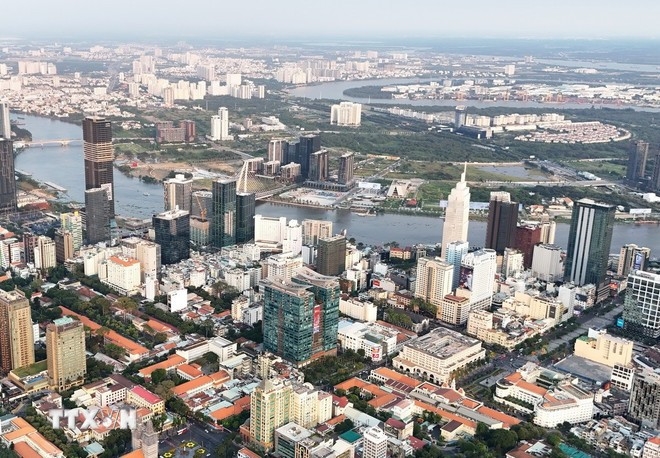
Ho Chi Minh City’s downtown area and the Thu Thiem peninsula, where the International Financial Center is being developed |
Within this framework, Ho Chi Minh City is positioned as the focal point for market-oriented financial innovation connected to enterprises and the innovation ecosystem, while leading efforts to pilot new economic models for Vietnam.
The GOE Alliance was officially launched at the Autumn Economic Forum in November 2025 in the presence of the Prime Minister and leaders of International Financial Centre City. It was established as an “open economic laboratory,” bringing together technology firms, financial institutions, policy experts and international partners, including Viettel Digital Services, Dragon Capital, Tether, Ava Labs, Sky Mavis, Republic and Onchain Academy. The alliance aims to pilot on-chain economic models within a policy-oriented legal framework.
The alliance said it intends to work alongside the International Financial Centre City IFC in rapidly deploying financial–technology initiatives, while acting as a bridge between the public and private sectors and the global innovation community. It added that the IFC’s operation has created an institutional space in which pioneering economic models can be tested, refined and scaled in a controlled manner.
Assoc. Prof., Dr. Nguyen Huu Huan, recently appointed Deputy Director of the Executive Agency of the International Financial Centre City IFC, said the alliance’s distinguishing feature lies in its role as an open economic laboratory within the center. This allows technology firms, financial institutions, regulators, start-ups and universities to jointly test new models, including real estate asset tokenization, carbon credit tokenization and real-time cross-border payment systems. Such an approach, he said, reflects the direction of new-generation international financial centers, where mastery of on-chain infrastructure and standards will shape future markets.
According to Huan, the alliance’s strategic value extends beyond technology to market restructuring. Moving assets, data and transactions onto on-chain infrastructure increases transparency, reduces costs, enables instant cross-border transactions and manages risks through automation. As a result, the International Financial Centre City IFC could evolve into a transit hub for future financial models, rather than merely a destination for capital flows.
Beyond infrastructure and markets, the GOE Alliance is also expected to contribute to developing interdisciplinary human resources in finance, technology and data, addressing one of Vietnam’s current constraints. Through training and participation in internationally standardized on-chain ecosystems, this workforce can build practical experience and global competitiveness, supporting the long-term development of the international financial center.
Source: VNA