Vietnam’s digital economy to reach 39 billion USD in 2025
The digital economy is taking on an increasingly important role, becoming a key driver in shaping new productive forces and growth methods. It’s helping many countries seize opportunities, tackle challenges, and better adapt to the changes of the digital age.
Fully aware of the role and importance of the digital economy, Vietnam’s Party and State have issued numerous guidelines and policies to promote the transformation of production models towards digitization. The development of the digital economy and digital society has been given high priority in national development strategies. Vietnam is also among the regional pioneers in issuing a national digital transformation program and strategy that are accompanied by a system of specific targets.
    |
 |
|
Digital economy – Driver for Vietnam's breakthrough in new development |
Located at the heart of Southeast Asia and possessing strong growth potential, Vietnam has one of the region’s most dynamic digital economy growth rates. In recent years, its digital economy has recorded significant progress.
According to the tenth annual Southeast Asia digital economy report (e-Conomy SEA 2025), released on November 25, 2025 by Google, Temasek and Bain & Company, Vietnam’s digital economy is expected to reach a gross merchandise value (GMV) of 39 billion USD by the end of 2025, up 17% year-on-year (compared to 34 billion USD in 2024 and 30 billion USD in 2023). This growth places Vietnam second in Southeast Asia, behind only Indonesia, and among the region’s fastest-growing digital economies. By 2030, its digital economy's GMV is forecast to reach 85–190 billion USD.
E-commerce continues to serve as the backbone of the digital economy, accounting for two-thirds of its total size and projected to exceed 25 billion USD in 2025, equivalent to an expansion rate of 17%. With a large population, high Internet penetration and the growing popularity of online shopping, Vietnam is regarded as one of Asia’s most promising e-commerce markets.
Another notable bright spot is the level of artificial intelligence (AI) adoption among Vietnamese users. Vietnam currently leads Southeast Asia in three key indicators: 81% of users interact with AI daily, 83% actively learn or upskill in AI-related areas, and 96% are willing to share data access with AI agents. The country is home to more than 40 AI startups, which attracted 123 million USD in private investment over the past year, making up 5% of total AI investment in the region.
Marc Woo, Managing Director of Google Vietnam, said the fact that 81% of Vietnamese users proactively interact with AI every day demonstrates a highly adaptive digital environment. Vietnam is emerging as one of the most important markets in Southeast Asia thanks to its rapid technology adoption and exceptionally high level of trust in AI.
The e-Conomy SEA 2025 report also notes a strong rise in digital financial services (DFS) in Vietnam, with total digital payment transaction value projected to reach 178 billion USD in 2025, reflecting the rapid nationwide shift toward cashless payments.
Science – technology, innovation, digital transformation identified as core driver
Vietnam has set a vision of becoming a high-income country by 2045, with the digital economy identified as one of the key growth engines and expected to contribute 30% of GDP by 2030. To realise this goal, it is pushing ahead with implementing the National Digital Transformation Program, with a focus on three pillars: digital government, digital economy, and digital society.
The recent commercial rollout of 5G services has translated the Government’s vision of leveraging science, technology, and innovation into concrete action to accelerate digital transformation within enterprises and advance the Fourth Industrial Revolution nationwide.
At the same time, Vietnam is augmenting efforts to perfect the legal framework for AI. The AI Strategy issued in 2021 is currently being updated, with a revised version and a dedicated AI law expected by the end of 2025. This not only provides an essential legal foundation, but also reflects a national vision in which AI becomes a form of “intellectual infrastructure” serving the people, promoting sustainable development, and enhancing national competitiveness.
To create breakthroughs in digital economy development, the Politburo has issued several strategic resolutions, including Resolutions No.57-NQ/TW, 68-NQ/TW, 59-NQ/TW, and 66-NQ/TW, which focus on key areas such as science – technology, innovation, and digital transformation; international integration; law making and enforcement; and private-sector development.
|
|
 |
|
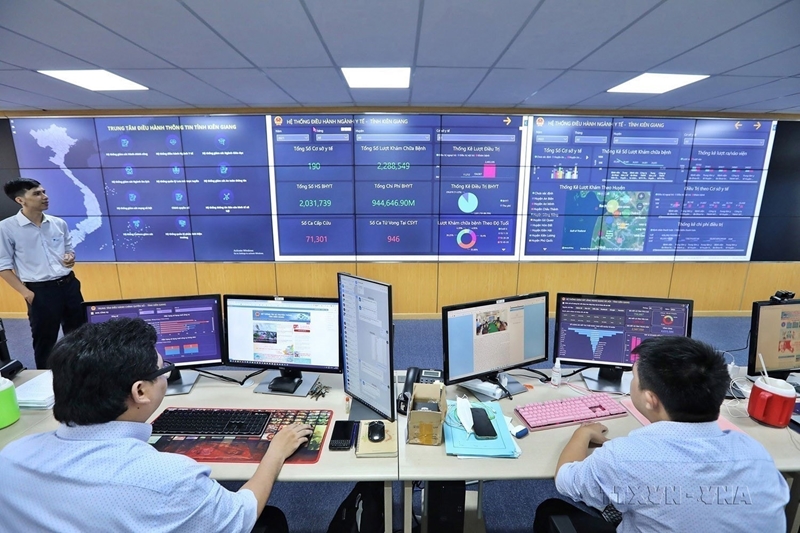
Amidst profound transformation around the globe, the strong rise of the digital economy presents Vietnam with a major opportunity to make breakthroughs. (Photo for illustration) |
Resolutions No.57-NQ/TW, 68-NQ/TW, 59-NQ/TW, and 66-NQ/TW serve as critical institutional pillars, opening up new development space for the business community while creating strong momentum for the digital economy to accelerate.
In the 13th Party Central Committee's draft Political Report to be submitted to the 14th National Party Congress, one of the Party’s guiding viewpoints for the coming period is: “To establish a new growth model, with science – technology, innovation, and national digital transformation as the primary drivers, and private-sector development as one of the most important engines; to perfect institutional frameworks for development in tandem with conducting four transformations: digital transformation, green transformation, energy transformation, and transformation of human resources structure and quality; and to attract and utilise talent, and promote the development of new productive forces.”
Basing on this, the Party sets the task of: “Establishing a new growth model aimed at improving productivity, quality, efficiency, added value and competitiveness of the economy; and promoting science – technology, innovation and digital transformation as the main driver; creating new, high-quality productive forces and production methods, with a focus on the data economy and digital economy; and stepping up digital, green and energy transitions, as well as the transformation of human resources structure and quality. Identifying new growth drivers with science – technology as the core to renew traditional ones. Forming strong growth poles, key economic regions, cities, and new-generation special economic zones on par with regional and global peers.”
Amid profound transformation around the globe, the strong rise of the digital economy presents Vietnam with a major opportunity to make breakthroughs and establish a new growth model based on knowledge and technology. With the Party’s right strategic direction, the digital ecosystem is gradually taking shape, enabling businesses to innovate, people to adapt, and the economy to operate more efficiently, helping Vietnam advance closer to its goal of becoming a developed country by 2045.
Source: VNA