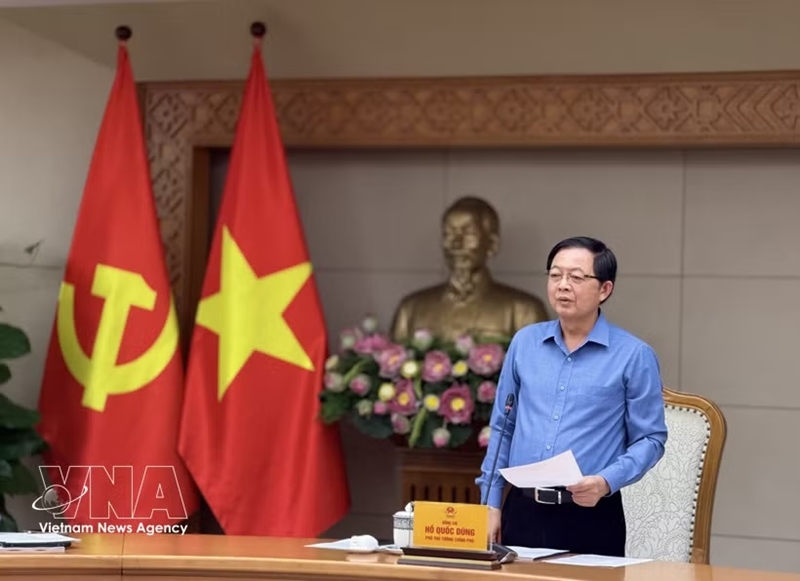
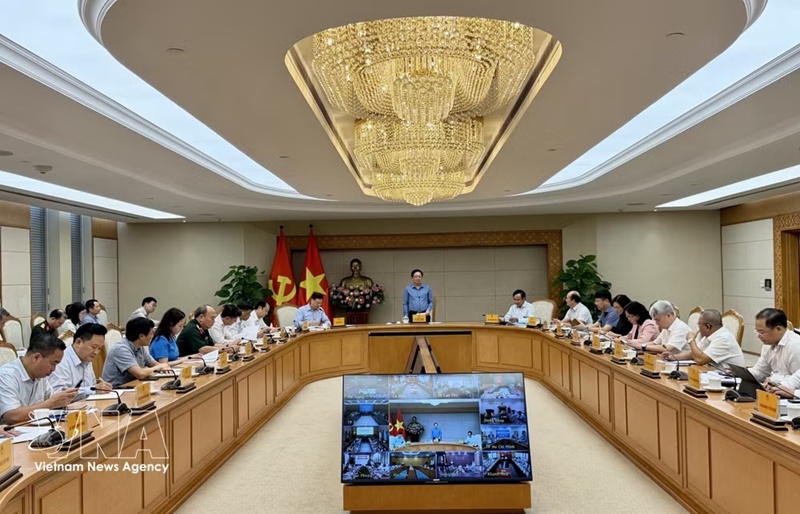
Chairing the 35th meeting of the National Steering Committee for IUU Fishing Prevention and Sustainable Fisheries Development, held in a hybrid format on July 28, the Deputy PM stressed that developing the marine economy in general, and fisheries in particular, remains an issue of critical importance.
    |
 |
|
Deputy Prime Minister Ho Quoc Dung speaks at the meeting. |
He noted that over the past five years, the fisheries sector has generated tens of billions of U.S. dollars in revenue and made a significant contribution to national development. However, shortcomings in fishing management persist, with the E.C.'s "yellow card" now entering its eighth year despite extensive efforts.
Dung acknowledged progress in addressing E.C. recommendations, including inspections in three localities that identified six major groups of shortcomings. Police have intensified investigations into vessel monitoring system (VMS)-related violations, authorities have strengthened vessel monitoring and port controls, and seafood traceability has improved. While customs authorities have also reviewed weaknesses in seafood import management, the Coast Guard and Border Guard have stepped up patrols and enforcement.
However, he said digital transformation still falls short of requirements. Although national databases have been established, data sharing among ministries and local authorities remains weak. Following its June inspection, the E.C. issued 37 recommendations covering five key areas requiring further action.
The Deputy PM blamed the remaining shortcomings mainly on inconsistent leadership and enforcement at the local level.
Localities that have acted decisively have made clear progress while those taking a passive approach continue to see violations, he said, adding that closer coordination among ministries, sectors and local authorities is needed to establish a unified nationwide fisheries management system.
Looking beyond the immediate goal of lifting the "yellow card", the official asked for a strategy for sustainable fisheries development aligned with the country's new marine economy policy, covering the entire value chain, from breeding and harvesting to processing, exports and the application of science and technology.
He urged ministries and local governments to immediately implement the measures agreed upon at the meeting, stressing that each locality will be held fully accountable for results and must be thoroughly prepared for the EC's next inspection.
Deputy Minister of Agriculture and Environment Vo Thanh Hung reported that Vietnam has continued to make progress in combating IUU fishing, with improvements in institutional arrangements, fisheries management, vessel monitoring, catch traceability and enforcement.
However, the E.C.'s fifth inspection found that key shortcomings remained in on-the-ground enforcement, particularly in handling violations, integrating the VMS, preventing fishing vessels from encroaching into foreign waters and strengthening catch traceability. These issues will be decisive in Vietnam's efforts to have the "yellow card" lifted in 2026.
Following the inspection, the Government issued Official Dispatch No. 34, restructured the national steering committee, established an inter-agency task force, developed a nationwide electronic reporting system and dispatched inspection teams to key coastal localities.
Of the 267 tasks assigned before the latest EC inspection, 254 have been completed. After the inspection, the Government assigned another 35 tasks, of which 21 have been fulfilled while 14 remain under implementation.
Hung said Vietnam's legal framework for combating IUU fishing now largely meets requirements. The Government has issued Decree No.246/2026/ND-CP on administrative sanctions in the fisheries sector while continuing to refine fisheries policies and review the Fisheries Law and related regulations.
The national VN-Fishbase database currently manages 80,332 fishing vessels. Among registered vessels, 91.9% hold valid inspection certificates, 95.7% have valid fishing licenses and 98.5% possess food safety certificates. Meanwhile, 99.6% of vessels measuring at least 15 meters have installed VMS equipment, and cases of vessels crossing fishing boundaries or losing VMS signals have both declined from a year earlier.
During the first six months of 2026, Vietnam had 94 designated fishing ports, including 79 serving offshore fishing vessels. Authorities conducted 138 patrols and inspections, checked 2,502 vessels and fined 261 vessels, collecting about 4.6 billion VND (about 175,000 USD). The EC also acknowledged progress in Vietnam's deployment of the electronic catch documentation and traceability system (eCDT), while seafood landings through ports reached 421,000 tons.
|
|
 |
|
An overview of the meeting |
Despite these improvements, enforcement remains a challenge. Authorities detected 4,713 violations during the period but imposed penalties in only 1,341 cases, with total fines exceeding 42 billion VND.
To meet the goal of lifting the "yellow card" in 2026, the Ministry of Agriculture and Environment proposed designating the time from now through August 31 as a nationwide peak enforcement period.
Source: VNA