On the morning of January 28, Phu Quoc officially broke ground on two key projects among the 21 developments designated to serve APEC 2027: the Bai Dat Do Mixed-Use Urban Area and the Nui Ong Quan Ecotourism Urban Area, with a combined investment of nearly 70 trillion VND. The Bai Dat Do development is planned as a large-scale, fully integrated accommodation complex built to international standards, with operations managed by leading global hospitality groups including Marriott International, Hilton Worldwide, Accor, and Lotte.
    |
 |
|
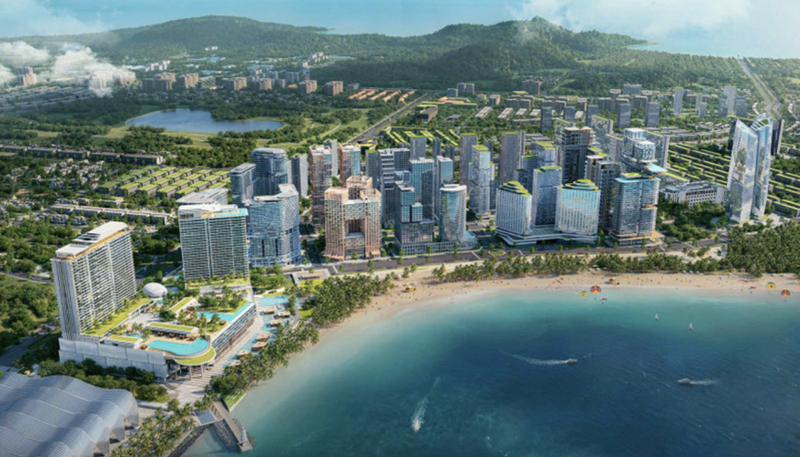
A panoramic view of the future hotel cluster at Bai Dat Do, scheduled to be delivered in Phu Quoc within 18 months for APEC 2027 |
What distinguishes the project is not only its scale or the caliber of brands involved, but the timeframe Sun Group has set: completing the entire development within 18 months in time for APEC 2027. In construction terms, this equates to an average output comparable to delivering a hotel tower of roughly 40 storeys in just over one month, a pace that even experienced construction professionals describe as a race against time.
Covering 88.4 hectares with a total investment of approximately 64 trillion VND, the project is being developed along the APEC Boulevard, occupying a rare location adjacent to the APEC Convention Center and next to Sunset Town. Bai Dat Do is positioned as a concentrated hotel corridor bringing together 13 internationally recognized hospitality brands, a configuration not previously seen in Vietnam. Once completed, the development is expected to double Phu Quoc’s current supply of five-star rooms, addressing what has become an increasingly acute accommodation shortage on the island.
Alongside Bai Dat Do, the broader cluster of APEC 2027 infrastructure projects provides the clearest example of the exceptional construction tempo now visible in Phu Quoc. Progress across these sites has attracted international attention. ASEAN Urbanist, a regional platform with nearly half a million followers, has publicly expressed its astonishment at what it termed the “light-speed” construction underway on the island.
At Phu Quoc International Airport, construction began in July 2025, yet major components are already advancing rapidly. These include the second runway, a new VIP terminal, and the T2 passenger terminal. At present, the T2 terminal has completed 100% of its primary structural works. The VIP terminal has also reached 100% completion of both its main structure and steel framework, while the second runway has achieved approximately 30% of its total workload.
Just four months after ground-breaking, all terminal buildings had been constructed up to the fourth floor, with the overall project targeting completion by March 2027. The airport expansion is expected to be delivered within just 18 months, a timeline regarded as exceptional within the aviation sector. By comparison, Singapore’s Changi Airport required six years from initial development to first operation, while large international airport projects commonly take up to a decade.
Another key project now being prioritized is the APEC Convention Center, with a total investment of 21.86 trillion VND. The convention complex in Subzone S3 has largely completed its main structural framework, reaching approximately 90% completion. Meanwhile, the multi-purpose theatre in Subzone S2 has achieved around 80% completion of its primary structural works, creating a solid platform for the next stages of construction. The project is scheduled for completion in the second quarter of 2027.
The accelerated construction model evident in Phu Quoc is not an isolated case. Similar execution speeds have been recorded across a range of infrastructure and tourism projects developed by Sun Group in recent years, from northern to southern Vietnam.
One prominent example is Van Don International Airport in Quang Ninh, Vietnam’s first privately developed airport. Construction began in the second half of 2016, and the airport entered operation by the end of 2018. In just over two years, the entire system, including runway, apron, and a terminal built to 4E standards, was completed, while comparable airport projects globally often require between six and ten years.
In the tourism and entertainment sector, projects under the Sun World brand have also been noted for their compressed construction schedules. Sun World Vung Tau, Sun Group’s upcoming development, has attracted attention as construction was completed in approximately five months, with its opening scheduled for February 12.
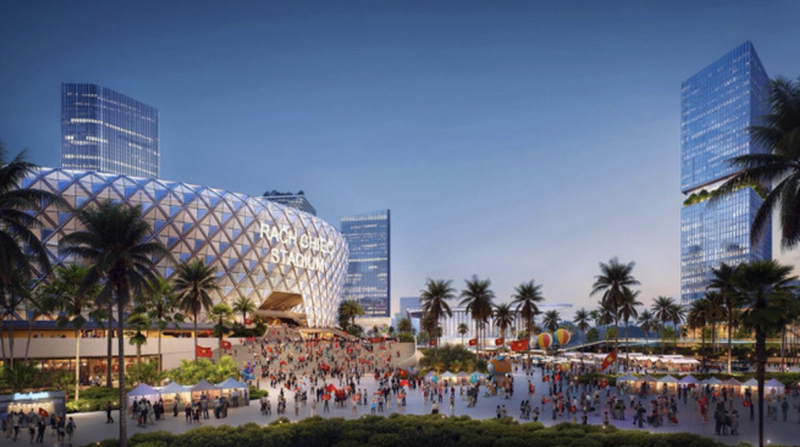
Rach Chiec National Sports Complex is increasingly seen as more than a sporting venue, but as a tangible reference point for Vietnam’s long-held World Cup dream.
|
|
 |
|
Rach Chiec National Sports Complex is increasingly seen as more than a sporting venue, but as a tangible reference point for Vietnam’s long-held World Cup dream. |
Among the projects currently being accelerated, the Rach Chiec National Sports Complex in Ho Chi Minh City stands out for its national significance. With a total investment exceeding 145 trillion VND, the project is designated as a strategic infrastructure catalyst. Under Decision No. 269/QD-UBND dated January 13, 2026, the official implementation period spans approximately eight years from the signing of the BT contract. However, Ho Chi Minh City authorities and Sun Group are now targeting completion of the entire complex in around five years by accelerating land clearance and organizing synchronized construction across all components.
At a time when many large-scale infrastructure projects in Vietnam and the region remain constrained by prolonged procedural cycles and phased timelines, the emergence of tightly scheduled, stopwatch-driven construction sites presents a contrasting picture. In this context, delivery timelines are no longer abstract commitments, but outcomes demonstrated by visible structures rising month by month. It is this consistent pace that has turned the notion of “light-speed” construction from a metaphor into a phenomenon increasingly noted across Vietnam’s infrastructure and urban development landscape.
Source: VNA