At a special session on Viet Nam themed “Investing in Viet Nam – Rising to a new era,” Chairwoman of the State Securities Commission (SSC) Vu Thi Chan Phuong said Viet Nam is entering a new development period with strong demand for capital for growth, infrastructure development, energy transition, high technology and new industries.
    |
 |
|
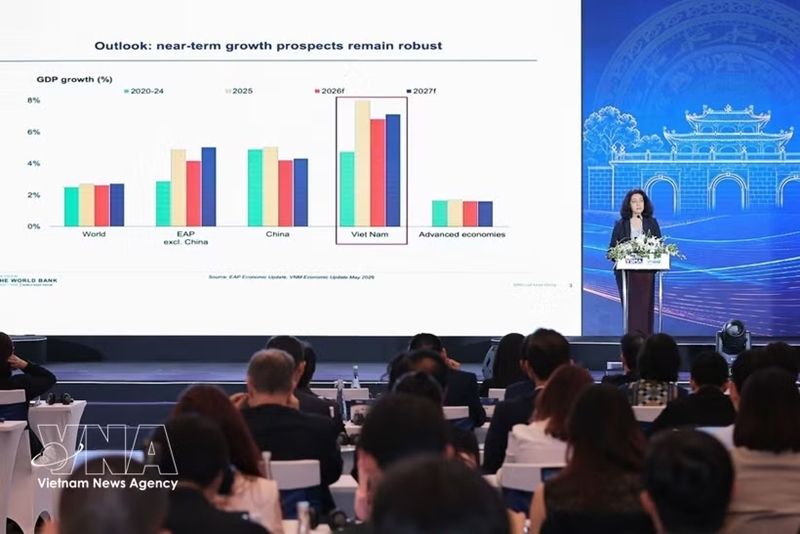
Tehmina Khan, the World Bank's Lead Economist for Viet Nam, Cambodia and Laos, speaks at the event |
The capital market, therefore, needs to play a greater role, becoming a channel for providing medium- and long-term capital to the economy while also connecting domestic and international capital flows, she stressed.
Phuong noted that FTSE Russell's market upgrade of Viet Nam to secondary emerging market status marked an important milestone in market reform, from improving the legal framework and modernising infrastructure to enhancing market access for international investors.
According to Phuong, stock market capitalisation on the Ho Chi Minh Stock Exchange (HOSE) and the Hanoi Stock Exchange (HNX) has reached about 404 billion USD, equivalent to 81.7% of the national GDP, while average daily stock trading value has been around 1 billion USD so far this year. As of the end of September, the number of securities trading accounts stood at nearly 13.9 million.
She stressed that market upgrading is not an end in itself but the beginning of a new journey, requiring a market that is more transparent, efficient, safe and closer to international standards.
Viet Nam will continue improving its legal and regulatory framework, strengthening disclosure and corporate governance, diversifying products, broadening the investor base and facilitating international investors’ access, Phuong said, adding that attention will be paid to modernizing infrastructure, introducing the central counterparty clearing model, promoting green finance, and applying digital technology in market management and supervision.
Tehmina Khan, the World Bank's Lead Economist for Viet Nam, Cambodia and Laos, said the key challenge for Viet Nam is not only maintaining high growth but also improving growth quality. She cited labour productivity, human resources, public investment and infrastructure as priorities amid global trade uncertainty, demographic changes and climate change.
According to Khan, Viet Nam has room to mobilize both domestic and international capital. Priorities for the capital market include diversifying institutional investors, improving liquidity, pricing mechanisms and the secondary market, and strengthening infrastructure, clearing and settlement, information transparency and credit ratings.
She said Viet Nam has yet to attain investment-grade status. The process of moving toward this rating is linked to transparent public financial management, coordination between monetary and fiscal policies, and a sound banking and financial system.
SSC Vice Chairman Nguyen Hoang Duong said Viet Nam is targeting average GDP growth of more than 10% over the next five years, requiring an estimated 38.5 quadrillion VND (over 1.48 trillion USD) in total social investment during 2026-2030.
The State budget is expected to provide about 8.5 quadrillion VND, or 20%, with the remainder coming from the private sector and international capital.
The capital and securities markets are expected to contribute about 10 quadrillion VND, or 2 quadrillion VND annually. Securities-market mobilization alone is projected at 5.4 quadrillion VND over the next five years, more than double the amount raised during 2020-2025.
The SSC has identified five priorities, namely rebalancing the economy’s capital structure; diversifying domestic-currency debt instruments; building a long-term institutional investor base; developing sustainable bonds to international standards; and deepening integration through IFRS adoption, stronger OECD-based corporate governance and ESG disclosure.
By 2030, the commission targets foreign investors’ assets at about 15% of the national GDP, total net assets of funds at 5% of GDP and average annual growth of pension fund assets at 11.5%. It also aims to maintain Viet Nam’s FTSE Russell classification and meet MSCI emerging-market and FTSE Russell’ advanced-emerging-market criteria by 2030.
Duong said Viet Nam’s recent market upgrade will require time to adapt to the new investor base, with the country seeking to build a safe, efficient, reliable and sustainable destination for regional and global capital inflows.
Source: VNA