    |
 |
|
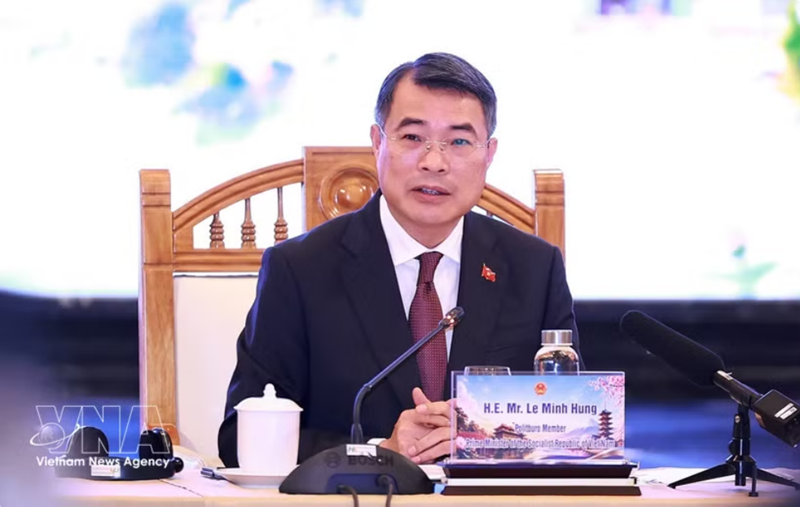
Prime Minister Le Minh Hung speaks at his meeting with Japanese businesses in the central city of Hue on September 6. |
The Prime Minister made the remarks while chairing a meeting with Japanese businesses in the central city of Hue, held within the framework of the 2026 Viet Nam-Japan Local Cooperation Forum.
He told participants that Viet Nam is entering a new stage of development, with a focus on rapid and sustainable growth based on science and technology, innovation, digital and green transformation, as well as improved productivity and economic competitiveness.
To achieve the country's two centenary goals and double-digit growth during 2026-2030, Viet Nam will seek to bring into full play the role of all economic sectors, with the foreign-invested sector regarded as an important component of the national economy, he said.
PM Le Minh Hung stressed that Viet Nam's policy is to selectively attract high-quality foreign direct investment (FDI) projects featuring advanced technologies, high added value and strong spillover effects, while fostering close linkages with domestic businesses.
Under Resolution No.10-NQ/TW issued by the Politburo on June 8, 2026, Viet Nam seeks not only investment capital but also advanced technologies, knowledge, modern management practices, research and development (R&D) investment, high-quality human resources and substantive connections with domestic enterprises. Japanese businesses, with their experience, resources and reputation, are expected to make active contributions to these objectives, he stated.
The Government leader noted that since Viet Nam and Japan upgraded their ties to a Comprehensive Strategic Partnership for Peace and Prosperity in Asia and the World in 2023, bilateral relations have entered a new phase of increasingly substantive and effective development. Economic, trade and investment cooperation remains one of the key pillars, with bilateral trade enjoying a stable and highly complementary structure.
At the meeting, Japanese organizations and businesses raised nine groups of issues concerning transport, education, energy, taxation, science and technology, retail and other areas. The Prime Minister instructed ministries, sectors and localities to urgently review the progress in addressing the recommendations and resolve matters under their jurisdiction in a timely manner, with specific roadmaps and the highest sense of responsibility.
He requested that responses and updates on the handling of recommendations be sent to the Viet Nam Chamber of Commerce and Industry (VCCI) for coordination with the Japanese Chamber of Commerce and Industry in Viet Nam and Japanese enterprises. The results should be made public on the Government Portal and relevant websites to ensure transparency and facilitate monitoring.
PM Le Minh Hung also encouraged Japanese firms to continue engaging in open and constructive dialogue with Vietnamese authorities and enterprises to clarify difficulties and agreed on solutions to outstanding issues in a constructive and straightforward manner.
Highlighting Japan's strengths in technology, capital, management expertise, high-quality human resources and a business culture that values quality, credibility and long-term cooperation, the PM said these strengths are highly compatible with Viet Nam's development priorities.
He called on Japanese businesses to continue trusting and choosing Viet Nam as a long-term investment destination, expand their operations and work more closely with Vietnamese partners to fully tap the substantial potential for cooperation between the two economies.
Looking ahead, he proposed the two sides focus on major areas agreed upon by their high-ranking leaders, including next-generation official development assistance (ODA), strategic infrastructure, urban and high-speed railways, high-tech agriculture, green and energy transitions, digital transformation, science and technology, innovation, semiconductors and high-quality human resources training.
Japanese companies were encouraged to strengthen links with Vietnamese enterprises, help them improve management capacity, technology and production standards, and create opportunities for Vietnamese businesses to participate more deeply in Japanese corporations' supply chains.
He reaffirmed the Vietnamese Government's commitment to listening to, accompanying and supporting businesses, while building a stable, transparent, fair, safe and predictable investment and business environment. Viet Nam will continue to reform institutions, streamline administrative procedures and business conditions, improve infrastructure and human resources, reduce compliance costs and protect the legitimate rights and interests of investors, including those from Japan.
PM Le Minh Hung expressed his belief that, on the foundation of sincere and trusted bilateral ties, together with the determination of both Governments and the dynamism and creativity of the business community, Viet Nam-Japan economic, trade and investment cooperation will continue to grow strongly and substantively, matching the framework of their Comprehensive Strategic Partnership for Peace and Prosperity in Asia and the World.
Speaking at the meeting, Japanese Ambassador to Viet Nam Ito Naoki spoke highly of Viet Nam’s development orientations in the new era, particularly in science and technology, innovation, artificial intelligence (AI), semiconductors, digital transformation, green transition and administrative reform.
Within the framework of the Viet Nam-Japan Comprehensive Strategic Partnership, Japan wishes to further expand collaboration, enabling businesses of the two countries to work closely together and contribute to Viet Nam’s modernization process and its economic growth targets, he added.
In the first seven months of 2026, two-way trade reached 33.7 billion USD, up more than 16.8% year-on-year. Japan has consistently ranked among Viet Nam’s top three foreign investors for many years. As of the end of July, Japanese investors had registered a cumulative 80.3 billion USD in new and adjusted investment capital in Viet Nam, ranking third among 153 countries and territories pouring capital into the country. Japan is also Viet Nam’s largest ODA provider, with cumulative ODA loans totaling nearly 3 trillion JPY (19.1 billion USD).
Source: VNA