The top Vietnamese leader is now in China to attend the 33rd APEC Economic Leaders' Week and conduct bilateral activities.
Speaking at the forum, Governor of Guangdong Province Meng Fanli highlighted the geographical proximity and long-standing close ties between Guangdong and Viet Nam, with active economic relations and people-to-people exchanges. He noted that Viet Nam had been Guangdong's largest trading partner in ASEAN for many years, while Guangdong was Viet Nam's largest provincial-level trading partner in China. Bilateral trade continued to grow rapidly, and many Guangdong businesses, universities and research institutes had extensive partnerships with Vietnamese localities and across a range of sectors.
    |
 |
|
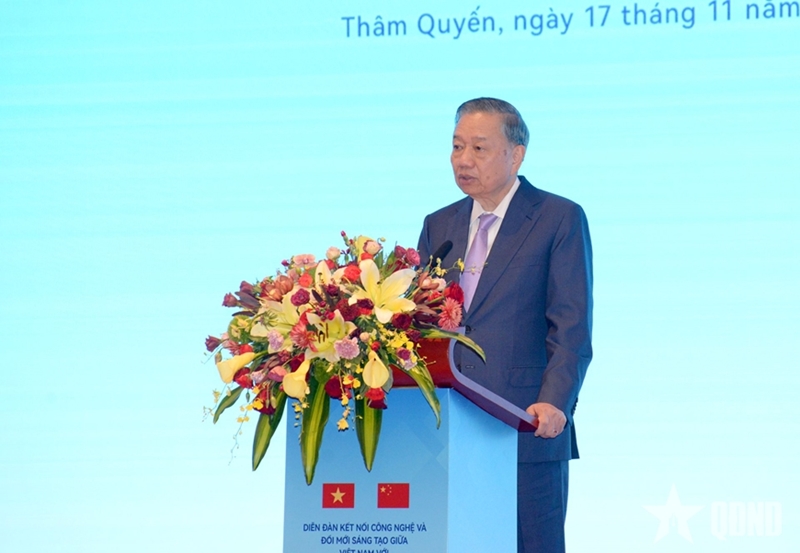
Party General Secretary and State President To Lam delivers a speech at the forum. |
General Secretary and President To Lam stated that Viet Nam consistently regards the consolidation and development of relations with China as a strategic choice and top priority in its foreign policy of independence, autonomy, self-reliance, multilateralization and diversification.
He expressed his hope that cooperation in science, technology and human resource development between Viet Nam and the Greater Bay Area would become a highlight of bilateral relations.
The Vietnamese leader stressed the need to select areas where the two sides have complementary strengths and practical needs for joint research, focusing first on artificial intelligence (AI), semiconductors, robotics and autonomous systems.
He noted that research institutes, universities and businesses should be encouraged to establish joint research teams and collaborative laboratories and make effective use of each side's research infrastructure.
|
|
 |
|
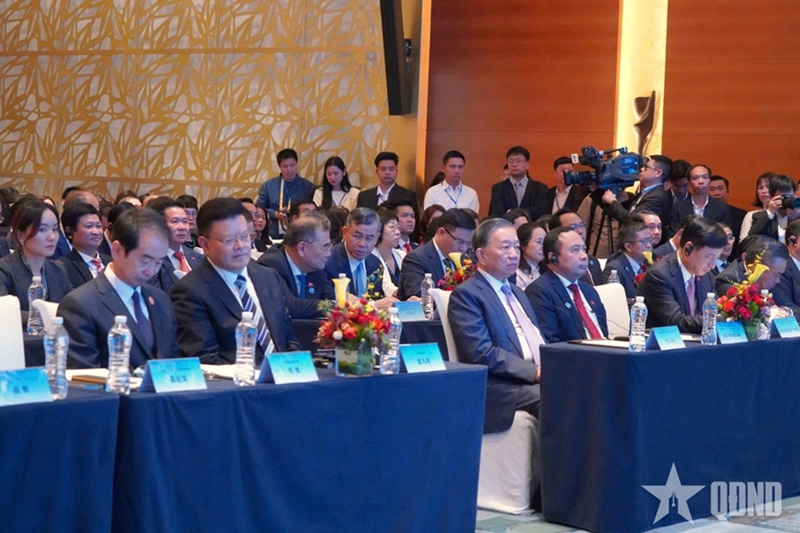
Party General Secretary and State President To Lam and delegates at the event |
Semiconductor cooperation should link training with design, pilot production, packaging, testing and development of products suited to the capabilities and needs of both sides. Each program should clearly define the contribution of each partner, ownership of research results and arrangements for their exploitation, he added.
Placing high-quality human resource development and talent cultivation at the center of cooperation, Viet Nam wishes to strengthen partnerships with educational institutions, research institutes and businesses in the Greater Bay Area to train engineers, experts and scientists capable of conducting independent research and addressing complex practical challenges, the General Secretary and President stressed.
He proposed expanding joint training programs, co-supervising doctoral candidates and exchanging lecturers and experts, while linking academic study with research projects and practical experience at businesses. Learners should have opportunities to access laboratories, technological processes and modern working environments. He said enterprises should participate in defining training needs, developing curricula and using the outcomes of training, while universities and research institutes ensure a sound knowledge base and academic quality.
|
|
 |
|
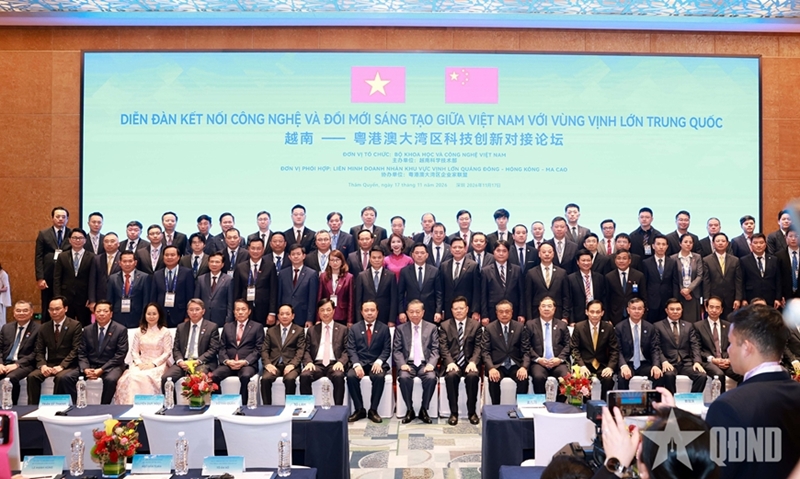
Delegates in a joint photo |
General Secretary and President To Lam highlighted the need to link innovation with industrial cooperation and promote businesses' leading role, saying that enterprises should participate from the stage of identifying research needs through technology development and the application of results in production and business activities. He called for closer links between high-tech parks, innovation centers and production facilities on both sides to develop flagship joint projects capable of having wider benefits and attracting more businesses to participate.
He expressed his hope that partners will create more opportunities for Vietnamese technology companies to join the Greater Bay Area's innovation ecosystem, provide solutions and expand their markets.
Affirming Viet Nam's commitment to improving its institutions, law enforcement and administrative procedures, General Secretary and President To Lam said the country will protect the legitimate rights and interests of organizations and individuals involved in research, investment and business activities.
He said relevant agencies from both sides should also enhance policy exchanges and cooperation on standards, intellectual property and technology testing in accordance with their respective laws and international commitments.
General Secretary and President To Lam expressed his hope that APEC member economies would work together to promote new growth drivers, strengthen connectivity and expand development opportunities through science, technology and innovation.
The National Foundation for Science and Technology Development (NAFOSTED) under Viet Nam's Ministry of Science and Technology and China's Ministry of Science and Technology announced a cooperation document on co-funding four joint research tasks, which cover AI applications in medicinal materials and traditional medicine research, water security and early risk warnings amid climate change, monitoring and early warnings for multiple hazards affecting mountainous transport infrastructure, and service robots for smart hospitals.
Agencies, universities, research organizations and businesses of the two countries exchanged memorandums of understanding (MoUs) focusing on strategic technology fields and key industries.
Translated by Song Anh