To Lam
General Secretary of the Communist Party of Viet Nam Central Committee
President of the Socialist Republic of Viet Nam
The Pacific binds together coastlines, economies and cultures of remarkable diversity. It is a shared space where people across APEC member economies and other countries in the region live, interact and thrive. With one ocean and one future, we share a responsibility to keep the Pacific an ocean of peace, solidarity, cooperation and development, where all parties respect one another, abide by international law, work together to protect the marine environment and expand opportunities for mutual benefit.
APEC: A journey of cooperation and development
    |
 |
|
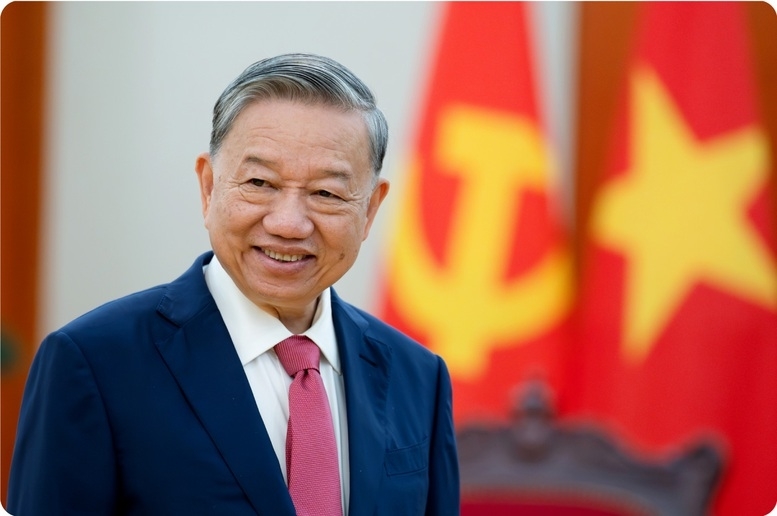
General Secretary and President To Lam (Photo: baochinhphu.vn) |
Nearly four decades ago, the Asia-Pacific Economic Cooperation (APEC) forum was founded on a belief in the power of openness and cooperation. From its 12 founding members in 1989 to the 21 member economies of today, APEC has helped transform the region into one of the world’s most dynamic centers of growth.
APEC’s vitality lies in an approach grounded in respect for diversity, dialogue among equals, consensus-building and voluntary action. The development of each member goes hand in hand with the prosperity of all. The success of one economy can open up opportunities for others.
Today, technological breakthroughs are unlocking new possibilities, while trade barriers, the risk of economic fragmentation and development gaps pose challenges. Economies must improve connectivity, facilitate trade and investment, and build stable, resilient supply chains. Connectivity also means sharing knowledge, fostering business cooperation and deepening ties among our people. Above all, economic growth must translate into tangible improvements in the people’s lives.
This is also the spirit of the Putrajaya Vision 2040: to build an open, dynamic, resilient and peaceful Asia-Pacific community. Realizing that vision calls for all members to work together to reinforce the rules-based multilateral trading system with the World Trade Organization (WTO) at its core.
APEC China 2026: Giving fresh impetus to regional cooperation
China joined APEC in 1991 and has made its mark each time it has hosted the forum. From the Shanghai Accord of 2001 to the Beijing Roadmap for APEC’s Contribution to the Realization of the Free Trade Area of the Asia-Pacific and the APEC Connectivity Blueprint, adopted in 2014, APEC meetings hosted by China have made a positive contribution to regional integration. Viet Nam greatly values China’s achievements in reform, opening up and innovation.
APEC China 2026, under the theme “Building an Asia-Pacific Community to Prosper Together” and guided by three priorities - openness, innovation and cooperation - has clear practical significance. Its agenda, spanning economic integration, connectivity, the digital economy and artificial intelligence, will both strengthen the foundations of cooperation and open new paths for development.
Shenzhen, where APEC Economic Leaders will meet, holds special significance. The city’s development journey underscores the power of reform, opening up, innovation and global engagement, values the region must continue to build on.
Sharing aspirations for development, shaping the future together
Viet Nam and China are close neighbors, joined by shared mountains and rivers and bound by a longstanding tradition of friendship. The two Parties and the two countries have agreed to further deepen the Comprehensive Strategic Cooperative Partnership and advance the building of a Viet Nam-China Community with a Shared Future that carries strategic significance. We see each other’s development as an opportunity for the other and strive for balanced, sustainable economic and trade ties.
Our two countries have ample scope to cooperate in infrastructure connectivity, logistics, science and technology, human resource development and people-to-people exchanges. Together, these efforts will deliver tangible benefits to the people of both countries and strengthen connectivity across the region.
Since joining APEC in 1998, Viet Nam has consistently supported trade and investment liberalization and open regionalism. Viet Nam has contributed through the 2006 Ha Noi Action Plan to implement the Busan Roadmap toward the Bogor Goals. It also advanced work on a post-2020 vision and promoted the establishment of the APEC Vision Group in Da Nang in 2017.
Aspiring to become a developed, high-income country by 2045, Viet Nam views science and technology, innovation and digital transformation as important drivers. We remain committed to a foreign policy of independence, autonomy and self-reliance, and to multilateralizing and diversifying our external relations. We actively seek deeper international integration and make a responsible contribution to peace, cooperation and development.
Building on APEC’s established framework for cooperation, we must continue to facilitate trade and investment and bolster connectivity and supply chain resilience. We must also help small- and medium-sized enterprises access technology and pursue digital transformation, collaborate on human resource development, and promote green and sustainable growth. These efforts must expand opportunities for people and businesses to take part in, contribute to and benefit from the region’s development.
I am confident that the 2026 APEC Economic Leaders’ Meeting in Shenzhen, under the chairmanship of General Secretary and President Xi Jinping, will prove a resounding success, strengthening consensus and delivering tangible results in cooperation.
Viet Nam supports China and is working closely with it to ensure a successful APEC 2026. We also look forward to building on its achievements as Viet Nam hosts APEC in 2027. Close coordination and mutual support between our two countries will help sustain continuity and inject fresh impetus into regional cooperation.
Sharing one ocean and an aspiration for a better future, Viet Nam stands ready to work with China and APEC member economies to safeguard peace, strengthen connectivity and expand opportunities for development, working toward a prosperous and sustainable Asia-Pacific for generations to come.