The meeting brought together representatives of A.P. Moller - Maersk, which specializes in trade and logistics; LEGO, Carlsberg and Pandora, which invest in industry; Copenhagen Infrastructure Partners (CIP), an energy investor; and Vestas, which specializes in energy transition.
Expressing confidence in Viet Nam’s investment environment and high expectations for its prospects, representatives of the Danish companies shared their long-term investment orientations in Viet Nam and put forward specific proposals to facilitate continued investment and business expansion in the country.
Addressing the meeting, General Secretary and President To Lam acknowledged and highly valued the presence, contribution and long-term investment commitments of Danish businesses in Viet Nam.
    |
 |
|
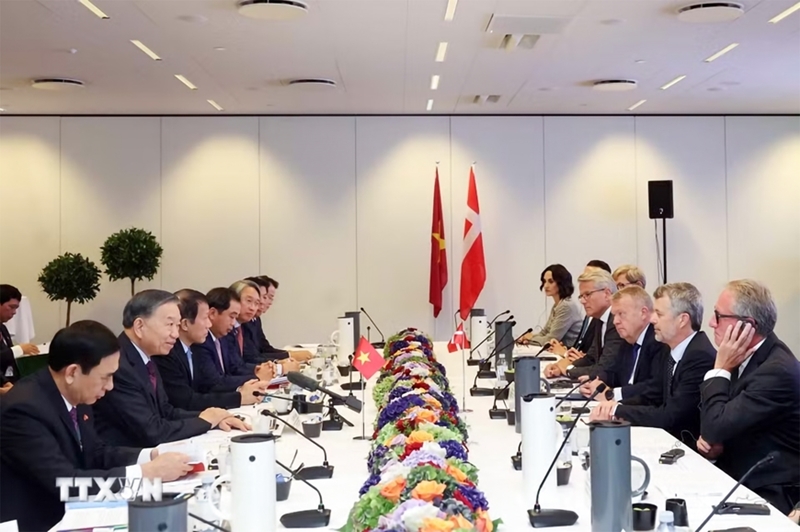
General Secretary of the Communist Party of Viet Nam Central Committee and President To Lam and Danish King Frederik X attend a meeting with leaders of several prominent Danish businesses. |
He praised the decision by many leading Danish companies to choose Viet Nam as a long-term destination for investment, production and business. Beyond capital, these companies have brought technology, management expertise, international standards, and approaches to green and sustainable development, contributing to improving the quality of foreign investment in Viet Nam.
Against the backdrop of a new situation, Viet Nam and Denmark need to set higher requirements for their economic cooperation, with greater emphasis on cooperation quality, technological content, productivity, innovation capacity, and the participation of businesses from both countries in strategic value chains, he said.
Viet Nam wishes to expand cooperation with Denmark into new areas with high added value and strategic significance for the future of both countries, including energy transition and renewable energy ecosystems; seaports, logistics and green maritime transport; the circular economy; environmental technology and water management; sustainable agriculture and food production; and digital transformation, artificial intelligence, automation and smart manufacturing.
The two sides should also strengthen links among businesses, research institutes and training institutions; promote research and development (R&D), technology transfer and high-quality human resource training; and help Vietnamese businesses improve their management capacity, meet green and environmental, social and governance (ESG) standards, and participate more deeply in the value chains of Danish corporations.
General Secretary and President To Lam noted that the Communist Party of Viet Nam Central Committee Politburo’s Resolution No.10-NQ/TW on developing the foreign-invested economy calls for continued fundamental changes in thinking, improvements to the institutional framework for development, the mobilization of resources, and the creation of new space for investment and business, with enterprises and investors regarded as important subjects of the development process.
Viet Nam will continue reviewing and comprehensively improving its legal framework for investment, land, planning, energy, infrastructure, science and technology, and innovation in a stable, transparent, consistent and predictable manner. The country will resolutely cut unnecessary administrative procedures, promote decentralization and delegation of authority, digitize processes, shorten the time required to prepare and implement projects, and introduce appropriate mechanisms to address emerging issues arising from practical implementation.
Viet Nam hopes international partners will bring not only capital but also technology, management expertise, high-quality human resources and global market networks, working with Vietnamese businesses to build internationally competitive supply chains and industrial ecosystems.
Regarding logistics and seaports, General Secretary and President To Lam called on Danish businesses to study expanding investment in seaports, international transshipment ports, logistics centers, smart warehouses, air and rail logistics, and modern supply chain management solutions.
International logistics groups should not only transport Vietnamese goods but also help Viet Nam become an important link in global logistics networks, establishing distribution, transshipment and supply chain management centers in the country for the region, he said.
In the energy sector, Viet Nam hopes corporations with technological, financial and management capabilities will continue working with the country to develop clean and renewable energy, wind and solar power, stable and flexible power sources, energy storage systems, and solutions to improve energy efficiency.
The two sides should move beyond individual energy projects and gradually build an energy industry ecosystem in Viet Nam, including supply chains, equipment manufacturing, technical services, research and development, human resource training, and greater participation by Vietnamese businesses.
In advanced manufacturing, international corporations should move beyond establishing processing plants in Viet Nam and gradually bring more high-value activities to the country, including design, research and development, content creation, product development and human resource training, while building networks of Vietnamese suppliers.
The goal is for products researched, designed and manufactured in Viet Nam to reach hundreds of millions of consumers worldwide, the General Secretary and President said.
He asked Vietnamese agencies to fully take note of the proposals raised at the meeting. Each feasible proposal should have a designated focal point for handling; each potential project should have a roadmap for promotion; and each legitimate difficulty should have a clearly identified agency responsible for consideration and resolution.
General Secretary and President To Lam affirmed that Viet Nam is ready to work with Denmark and the business communities of both countries to create new cooperation models, open up new development space and create new value for the prosperity of both countries and a green, sustainable future.
He expressed his hope that businesses will continue to choose Viet Nam as a long-term investment destination, a manufacturing base, an innovation hub and an important link in global value chains, while strengthening links with Vietnamese businesses, transferring technology, developing human resources and jointly creating new value.
Viet Nam remains committed to listening to businesses, working alongside them and resolving difficulties, while creating a favorable, transparent and stable investment and business environment so that businesses can invest with confidence and achieve sustainable, long-term development in Viet Nam.
Reported by Pham Kien (from Copenhagen, Denmark)
Translated by Chung Anh