Joachim Mathiesen, head of the institute, briefed the Vietnamese guests on its history and research activities. He said that as a leading physics research center at the University of Copenhagen, the institute is renowned for its foundational contribution to atomic physics and quantum mechanics. Its current research focuses on cutting-edge fields, including quantum technology, particle physics and astronomy.
    |
 |
|
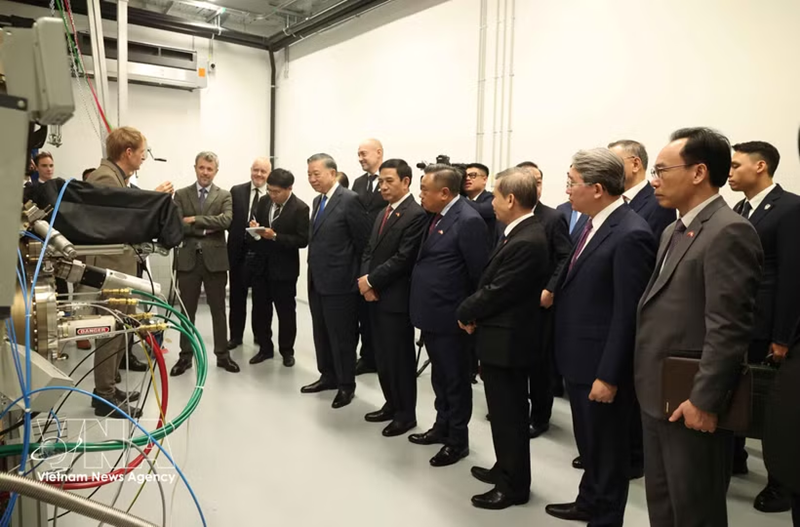
General Secretary of the Communist Party of Viet Nam Central Committee and President To Lam (sixth from right, front row) visits the Niels Bohr Institute at the University of Copenhagen on October 19 afternoon (local time). |
Founded in 1921 at the initiative of renowned Danish physicist Niels Bohr, the institute was initially known as the institute for theoretical physics of the University of Copenhagen. It became a world-leading center for atomic physics and quantum mechanics during the 1920s and 1930s before being officially renamed the Niels Bohr Institute in 1965.
The institute conducts physics research and training, with strengths in quantum physics, particle physics, astronomy, climate and geophysics, and biophysics. It is now one of Northern Europe’s important physics research centers.
It also plays a pioneering role in the University of Copenhagen’s scientific cooperation with Viet Nam, focusing on research links, academic exchanges and training high quality human resources.
In July 2025, the Niels Bohr International Academy (NBIA) under the institute signed a memorandum of understanding with the International Centre for Interdisciplinary Science and Education (ICISE) in Quy Nhon, Viet Nam, agreeing to promote exchanges among scientists, joint research, conferences, workshops and doctoral training programs. Joint scientific activities at ICISE are expected to be arranged in 2026, thus strengthening links among researchers from Denmark, Viet Nam and Southeast Asia.
During the visit, General Secretary and President To Lam toured the institute’s quantum computing lab and quantum fabrication lab.
Source: VNA