Building on that success, he has restored and created many other bamboo instruments such as viola, cello, guitar, and mandolin. All can perform with modern ensembles while preserving the distinctive bamboo timbre of Central Highlands music.
Echoes of the forest
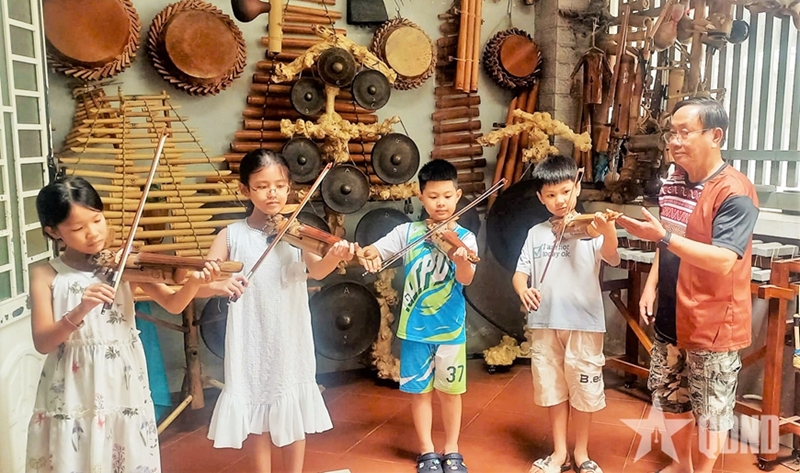
We visited Nguyen Truong’s small house on Ngo Quyen Street on a cool spring morning. At the doorway, violin melodies filled the air as students practiced under his guidance.
In his 60s, he remains energetic, demonstrating with the posture and expression of a professional performer.
    |
 |
|
Teacher Nguyen Truong guides young students in bamboo violin ensemble practice. |
Nguyen Truong graduated in violin from the Hue Academy of Music. In 1981, he moved to the Central Highlands to work with the Dak Lak Ethnic Music and Dance Troupe, teaching violin at Dak Lak College of Culture and Arts for decades later. After retiring in 2018, he began a new journey: researching, restoring, and creating traditional instruments from bamboo.
Listening to the sounds of bamboo cowbells in the fields, he reflects that ancestors had long mastered bamboo percussion and created instruments such as t’rung, ding pong, gongs, and lithophones. Over time, many face extinction due to low volume, lack of artisans, and fewer players.
His first bamboo creation was inspired by the cowbell. From there, he devoted himself to restoring folk instruments and adapting Western ones using local materials at lower cost.
He explains that crafting an instrument requires years of experience and precision, tiny deviations can ruin the sound. Bamboo must be carefully selected, dried, soaked in saltwater, and smoked to ensure durability.
|
|
 |
|
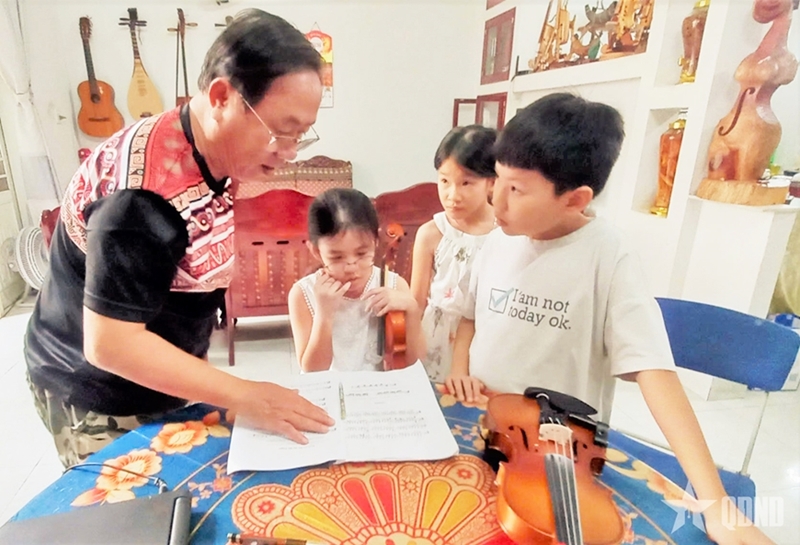
He teaches music theory to learners. |
After persistent work, he successfully produced many instruments, notably the “viokram,” a bamboo violin that has impressed experts. Its sound carries the spirit of the forest and has been performed both domestically and internationally, helping spread Central Highlands culture.
Spreading cultural values from stage to classroom
“For recognition to matter, it must be embraced by the people,” he says.
Truong explained that viokram combines “violin” and “kram” (bamboo in the Ede language). It retains the four strings (G-D-A-E) of a standard violin but produces a warm, rustic tone, sometimes like a lullaby, sometimes like epic storytelling.
He also experimented with old coffee tree roots to create “cofevio,” a violin with a uniquely deep and warm sound.
He humbly noted that his knowledge is modest compared to the vast musical heritage of ethnic communities, but with formal training, he aims to restore instruments using a scientific approach.
Another creation of his is a 14-piece gong set of the Jarai ethnic people, tuned to Central Highlands scales and mounted on a frame made from treated coffee wood shaped like a rong house (communal stilt house of ethnic people in the Central Highlands) roof. This allows flexible performance with both modern and traditional ensembles.
Nguyen Truong and his students performed viokram on VTV7 Channel in 2021, attracting audience interest. His bamboo instruments were also showcased at the 2022 conference of the World Bamboo Association in Binh Duong (now Ho Chi Minh City), earning international admiration.
In addition to performing, he teaches ethnic students in remote villages how to craft and play bamboo instruments. He hopes these instruments will be integrated into the school curriculum, helping students appreciate their cultural identity.
|
|
 |
|
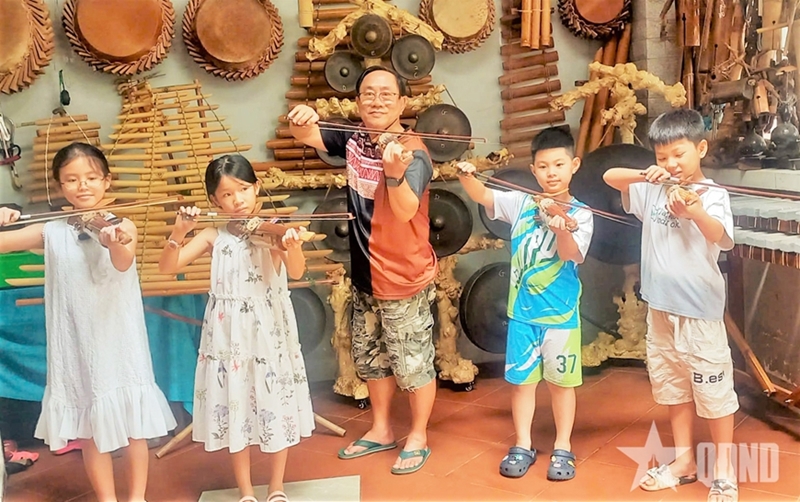
Teacher Nguyen Truong rehearses bamboo violin ensemble with his students. |
Reflecting on his journey, he remains modest, saying decades of living among E De, M’nong, and Jarai ethnic communities deepened his respect for their rich musical heritage. His work, he believes, is only a small contribution.
For him, the greatest reward is not records, but seeing bamboo instruments embraced by communities, performed on stage, and loved by young generations.
Amidst urbanization, Nguyen Truong’s bamboo violin continues to resonate, sometimes gentle like forest winds, sometimes lively like footsteps in the fields. Though retired, he continues creating, enriching Vietnam’s musical heritage and revitalizing Central Highlands culture.
Translated by Song Anh