I was born and raised in a poor rural area in western Nghe An, where people are used to the scorching wind and the floods that visit every year. People toiled in the fields year-round, enduring a life of relentless farm labor. Yet in my memory, my hometown has never appeared harsh. The people there loved one another with a simple, steadfast affection, enough to soften every hardship. Those memories sustained me through the years I lived far from home, when loneliness and uncertainty crept in amid the rush of city life.
    |
 |
|
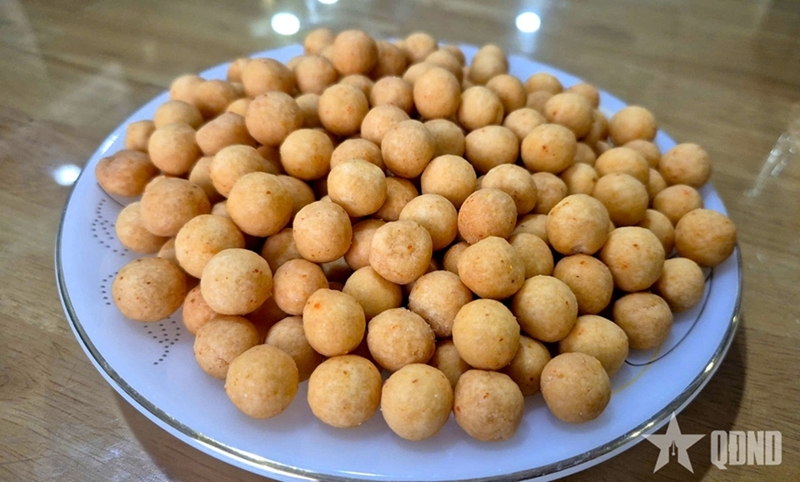
Today, Keo ca is mostly machine-made, with perfectly round, evenly golden, crispy balls. |
Like most villagers, my family was rarely well-off. Amidst cycles of drought and flood, poverty endured. Yet every Tet, my parents shrugged off their exhaustion to ensure a complete holiday. There wasn't much, just "Banh chung," "Banh tet," grilled carp, or pork braised in molasses. But Tet felt incomplete without "Keo ca," a modest treat I have cherished for thirty years.
Resembling northern "Banh nhan," "Keo ca" are small, golden spheres. Their distinct local flavor blends the warmth of ginger with the creaminess of condensed milk, eggs, and fragrant glutinous rice flour. A perfect batch must be airy and crisp, leaving a lingering sweetness. No gourmet version since has ever recaptured that exact taste.
Quality began with my mother’s meticulous preparation. Regardless of her workload, she hand-selected the best rice to be ground into flour, used eggs from our own chickens, and extracted fresh ginger juice. When the ingredients were ready, the Tet spirit finally entered our home.
Neighborhood children never needed an invitation. As word spread, our kitchen soon overflowed with laughter. Friends traveled kilometers through the dark to join, bringing corn, sweet potatoes, or sugarcane. Though they claimed to help, they mainly came for the communal excitement.
The crucial kneading remained the domain of my mother and skillful neighbors. We watched in awe as she expertly mixed the dough to ensure the candy would puff perfectly, a feat few could master. While she worked, we tended the fire and swapped stories in a kitchen as bustling as a market.
Once the dough was ready, my mother rolled and cut it into fingertip-sized cubes. We eagerly helped shape them, resulting in a mix of lopsided and square pieces. With a gentle smile, mother would toss them in a floured basin; a few shakes magically rendered them smooth and round.
Frying was the most anticipated stage. We scrambled to "help," though we often grew distracted by roasting corn. The aroma of candy hitting hot oil was intoxicating. Despite some pieces ending up burnt or undercooked, mother always indulged our pleading eyes.
Those "failed" pieces were our delight. Since the best were saved, we rejoiced over the misshapen ones as if at a festival. To me, they remain the world's most delicious candies, seasoned with laughter and a mother’s quiet love. Touched by our gazes, she would always reward us with a final handful.
Today, machine-made "Keo ca" is everywhere, perfectly round and uniformly golden. Yet, something is missing. Every Tet, amidst life’s hurried pace, I long for those slow, warm moments of togetherness. That flavor belongs to a time long gone, forever preserved in my heart.
TRAN HOAI