Du ke theatrical art, with a history spanning nearly a century, has made immense contributions to the spiritual life of the Khmer people and was recognized as a National Intangible Cultural Heritage in 2014. This unique folk performance genre, combining music, operetta, dance, poetry, martial arts, make-up, and painting, is deeply imbued with distinct Khmer identity and linked to the development of Vietnam's Southwest region. However, this rich heritage now faces the risk of decline due to modern pressures and diminishing interest, prompting dedicated preservation efforts.
    |
 |
|
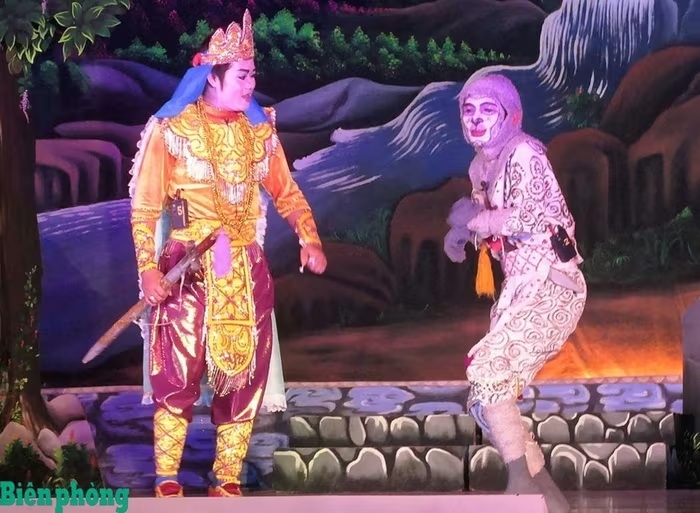
A scene from a “Du ke” play performed by the Anh Binh Minh Khmer Art Troupe |
Meritorious Artist Thach Set emphasizes that Du ke scripts are very rich, highly educational, promote good values, celebrate beauty, and always conclude with a happy ending. The diverse costumes and make-up immediately help identify good and evil characters. Mr. Thạch Bồi notes that Du ke also incorporates the artistic essence of the Kinh and Chinese people, featuring both classical, folk, and contemporary social themes.
Previously, Du ke was an indispensable spiritual nourishment during Khmer festivals. Artists, who were farmers by day, transformed into princes and princesses to perform on stage at night. However, the burdens of life have led to the dissolution of many Du ke troupes.
In recent years, Du ke art is confronting the risk of fading within the Khmer community. The Ánh Bình Minh Khmer Art Troupe in the Mekong Delta is a pioneer in preservation efforts, regularly restoring, composing new scripts, and organizing tours. In particular, the troupe focuses on training the next generation through Du ke dance and singing classes. Meritorious Artist Thạch Sung affirms that Du ke is a quintessential spiritual cultural product, reflecting the solidarity and exchange among the three Kinh, Khmer, and Chinese ethnic groups, significantly contributing to community education and cohesion.
Mr. Hữu Trung, Head of the Ca Mau Provincial Khmer Art Troupe, highlights challenges posed by the explosion of modern entertainment, the declining number of veteran artisans, the inadequately trained successor generation, and limitations in collection and dissemination. To revive the art, the Ca Mau troupe is making efforts to train actors, planning performances in areas with large Khmer populations, and recently successfully revived the program "Hương sắc tình quê" (The Beauty of Homeland Love).
Du ke art is currently receiving attention for improvements in scriptwriting, direction, scenery, costumes, and music. While actors in professional troupes receive salaries, artisans and actors in private troupes often must earn a living through other professions, frequently leading them to leave the craft despite their passion. Mr. Luu Thanh Hung (Head of the Can Tho City Khmer Art Troupe) expresses concern about the shrinking scope of Du ke's activities and audience, a lack of new authors and works, and especially the disinterest of the younger generation, leading to the risk of this precious art form disappearing.
Translated by Minh Anh