Chairman of the municipal People’s Committee Nguyen Khac Toan has instructed the center to place greater emphasis on scientific research, digitization and digital transformation in heritage conservation.
    |
 |
|
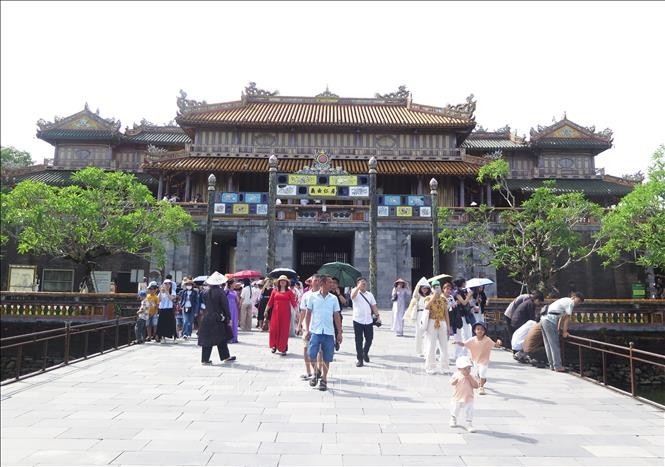
Tourists visit the Hue Imperial Citadel |
As science and technology advance rapidly, the center was asked to accelerate the digitization of documents, drawings, images and artefacts, build a unified database of monuments, and apply 3D, virtual reality (VR) and augmented reality (AR) technologies in research, exhibitions, and heritage interpretation.
These efforts are seen as a dual solution: safeguarding “digital replicas” of heritage assets against disasters and climate impacts, while also serving as an effective tool for education, promotion, and engagement with younger generations and international audiences.
The center is responsible for managing sites within the Complex of Hue Monuments, a UNESCO World Cultural Heritage site. In the past, ticket sales for visitors were conducted manually. With the adoption of digital technology, the center has introduced an electronic ticketing system available in three languages – Vietnamese, Korean and English – along with international payment options through 36 banks and e-wallets. The move has helped enhance visitor convenience and attract more tourists.
In 2025, heritage sites in Hue welcomed more than 3.1 million visitors, up over 14% year-on-year. Revenue from ticket sales reached 473 billion VND (over 18 million USD), an increase of more than 12% compared to 2024. For 2026, the center aims to raise total ticket revenue to 480 billion VND.
To date, the center has digitized more than 114,870 pages of documents, mapped and digitized 7,830 trees in the Hue Imperial Citadel and green and water spaces at 13 relic sites, and carried out digital documentation of major landmarks such as Thai Hoa Palace, the Tomb of Emperor Gia Long, and Hai Van Gate. It has also assigned digital identities to 108 artefacts and installed 96 smart tourism interaction stations across 13 relic sites.
Digital technologies are increasingly being applied to develop cultural industry products and immersive experiences, including VR-based tours.
The center’s Director Hoang Viet Trung said it will expand the heritage database, digitize artefacts, and apply digital technologies to artefact identification and exhibition to enhance conservation and visitor engagement.
Source: VNA