Yet as the city undergoes rapid urban transformation, turning heritage into a living asset that defines its identity, integrates into contemporary life and becomes part of its development “pulse” is no longer a strategic consideration but an urgent imperative in shaping Hanoi as a creative, civilized and sustainable capital.
Heritage as a living resource
At the international seminar “The journey to transform cultural heritage into assets” held at the Hanoi Museum, a central message emerged: cultural heritage should not be preserved in isolation but leveraged as a driver of development. While this approach reflects global trends, translating it into effective action remains a complex task.
    |
 |
|
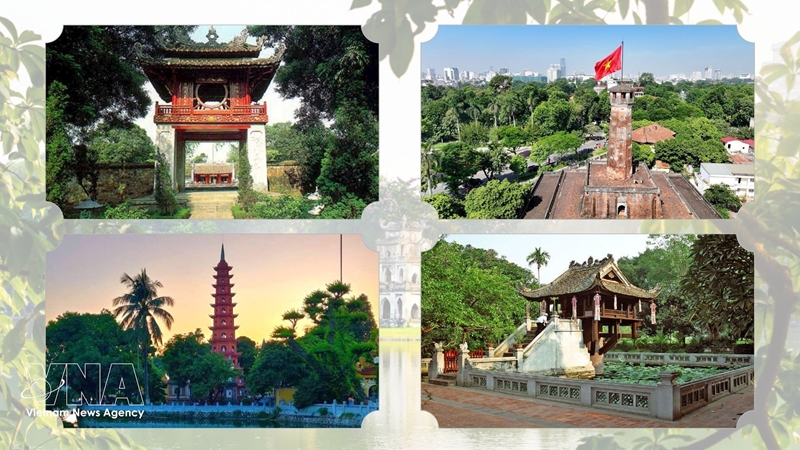
Hanoi boasts a rich cultural legacy, with 6,489 historical and cultural sites. |
Hanoi holds unique advantages, with more than a thousand years of history since the 1010 Edict on the Transfer of the Capital, alongside a rich and diverse heritage ecosystem spanning temples, pagodas, the Old Quarter, craft villages, festivals and social customs. Its membership in the UNESCO Creative Cities Network further raises expectations, not only to safeguard heritage but to reinterpret it in ways that resonate with contemporary society.
In practice, once “activated, heritage can clearly become a dynamic resource. In recent years, many of Hanoi’s cultural spaces have been revitalized, shifting from static attractions to hubs for experience, creativity and interaction.
At the Temple of Literature, the night tour “Essence of Confucian learning” exemplifies this shift. The historic site is reimagined through light, sound and modern technologies, vividly recreating the scholarly journey of past generations. Visitors are encouraged to engage actively, interacting with digital applications, experiencing traditional classrooms and exploring history through 3D mapping.
Elsewhere, heritage sites are also being reinterpreted. At the Hoa Lo Prison, the “Sacred Night” tours have gained popularity, particularly among younger visitors, presenting history through emotionally engaging narratives that deepen public connection.
Meanwhile, the Thang Long Imperial Citadel is evolving into a creative cultural space, offering experiences such as the “Decoding the Citadel” night tour, the digital platform “Thang Long Capital” and educational programs. The integration of preservation with digital technology is opening new ways to connect heritage with the public.
These initiatives point to a broader trend: heritage is no longer static but increasingly embedded in urban life. When effectively leveraged, it can generate economic value, strengthen the city’s brand and, crucially, reinforce cultural identity.
From policy to practice
Despite its potential, Hanoi still faces several bottlenecks in transforming heritage into a tangible asset, including limited awareness of cultural industries, a lack of effective models, constraints in socialization mechanisms, shortages of skilled human resources, and fragmented, insufficiently digitized heritage data.
These challenges persist even as the city aspires to become a national hub for cultural industries. Without addressing them, heritage risks remaining a latent asset rather than a true development resource.
As suggested by UNESCO experts, heritage should be approached as an integrated system encompassing space, people and everyday life. This perspective can inform urban planning, cultural tourism development and the creation of clear economic drivers.
In this context, the Politburo's Resolution No. 02-NQ/TW is seen as a key milestone, opening up a new direction for the capital’s cultural development. It defines “culture – identity – creativity” as core values and underscores the need to transform heritage into “living assets” linked to tourism, arts and cultural industries, marking a shift from preservation to promotion and from static to dynamic development.
According to Assoc. Prof., Dr. Bui Hoai Son, a standing member of the National Assembly’s Committee for Cultural and Social Affairs, the resolution places culture at the heart of the development strategy, viewing it as both a foundation and a driving force. This approach aligns with global trends, where culture is increasingly recognized as a form of soft power for nations and cities.
Building identity through heritage
From practical models to policy direction, Hanoi is entering a critical transition, from preserving heritage to unlocking its value. However, for heritage to truly shape identity, broader and more systematic efforts are required.
First, communities must be placed at the center. Artisans, craft villages and local residents should be seen not only as custodians but as key actors in preserving and renewing heritage. At the same time, heritage needs to be integrated into urban planning, ensuring that cultural elements are embedded in every development project rather than treated as an afterthought.
In parallel, a comprehensive cultural industry ecosystem should be developed, covering training, finance and data infrastructure, so that heritage can generate clear value chains. Equally important is maintaining authenticity, development must not come at the expense of cultural essence. A modern Hanoi that loses its cultural depth would struggle to retain its distinct identity.
Hanoi now stands at a pivotal moment, with the opportunity to become a model for cultural development in the digital age. However, identity cannot be built overnight, it is shaped over time through the ways people live, preserve and innovate on the foundation of heritage.
Preserving heritage is not about nostalgia, but about ensuring that amid rapid growth and deep integration, Hanoi can still recognize itself. In that sense, heritage is no longer merely a reflection of the past but a foundation for the future, a lasting “breath” that defines the identity of a thousand-year-old capital.
Source: VNA