A mythical bet
Originating from India, Songkran has been officially organized by the Thai Royal Family since 1941 and has gradually become an indispensable cultural tradition. “Songkran” derives from Sanskrit, meaning “transition” or “change.” In astronomy, it marks the sun’s shift from Pisces to Aries, beginning a new year cycle according to the Buddhist calendar for Thailand and several other Southeast Asian nations.
    |
 |
|
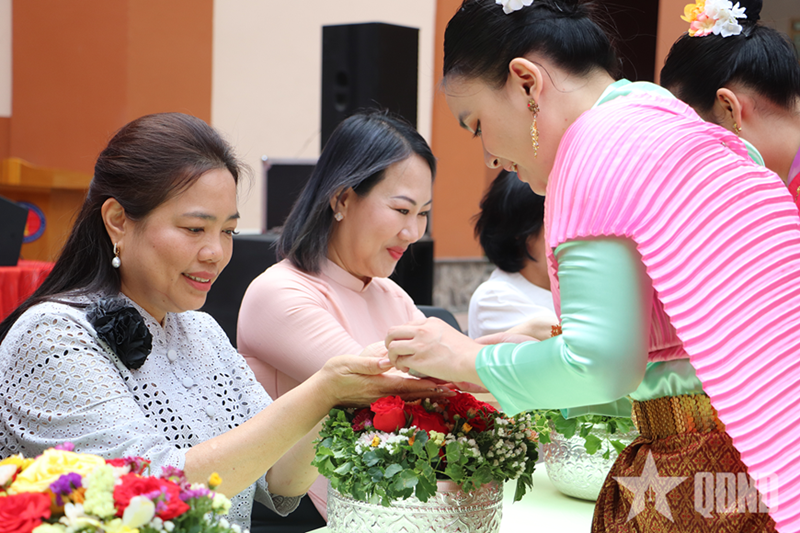
Students perform the water-pouring ritual on the hands of Thai Consul General in Ho Chi Minh City Wiraka Moodhitaporn during the 2026 Songkran Festival at University of Social Sciences and Humanities (Vietnam National University, Ho Chi Minh City). |
According to Thai mythology, Songkran stems from a bet between the god Kabilla Phrom and a clever young man named Dhammaban. The god challenged him with a riddle about where human pride lies in the morning, afternoon, and evening. As agreed, failing to answer within seven days would cost the young man his head, and vice versa. Ultimately, Kabilla Phrom lost. However, the god’s head possessed terrifying power: touching the earth would cause fires, throwing it into the sky would bring droughts, and dropping it into the ocean would dry up the sea.
To protect the world, the god’s seven daughters placed their father’s head on a tray and carried it to a cave in Mount Krailart. Every Songkran, one of the seven daughters rides a sacred animal to carry her father’s head - the origin of today’s “Miss Songkran” parades.
|
|
 |
|
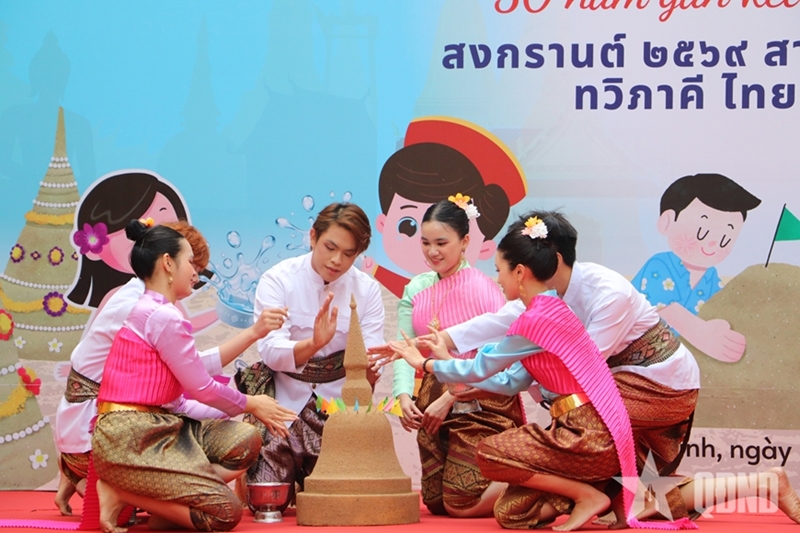
The tradition of “building sand pagodas” recreated by Vietnamese students. |
Currently, the first day of Songkran in Thailand is set for April 13 and lasts for three consecutive days. Maha Songkran is the day the sun officially enters Aries. This year, Maha Songkran falls on Tuesday (April 14), making the 2026 representative fairy Rakshasa Devi, the third daughter of Kabilla Phrom. She stands on a wild boar, wearing pink lotuses in her hair and agate jewelry, holding a trident in her right hand and a bow in her left hand. In Thai belief, Rakshasa Devi embodies radiant, fierce beauty, and ultimate authority.
A “miniature” Thailand in Ho Chi Minh City
During the annual Songkran festival, the Thai Consulate General in Ho Chi Minh City coordinates with University of Social Sciences and Humanities (Vietnam National University, Ho Chi Minh City) to organize the Songkran Festival. Over 30 years, the event has evolved from a pure exchange into an essential cultural space for Thai culture enthusiasts.
The 2026 festival features exhibitions, culinary stalls, folk games, and traditional rituals. A major highlight is exploring the culinary delights of the Golden Temple land, such as spicy papaya salad, grilled pork sticky rice, mango sticky rice, koithong cakes, rich Thai red tea, and refreshing chrysanthemum tea. Students also experience crafting carp from leaves, cutting Tung Sai Moo paper (traditional paper garland craft), and playing folk games. This combination brings immense joy and deepens their understanding of a diverse and cohesive ASEAN community.
Nguyen Nhat Minh Thu, a third-year Thai Studies student, expressed her pride in hosting the festival. She shared that using the Thai language and wearing traditional costumes in an authentic cultural space made the three years of her academic journey far more vivid and meaningful.
|
|
 |
|
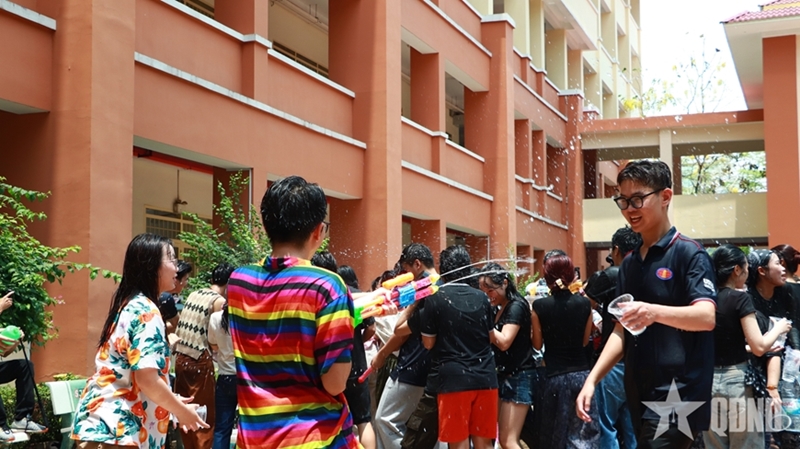
Young people join the “water splashing” activity at the 2026 Songkran Festival. |
According to Assoc. Prof., Dr. Phan Thi Hong Xuan, Chairwoman of the Vietnam - ASEAN Friendship Association of Ho Chi Minh City, this year’s festival is particularly special as it marks the 50th anniversary of Vietnam-Thailand diplomatic relations (1976-2026). The event not only provides a cultural space but also tightens bilateral friendship within an academic environment. For Thai Studies students, it serves as a platform to practice the language and seek employment opportunities via sponsors and international organizations.
In Ho Chi Minh City, the festival is also recreated through the traditional New Year celebrations of Cambodia, Laos, and Thailand (co-organized by the Ho Chi Minh City Union of Friendship Organizations and the Vietnam Buddhist Sangha at Pho Minh Pagoda), and the Thailand - ASEAN fair in An Dong ward.
Translated by Song Anh