Resolution No.02-NQ/TW, issued by the Politburo on March 17, 2026, on building and developing the capital in a new era, is seen as a key policy direction. It calls not only for preservation but also for promotion of heritage values as a development resource. This approach marks a shift from safeguarding to sustainable utilization, in line with the realities of a city as densely endowed with heritage as Hanoi.
    |
 |
|
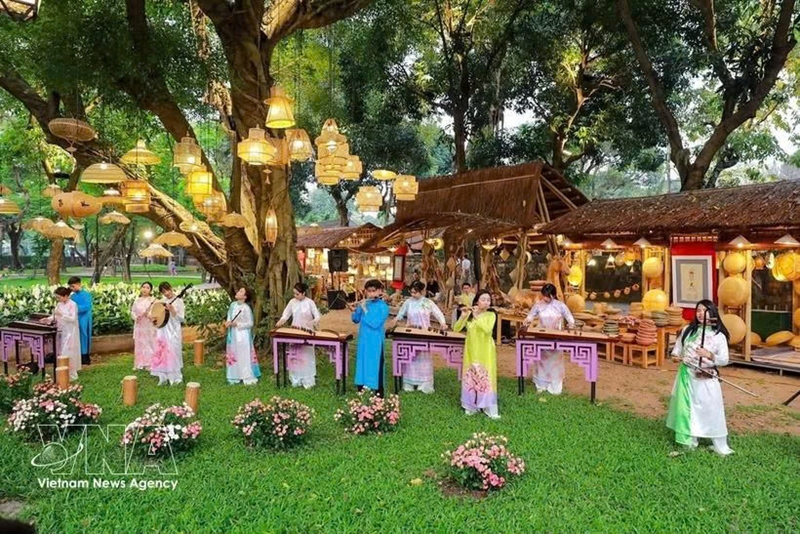
A traditional music performance at the Temple of Literature in Hanoi |
Heritage enters daily life
Hanoi’s reputation as a land of millennial culture is well-founded. The area was an early center of the Red River civilization, with archaeological traces spanning from the Phung Nguyen to Dong Son cultures. Since King Ly Thai To moved the capital to Thang Long in 1010, the city has, for centuries, remained the political, economic and cultural heart of the nation. This has resulted in a vast repository of heritage, including thousands of relics, many of them nationally recognized, alongside rich intangible values and a network of craft villages.
In recent years, many heritage spaces have been “revitalized” in connection with tourism and cultural industries.
The Hanoi Museum, which houses more than 70,000 artefacts and documents as well as six groups of national treasures, is regarded as one of the capital’s major modern cultural institutions. Its exhibitions, organized around seven major themes and 35 specialized topics, comprehensively present Hanoi’s formation and development. Beyond permanent displays, the museum has expanded experiential spaces, service areas and cultural–artistic events, bringing heritage closer to contemporary life. It has recently been designated a city-level tourist site, facilitating further promotion.
Similarly, the Temple of Literature special national relic site is renewing its approach by combining conservation with cultural, creative and experiential activities. Plans include enriching content, standardizing operations and diversifying interactive formats so that visitors can not only observe but also “live” with the heritage. Spatial linkages within the complex are also being expanded to offer a more comprehensive visitor journey.
Notably, young people are increasingly involved in reimagining heritage through creative projects, digital media and technology application.
Balancing preservation and utilization
As heritage generates higher economic value, it also faces greater risks if not managed appropriately. Experts warn that development detached from cultural foundations is unlikely to be sustainable. Tensions persist between residents’ livelihood needs and conservation requirements, particularly where restrictions on construction or renovation are not matched by adequate support. In addition, management mechanisms remain fragmented, and effective models for valuing and leveraging heritage economically are still evolving.
|
|
 |
|
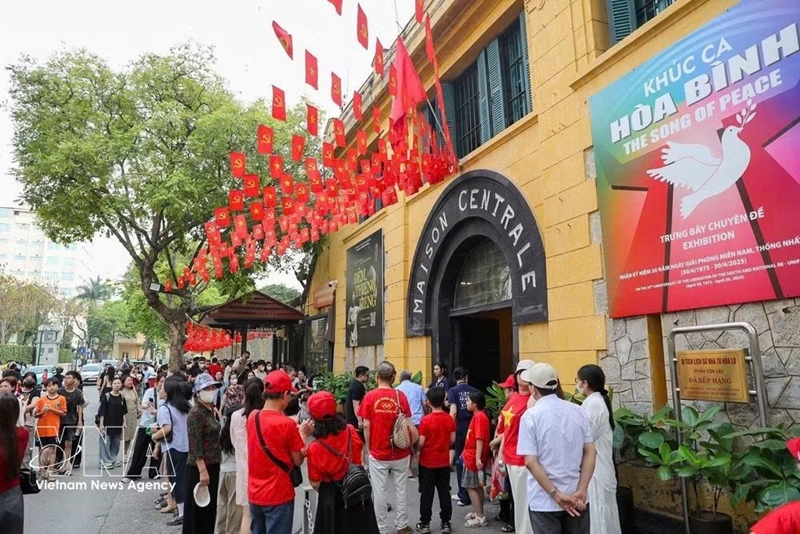
The Hoa Lo Prison relic site attracts a large number of visitors. |
Assoc. Prof., Dr. Dao Tuan Thanh from the Hanoi National University of Education emphasized the urgent need to establish a sustainable balance between development and preservation, between the pressures of modernization and the needs of residents, and between Hanoi’s role as a living space for its citizens and a destination for millions of visitors each year.
Experts suggest that implementing Resolution 02 requires a shift in mindset: heritage should be seen not only as memory but as a development resource. Placing people at the center is crucial as heritage can only be preserved and promoted when communities become active stakeholders. Hanoi must also refine its policy framework, promote public–private partnerships and attract businesses to invest in heritage conservation and utilization. Digital transformation, particularly heritage digitization, is another key pathway to enhancing visitor experiences and advancing the capital’s vision of becoming a creative and smart city.
The journey to “awaken” heritage in Hanoi is still at an early stage, with initial achievements accompanied by significant challenges. Heritage can only become a true “living asset” when it generates economic value while being properly preserved. In the context of rapid urbanization, finding the right balance between conservation and utilization is not only Hanoi’s challenge but also a common issue for many heritage-rich cities.
Source: VNA