During the Lunar New Year (Tet) 2026, the trend became even more pronounced as personal channels such as Ut Ve Vuon, Bep Tren Suon Doi, Que Noi, Nguoi Nha Que, and Mon Ngon Me Nau drew sustained attention with videos grounded in real people and real work, largely free of performance or staging.
On Bep Tren Suon Doi, Nguyen Trong Hieu, affectionately known as Ti, takes viewers, in just over three minutes, through a long and meticulous journey to produce bitter melon preserves. This video has, to date, attracted more than 3 million views.
    |
 |
|
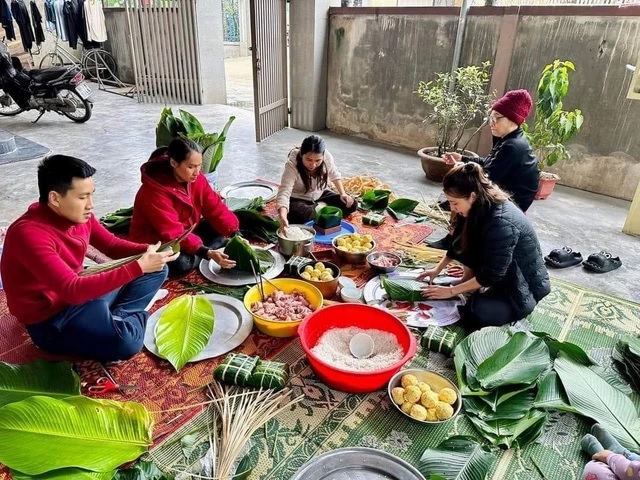
Making banh chung is one of the traditional features of the lunar New Year festival. (Photo: giadinh.suckhoedoisong.vn) |
Elsewhere, Tran Kim Ut, owner of the Ut Ve Vuon channel with more than 1.8 million followers, similarly takes viewers back to Tet memories of the Mekong Delta. Her videos feature Buddha’s hand citron preserves, vegetable-based floral preserves, nipa palm candy, kumquat and pomelo preserves.
From thin peeling and overnight lime water soaking to boiling, sugaring, carving papaya into lotus shapes, and slow candying over low heat to preserve form, each step demands patience. Ut admits these dishes take a great deal of time, but the process makes her feel “excited, as if reliving Tet of the past.” Her videos often garner hundreds of thousands of views and thousands of comments and shares, forming a community devoted to traditional home cooking.
Redefining values
Globally, since 2020, the Cottagecore trend - idealizing a simple, slow-paced rural life close to nature - has gained traction, driven by fatigue with urban pressure, technology overload, and the COVID-19 period. Young people began dreaming of gardening, cooking, reading, sewing, and living in small homes amid nature. Pastoral imagery from farm to table attracted widespread engagement.
Today, returning from the city to the countryside remains a viable lifestyle choice. Remote work allows young people to stabilise income, reduce costs, and stay closer to family. Psychologist Vu Dieu My describes this shift as a “redefinition of life values,” since opportunities are no longer seen as inherently tied to cities.
Ahead of Tet 2026, TikTok and YouTube Shorts overflowed with videos titled “making fruit preserves with grandma,” “going home to learn braised pork,” “wrapping banh chung without moulds,” or “going to the Tet market with mom.” Most clips are simply shot, often on older phones, without elaborate lighting or scripts. The creators are ordinary students, office workers, or freelancers returning home for Tet, yet many videos still reach tens or hundreds of thousands of views.
Tet as a pause
In recent years, Tet content online has moved beyond showcasing food trays or lucky money. The holiday now unfolds in vlogs, kitchen sounds, and photo albums curated like diaries. Simple YouTube vlogs such as “Tet in my hometown” or “three days of Tet with my family” resonate because they offer what many feel they lack: familiarity.
“I made the vlog because I feared one day I might forget the image of my grandmother wrapping rice cake by the stove, the chopping sounds in the yard, my father pasting calligraphy on the porch,” shared Nguyen Tran Dang Khoa, creator of Tet in the countryside. His clip unexpectedly drew nearly 10,000 views, with many viewers saying it made them miss home and Tet of old.
Cultural researcher Nguyen Khoa from the Institute for Research, Preservation and Promotion of National Culture views the “returning home” craze as a natural response by young people to a hyper-digitized modern life.
When relationships are increasingly mediated through screens, people seek more direct, tangible and lasting emotional anchors. Family and hometown provide exactly that, he said. From a cultural perspective, the trend shows that young people are not turning away from tradition, but reconnecting with their roots using the language and tools of their own era.
Source: VNA