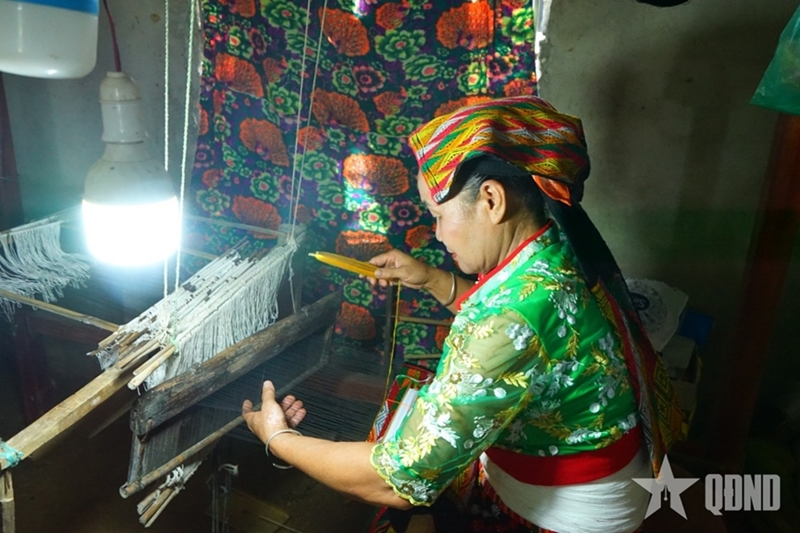
As dusk falls over Thanh Vinh village in Thanh Ky commune, Thanh Hoa province, straw smoke drifts among modest houses. Amidst the quiet, the steady creak of a loom echoes from the home of Lo Thi Khanh, 64. For decades, she has remained devoted to her weaving frame, preserving the Thai ethnic soul in every scarf and traditional garment.
Khanh has practiced Thai weaving for nearly 50 years, with every thread carrying a memory. "This craft is a family legacy," she shared. "Since childhood, I learned weaving from my parents, starting with silkworm raising."
    |
 |
|
Lo Thi Khanh diligently works beside her loom. |
Looking at the spools of colored thread beside her, she reflected, “Today it’s easier. I can buy ready-dyed threads from the market and just weave. In the past, we had to raise every silkworm ourselves, gather mulberry leaves for them to eat. It took about a month before we had silk to work with.”
In the past, a single Thai scarf required many meticulous steps, from silkworm raising, spinning, indigo dyeing, weaving to hand embroidery. All patterns were embroidered by hand, often taking months to complete. With skillful hands and constant creativity, Khanh found a way to overcome the limitations of hand embroidery. Speaking proudly of her innovation, she explained, “Before, everything had to be stitched bit by bit. Now, I pick colored threads and weave the patterns directly on the loom. With each movement of my hands, the motifs appear instantly on the fabric. Thanks to that, the time to complete a scarf has been shortened to just 10 days to a month.”
In Thai culture, nature is regarded as flesh and blood. Khanh explained that in the past, her ancestors worked in the fields, on the hillsides, by rivers and streams. Whatever they saw around them, they brought home and wove into patterns. For instance, the image of a crab’s legs became diamond-shaped motifs on a scarf. Through generations, descendants inherit and enrich these designs. The five colors on a Thai scarf symbolize the five breaths of nature: green for leaves, white for clouds, red for the sun, and yellow and orange for forest flowers.
Each Thai community in different regions nationwide carries its own cultural shade, together forming part of Vietnam’s vibrant cultural mosaic. However, in Thanh Ky commune, Thai scarf weaving is gradually fading, as most artisans are middle-aged women or elderly people.
Facing that risk, local authorities have opened vocational classes within the commune, equipping them with 10 new looms and full sets of tools. Lo Thi Khanh has become the “flame keeper,” personally guiding women in spinning and weaving techniques. Her small class now has 25 learners who, upon completion, will receive vocational certificates in weaving, a recognition of those continuing the craft’s legacy.
Under the soft glow of a small lamp, the loom illuminated the sun-darkened face of the Thai woman. When asked whether the craft is arduous and if she has ever felt discouraged, Khanh smiled gently, sharing that she once stopped weaving for more than ten years, but when she thought about the day no one in her village would know how to weave anymore, she felt afraid. “Now I do it out of passion. I just hope to preserve the craft of our ancestors so that our children and grandchildren will still know it and continue it,” she stressed.
With that belief, the loom’s creaking resumes, interweaving memory, faith and the enduring spirit of the Thai ethnic community.
Translated by Mai Huong