This expectation was shared by Dr. Hoang Thi Hong Ha, an ethnologist living and working in France, in an interview with the Vietnam News Agency (VNA)'s correspondent in Paris ahead of the major political event, scheduled to take place in Hanoi from January 19 to 25.
According to Ha, the 13th National Party Congress placed culture on an equal footing with economy, politics and society, laying an important foundation for viewing culture as a development pillar. Building on this, those working in the cultural sector hope that the 14th National Party Congress will further concretize this orientation through more effective implementation mechanisms.
    |
 |
|
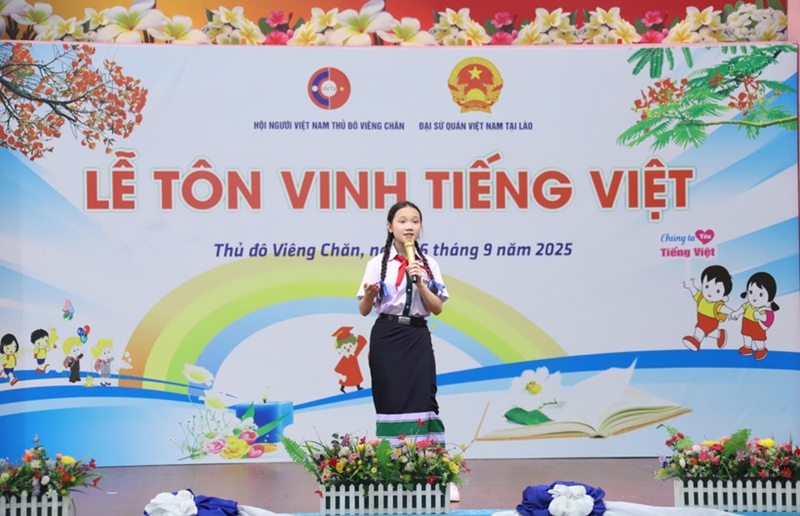
A student from Nguyen Du Lao-Vietnamese bilingual school participates in a story-telling competition in Vietnamese with the theme "Vinh Moc Tunnel - Quang Tri, where life is immortal" |
She noted that the upcoming congress is also expected to improve institutions and infrastructure for cultural industries, intellectual property and the creative economy sector. These fields are not only drivers of identity-based economic growth but also key tools for strengthening soft power and projecting the national image in an increasingly interconnected world.
Ha suggested that Vietnam could invest more strongly in cultural education, cultural diplomacy and international creative cooperation, particularly for younger generations and overseas Vietnamese (OV) communities. Drawing on France’s experience, she stressed that culture can only develop sustainably when it is embedded in education, everyday life and international networks of artists, scholars and communities.
Associating heritage preservation with the community's participation, digitizing cultural resources and developing digital cultural platforms would help Vietnam both preserve its cultural memory and expand global access. This presents an opportunity for culture to emerge as a source of soft power, fostering social cohesion and elevating the country’s position in a new development phase.
In the context of deep international integration, Vietnam should continue viewing culture as a strategic pillar of sustainable development and a foundation of national identity, Ha said, adding that the 14th congress could place greater emphasis on preserving and promoting cultural values through modernization, aligning them with contemporary life and public demand rather than focusing solely on formal preservation.
She also highlighted the need to encourage creative freedom and expand space for artists, designers, creative organizations and heritage-practicing communities. Based on France’s experience, Ha said creativity acts as a bridge that allows heritage to “live” and resonate with younger generations, while generating cultural products capable of competing internationally. Support mechanisms for cultural industries, intellectual property, product circulation and international cooperation are therefore essential.
Another important orientation is cultural diplomacy and cultural education for OVs. Supporting Vietnamese communities abroad in maintaining the Vietnamese language, heritage and traditional arts is a way for Vietnamese culture to “spread from within,” she noted.
As an expatriate directly involved in cultural and artistic activities, Ha noted that the potential contribution of OV artists, scholars and intellectuals remains significant but underutilized. She expressed her hope that the 14th National Party Congress would mark a turning point by recognizing OVs as an important “soft cultural institution” in national strategies for integration and promoting Vietnam’s identity abroad.
Source: VNA