Building cultural sovereignty in the digital space is among the key tasks identified for implementing the Politburo’s Resolution No.80-NQ/TW on developing Vietnamese culture.
Forming digital cultural ecosystem imbued with Vietnamese values
At the second meeting of the Central Steering Committee for the Development of Vietnamese Culture on July 13, 2026, General Secretary of the Communist Party of Viet Nam Central Committee and President To Lam stressed the need to build cultural sovereignty in cyberspace and make the digital space a place where Vietnamese culture is recognized, appreciated and widely shared.
    |
 |
|
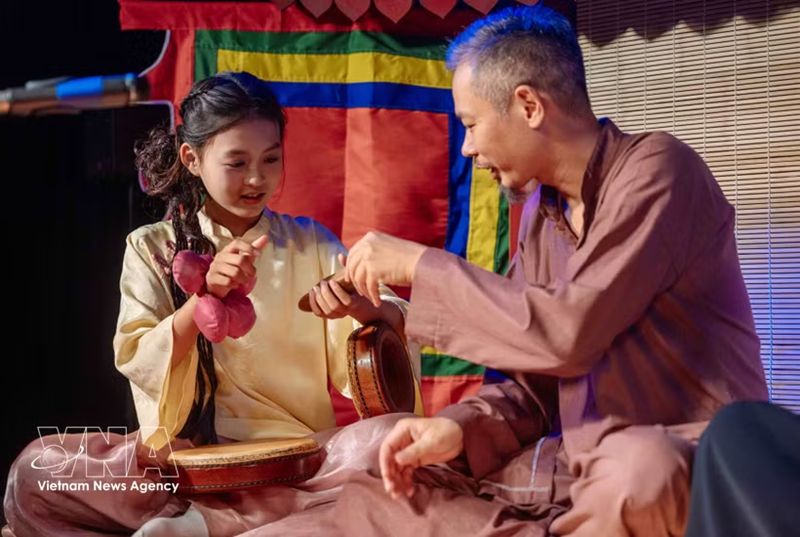
A young girl enjoys learning about musical instruments from an artisan. |
Son perceived that this requires a shift from simply “putting culture online” to fostering cultural life in the digital space.
He said Viet Nam needs to develop a national cultural database as core infrastructure connecting libraries, museums, heritage sites, research institutions, archives, artisans, and creative communities.
This platform can be used to create a variety of content such as digital libraries, virtual museums, heritage maps, virtual reality experiences, short videos, podcasts, animations, music, games, and interactive programs for young people.
The key is to tell cultural stories in modern and engaging ways without losing their depth and authenticity, the official noted.
Communities as a cultural resource
Groups devoted to Vietnamese village communal houses, pagodas, traditional music, ancient costumes, calligraphy, fine arts, history and local heritage can be seen as voluntary “cultural cells” in society, Son said.
Their strengths lie in passion, in-depth knowledge and the ability to connect people with shared interests. Community members can quickly document and share information about heritage sites, traditional architecture, artefacts and local cultural practices, sometimes faster than official institutions.
Their stories are also often more accessible to the public because they are based on personal experiences, images and memories.
However, passion alone is not enough to ensure sustainable development.
Son said such communities need to ensure the reliability of their information by checking sources and clearly distinguishing between documented facts, hypotheses and personal opinions.
They also need sustainability as a community should not be dependent entirely on certain enthusiast members. They should have plans on developing successors, content editorial standards, shared archives, and transparent financial mechanisms.
At the same time, heritage protection requires caution over sensitive information. Details about valuable artefacts or the locations of heritage objects should not be disclosed without considering risks such as theft, illegal trading and damage to heritage sites, he added.
The State, meanwhile, should support these communities through small grants and training in digitization, copyright, communications and community management while expanding their access to official cultural data.
Such support should not turn them into extensions of State agencies, Son stressed, as their vitality lies in their voluntariness, independence, diversity and sincere love for culture.
With proper support, each group can become a small hub of knowledge; the interconnection of thousands of such hubs will create a vast, sustainable network that safeguards and spreads Vietnamese culture.
Making culture meaningful online
The official cited the political-art program “To Quoc trong tim” (The Fatherland in Our Hearts) as an example of how cultural content can help shape social values in the digital environment.
In August 2025, the show drew over 50,000 people to Hanoi’s My Dinh Stadium and quickly gained wide exposure through television, newspapers, and social media. Photos and videos captured and shared by the crowd helped foster a stronger sense of patriotism, unity, and appreciation for past generations.
For cultural communities, he went on, building credibility as trusted sources of knowledge is essential. They should establish expert advisory teams, verification procedures, clear sourcing practices and mechanisms for correcting mistakes.
Son also stressed the importance of improving digital literacy. People need to know how to check sources, compare information, identify manipulated content and understand how algorithms influence what they see and share.
In the digital era, he argued, the ability to assess information is itself part of cultural literacy.
Building cultural sovereignty online, therefore, is not simply about promoting more Vietnamese cultural content. It is also about ensuring that Vietnamese people have access to accurate knowledge about their own history, culture, and identity, while enabling Vietnamese cultural values to reach wider audiences.
Source: VNA