Along with the strong growth momentum of the tourism sector, the overseas Vietnamese community is increasingly playing an important role in attracting international visitors and promoting the image of a dynamic city.
According to the city’s Department of Tourism, during the nine-day Lunar New Year 2026 holiday (from February 14 to 22), the total tourism revenue reached VND 12.15 trillion, an increase of 42.9% compared to the same period. Notably, the number of inbound tourists surged significantly in urban sightseeing products, cultural and culinary experiences, and inter-regional tours. This trend aligns with the city’s orientation toward developing modern and creative urban tourism.
    |
 |
|
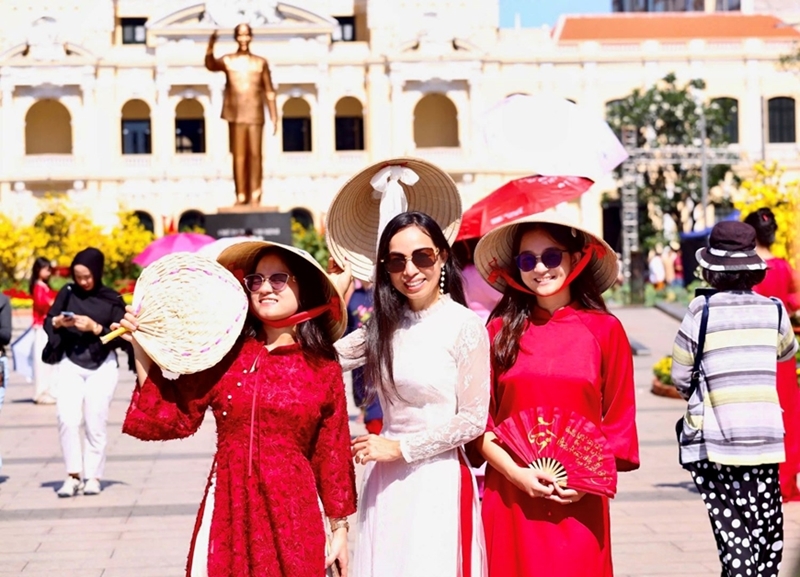
Overseas Vietnamese in Ao dai enjoy Tet atmosphere at Nguyen Hue flower street. |
In 2025, the city welcomed nearly 8.6 million international visitors, an increase of 40.3%, with a significant contribution from the overseas Vietnamese community. The city aims to develop tourism associated with cultural and historical values as well as distinctive products, striving to become a leading creative tourism hub in Asia by 2030. Within this strategy, promoting the role of overseas Vietnamese as a “bridge” is considered an important solution to combine cultural promotion with attracting high-quality tourist flows.
Nguyen Thi Thanh Thuy, an overseas Vietnamese in Germany, said that every time she returns to Vietnam, her family often walks around the city center to explore historical landmarks, take a cruise along Saigon River, and then depart from Bach Dang wharf by high-speed boat to Vung Tau to visit relatives. These familiar experiences make her eager to share images of the city with international friends and the Vietnamese community abroad.
Many overseas Vietnamese associations organize cultural exchange activities, thereby fostering tourism demand. Dinh Thi Minh Ha, an overseas Vietnamese living in Sydney, Australia, and co-founder of the Vietnam-Australia Cultural Exchange Organization (VACEO), whose family currently lives in Phu Nhuan ward, shared that each time she returns, she takes time to explore the city’s new tourism products and clearly notices the transformation of its urban landscape. Her connection with her homeland provides inspiration for introducing the city in cultural exchange programs in Australia.
Through programs featuring traditional musical instrument performances, traditional costume showcases, and introductions to the images of Vietnam’s land and people at cultural centers, schools, and community events in Sydney, the image of Ho Chi Minh City has become more familiar to local audiences. As they come to understand Vietnamese culture, many gradually develop the desire to visit and experience the country’s major urban centers firsthand, with the city standing out as a representative destination.
With their advantage of understanding both local cultures and the international environment, overseas Vietnamese are becoming a “soft bridge” in promoting the city’s image to the world, contributing to increasing the number of international visitors and enhance the city’s position as a creative, globally integrated urban tourism.
Translated by Quynh Oanh