According to Nguyen Huu An, Deputy Head of the Tourism Resource Planning and Development Division under the municipal Department of Tourism, the sector is under pressure to diversify tourism services and introduce unique products to support the city’s goal of achieving double-digit growth in 2026. In response, the department has conducted surveys to explore industrial tourism experiences, aiming to turn long-standing brand heritage into products with high economic value.
    |
 |
|
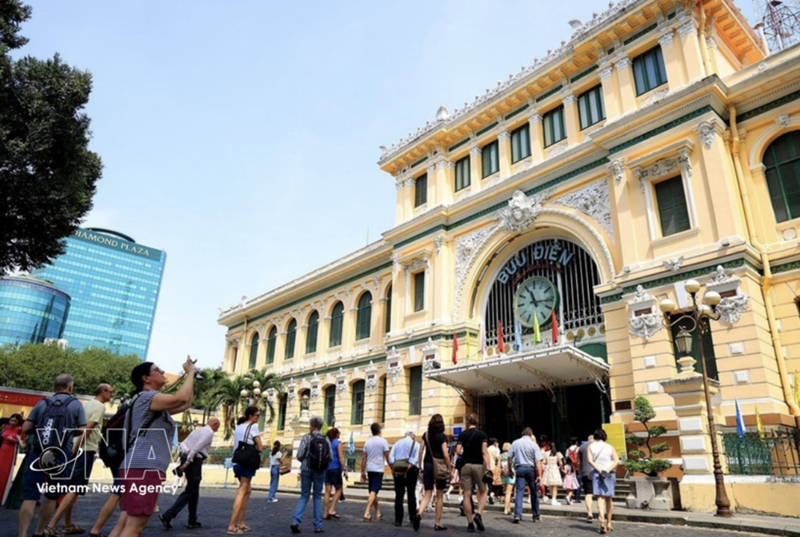
The Saigon Central Post Office in downtown Ho Chi Minh City draws international visitors. |
To realize this model, close coordination among manufacturers, travel firms and tourism experts is required. Developing industrial tourism is expected not only to boost tourism revenue but also to help preserve and promote the value of long-established Vietnamese brands. It also contributes to shaping the locality as a destination for entertainment and leisure while strengthening its image as a hub of knowledge, heritage and sustainable innovation.
A survey of Vissan Joint Stock Company identified the company as a potential industrial tourism site thanks to its more than 55-year history closely linked to the city’s urban life. With modern production processes, well-developed infrastructure and a wide range of branded products, the facility could become an attractive destination for educational tours and culinary experiences.
Similarly, cultural spaces and technological landmarks in Dong Hung Thuan and Trung My Tay wards are being assessed for their potential to form new tourism products. Tourism enterprises participating in field surveys have noted that the north-western area of the city still holds an underexplored “reservoir” of tourism resources, including historical relics, cultural sites and distinctive destinations that could form the basis for new tourism products if properly invested.
Among notable sites is Quang Trung Software Park, a symbol of innovation and technological development that offers a different perspective on tourism compared with traditional historical attractions. Experts suggested that building interconnected tourism routes linking these destinations with neighboring areas would be more effective than developing individual sites in isolation.
Travel firms have also proposed designing package tours that combine industrial tourism with visits to historical landmarks, thereby creating more appealing travel itineraries. However, for industrial facilities to become tourism products, infrastructure upgrades such as separate visitor pathways, heritage exhibition areas and interactive culinary spaces are needed to ensure professional experiences without disrupting production activities.
Meanwhile, Saigontourist Group has conducted surveys in Dau Tieng commune and surrounding areas to assess tourism potential, infrastructure conditions and service capacity. Sites such as Dau Tieng lake, Cau mountain, Thai Son pagoda and a historical exhibition on French-era rubber plantations were evaluated for their potential to support new tourism products and expand the city’s tourism space.
Local authorities said that following administrative restructuring in 2025, Dau Tieng commune now has favorable conditions to develop eco-tourism, resort tourism and nature-based experiences. Surveys carried out since early 2026 have opened up prospects for forming new tourism products and promoting inter-district tourism routes through cooperation among the Department of Tourism, businesses and local administrations.
These efforts are expected to create new opportunities for more professional tourism planning at ward and commune levels, contributing to destination development and human resource training to meet the needs of both domestic and international visitors.
Source: VNA