In a candid and lively atmosphere, the laureates reflected on their journeys from early inspirations to field-changing discoveries, showing that science is not simply a profession, but a responsibility to humanity.
Their stories ranged from childhood memories on farms to breakthroughs that successfully transfer technologies like clonal seed reproduction and nitrogen-fixing microbes from the lab to real-world agriculture. The conversation repeatedly pointed to Vietnam’s agricultural strengths as fertile ground for applying these advancements.
    |
 |
|
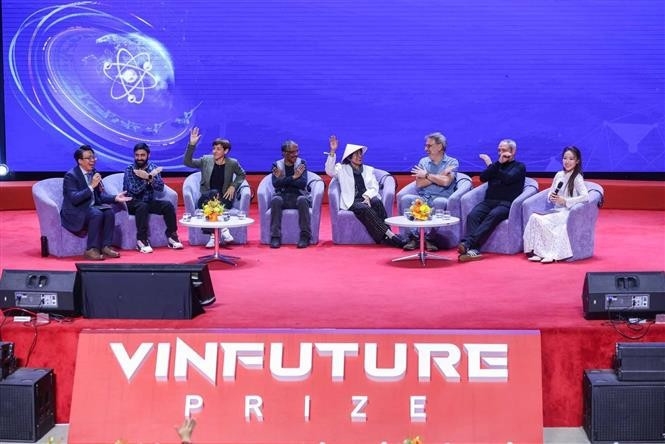
The winners of the "Innovators With Outstanding Achievements In Emerging Fields" and "Innovators from Developing Countries" prizes engage with participants at the event. |
The first session spotlighted pioneering work in crop science. Prof. María Esperanza Martínez-Romero, winner of the Special Prize for Innovators from Developing Countries, appeared in a Vietnamese conical hat, sharing her work on microbial ecology and symbiotic nitrogen fixation in the tropics. The professor has discovered and described numerous new Rhizobium species, significantly expanding scientific understanding of microbial taxonomy and plant-microbe interactions in agriculture. Her work has opened new directions in the study of bacterial-plant symbiosis, with profound implications for sustainable agriculture in resource-limited settings.
Alongside her, Prof. Venkatesan Sundaresan (the U.S.), Prof. Raphaël Mercier (Germany), Dr. Emmanuel Guiderdoni (France), Dr. Imtiyaz Khanday (the U.S.), and Dr. Delphine Mieulet (France), who won Special Prize for Innovators with Outstanding Achievements in Emerging Fields, outlined their groundbreaking technology enabling hybrid rice to reproduce clonally.
The team’s work has enabled rice plants to produce seeds that retain all the superior traits of the parent plant through self-pollination, grounded in new insights into developmental biology and genetics. This groundbreaking research improves yields, reduces seed production costs, and advances sustainable global food security.
The scientists expressed hope that during the VinFuture Sci-Tech Week, collaboration with Vietnamese researchers would advance field trials in Vietnam.
The second part of the exchange focused on breakthroughs against cancer. Prof. Mary-Claire King (the U.S.), who received Special Prize for Women Innovators for identification of the breast and ovarian cancer susceptibility gene BRCA1, emphasized that major advances often follow setbacks on letting failure come early; that is how science finds the right path.
Prof. Maura L. Gillison (the U.S.), a Grand Prize laureate, discussed shifting to molecular oncology to create greater patient impact, despite early scepticism and financial hardship. Responding to questions about gender, she and fellow laureate Dr. Aimée R. Kreimer affirmed that women can excel in science and stressed teamwork as essential.
The 2025 VinFuture Grand Prize valued at 3 million USD was awarded to Dr. Douglas R. Lowy, Dr. John T. Schiller, Dr. Aimée R. Kreimer and Prof. Maura L. Gillison for discoveries and development of HPV vaccines for prevention of tumors caused by human papillomaviruses.
Source: VNA