In his opening remarks, the Government leader, also head of the steering committee, noted that Vietnam is among the countries most severely affected by climate change and must adopt effective adaptation solutions. In 2025 alone, the country was hit by 21 storms and tropical depressions, resulting in 420 deaths, 730 injuries and estimated economic losses of around 100 trillion VND (3.8 billion USD).
According to the PM, these losses serve as a stark warning and underscore the urgency for Vietnam to strengthen its response to climate change, including the effective implementation of its COP26 commitments in order to meet the country’s development requirements in a rapid and sustainable manner.
    |
 |
|
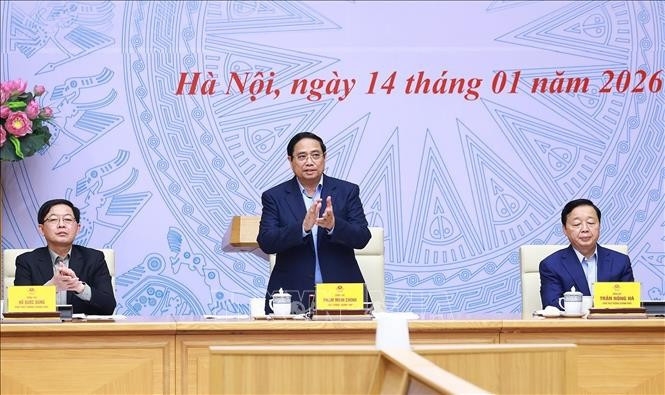
Prime Minister Pham Minh Chinh chairs the sixth meeting of the National Steering Committee for the implementation of Vietnam’s commitments at COP26 on January 14. |
He stated green transition, energy transition and emissions reduction, particularly in sectors such as energy, agriculture and transport, have become irreversible global trends and are now a strategic choice and top priority for many countries, including Vietnam.
The leader stressed that climate action remains a global movement and trend, in which Vietnam is actively engaged. In recent times, the steering committee has carried out a wide range of tasks and achieved important results. Institutional frameworks and policy mechanisms on climate change response have continued to be improved. Vietnam is implementing the project on the sustainable development of one million hectares of high-quality, low-emission rice cultivation in the Mekong Delta, while many local businesses have shifted strongly towards green investment, clean technologies and low-emission models.
However, PM Pham Minh Chinh acknowledged that despite notable achievements, shortcomings remain in implementation. In particular, the mobilization of resources through frameworks such as the Just Energy Transition Partnership (JETP) and the Asia Zero Emission Community (AZEC) has fallen short of expectations, and available green development credit has not been fully utilized. Coordination among ministries, sectors and levels of authorities has also yet to achieve full coherence and consistency.
To optimize resources and enhance coordination capacity in implementing COP26 commitments in the coming period, the PM called on the meeting to focus on comprehensive discussions and assessments of progress to date, including achievements, shortcomings, underlying causes, obstacles requiring resolution and lessons learned.
He urged participants to propose key tasks for the steering committee going forward, in line with domestic and international developments, particularly the orientations and objectives of the 14th National Party Congress on rapid and sustainable development.
PM Pham Minh Chinh also stressed the need to strike a balance between green development and the digital economy, green economy, circular economy and the pursuit of sustained double-digit growth, and to identify priority and breakthrough tasks for ministries, sectors, agencies and localities.
According to the Ministry of Agriculture and Environment, since the fifth meeting, ministries, sectors and the steering committee itself have actively implemented assigned tasks and recorded important progress. Under the Government’s new organizational structure, the committee has reviewed, supplemented and refined the policy and legal framework, including the Politburo’s Resolution No.57-NQ/TW on breakthroughs in science, technology, innovation and national digital transformation, and Resolution No.70-NQ/TW on ensuring national energy security through 2030, with a vision to 2045.
At the same time, Vietnam has actively participated in international climate forums, expanded strategic partnerships and attracted additional investment resources for domestic green and digital transitions. Many enterprises have also moved decisively towards green investment, clean technologies and low-emission business models.
Source: VNA