The initiative aims to bring healthcare services closer to residents and strengthen grassroots medical care, with a long-term goal of extending preventive health services to the city’s nearly 15 million people.
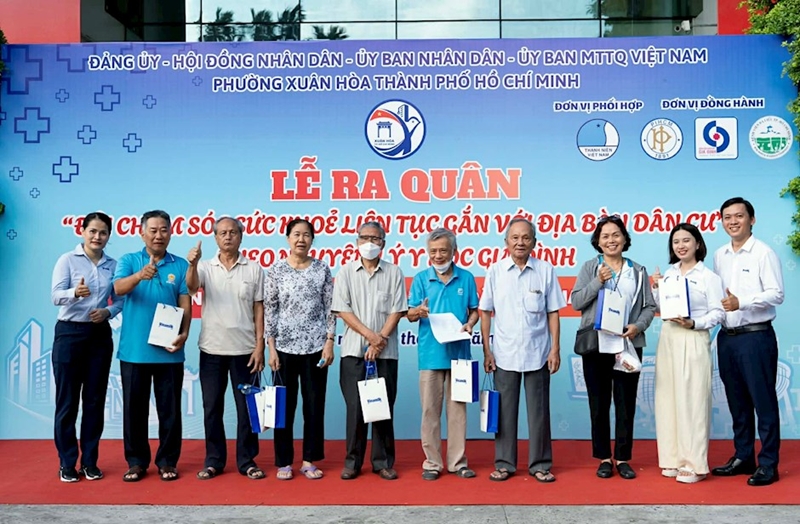
At the headquarters of the Xuan Hoa ward People’s Committee, doctors from the Ho Chi Minh City Dermatology Hospital and Sai Gon Eye Hospital joined staff from the local health station to provide medical check-ups for about 250 elderly residents. Services included general examinations, dermatology and eye checks, and blood tests.
    |
 |
|
Local people receive gifts after having medical check-ups. (Photo: www.hcmcpv.org.vn) |
According to Luu Quoc Hai, Director of the Xuan Hoa Ward Health Station, the program will help local health authorities collect health data and develop appropriate monitoring and treatment plans. After the initial phase, the station plans to expand health checks to all residents and deploy community healthcare teams to provide home-based services where needed.
A similar program was organized in Ba Ria ward, where the Ho Chi Minh City Oncology Hospital coordinated with the ward health station to screen more than 200 residents, mainly elderly people and women. The screenings focused on conditions such as thyroid, breast and cervical cancers, as well as common gynecological diseases.
Residents welcomed the initiative, noting that such examinations previously required traveling to central hospitals, which often meant additional time and costs.
In Bac Tan Uyen commune, the local health station partnered with Binh Duong General Hospital to organize disease screening for about 400 residents, prioritizing the elderly, poor and near-poor households, policy beneficiaries and other vulnerable groups. Medical teams conducted examinations in specialties including internal medicine, ear–nose–throat, ophthalmology and dentistry, along with diagnostic procedures such as ultrasound and electrocardiograms. Many non-communicable diseases and common conditions were detected early, enabling timely consultation, treatment or referrals.
According to local health officials, community-based screening programs are particularly valuable in areas located far from major hospitals, helping residents access specialized services while also enhancing the professional capacity of grassroots healthcare workers through collaboration with higher-level hospitals.
The municipal Department of Health said 58 general and specialized hospitals and medical centers joined the campaign. The initiative reflects the city’s shift from a passive “treat when sick” approach to proactive community health management. Authorities aim to ensure that every resident receives at least one health check-up.
In 2026, the city will prioritize screenings for groups requiring regular monitoring, including the elderly, vulnerable individuals, people with chronic diseases and those at high risk. Residents will also be able to choose any convenient healthcare facility for check-ups, regardless of their place of residence, helping expand coverage and reduce the risk of missing target groups.
Health data collected through the program will contribute to building a unified database for lifelong health management, supporting the development of a more modern, equitable and centered healthcare system in Vietnam.
Source: VNA