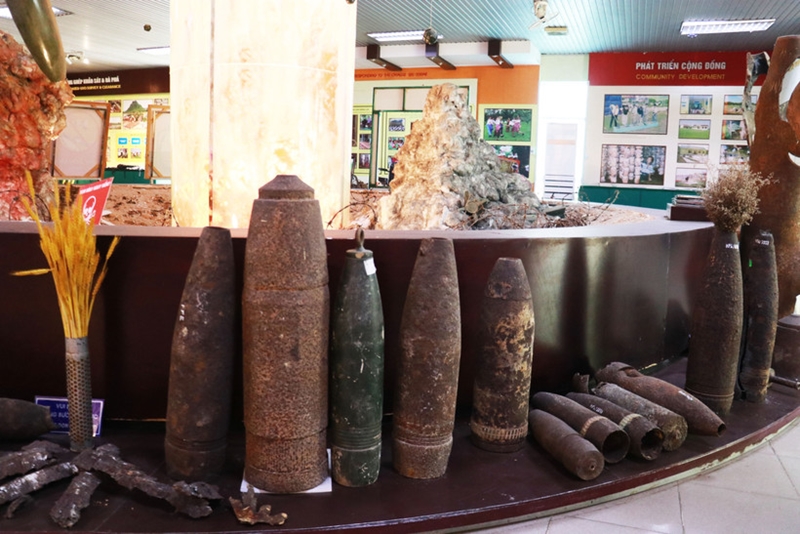
After the war, Quang Tri province—now comprising former Quang Tri and Quang Binh provinces—was heavily contaminated by unexploded ordnance (UXO), with an estimated 620,000 hectares affected, posing persistent risks to communities and hindering socio-economic development. Of this, the area corresponding to former Quang Tri province accounted for about 390,000 hectares (81%), while the area of former Quang Binh province recorded roughly 230,000 hectares.
    |
 |
|
The mine action exhibition center in Nam Dong Ha ward, Quang Tri province |
Although the war ended decades ago, the danger remains. In October 2025, a loud explosion caused by leftover ordnance was reported in a field in Le Xuyen hamlet of Nam Cua Viet commune, prompting a rapid response by the provincial Mine Action Centre (QTMAC).
Since becoming the first locality in Vietnam to be authorized to cooperate with foreign organizations in mine action projects in 1996, Quang Tri has received sustained support from international non-governmental organizations, including Norwegian People’s Aid (NPA), the Mines Advisory Group (MAG), PeaceTrees Vietnam, and Project RENEW.
Recent operations highlight tangible progress. After six months of fieldwork, NPA teams completed technical surveys in Phong Nha commune, covering over 15.7 million square meters and identifying 56 confirmed hazardous areas spanning more than 34.7 million square meters for future clearance. A total of 607 explosive items, including 523 cluster munitions, were detected and safely disposed of.
MAG has also played a key role in reducing daily risks for communities. In 2025 alone, it cleared 31.2 sq.km of contaminated land in Quang Tri, safely handled more than 9,700 explosive items, and conducted 581 explosive ordnance disposal missions. Its risk education programs reached over 14,600 people while more than 12,300 benefited directly from land clearance.
For local residents, each cleared site brings renewed hope. Every explosive removed eliminates a hidden danger, while each square meter of safe land creates opportunities for livelihoods, housing, and education, said Nguyen Van Sinh, a resident in Trieu Phong commune.
Mine clearance has also helped safeguard historical sites. At the Special National Relic of Quang Tri Ancient Citadel, MAG cleared more than 135,000 square meters and safely disposed of 325 explosive items, ensuring safety for visitors and staff while preserving the site’s historical value.
Deputy Director of the Mine Action Centre of Quang Tri Dinh Ngoc Vu said nearly 60,000 hectares of land in the province have been cleared of UXO contamination, with over 925,000 explosive items safely destroyed. Risk education programs have reached nearly 900,000 people.
Despite these achievements, challenges remain, including unstable funding largely dependent on international aid, uneven progress in some areas, and limitations in coordination, data sharing, and human resources. Victim support also requires stronger integration with broader social welfare policies.
Under the provincial mine action program for 2026–2035, Quang Tri aims to comprehensively enhance its Mine Action Centre's capacity; boost cooperation with foreign governments, international organizations, and domestic partners to better mobilize financial and technical resources; and apply advanced technologies to accelerate survey and clearance efforts. Priority will also be given to clearing all confirmed hazardous areas, and stepping up the official announcement of UXO contamination density.
The province is also intensifying risk education, particularly for children and farmers in high-risk areas, while strengthening support for victims through livelihood assistance, vocational training, and healthcare services.
By 2035, Quang Tri targets becoming a “safe province,” with all confirmed cluster munition-contaminated areas cleared, no UXO accidents caused by the lack of awareness by 2030, and all UXO victims and their families accessing support services, thus ensuring safer lives and sustainable development for its people.
Source: VNA