Talking to the Viet Nam News Agency (VNA), Prof., Dr. Nguyen Van Tam, Chair of the Department of Computer Science, Data and Artificial Intelligence at IP Paris, said the Political Bureau’s Resolution No.23-NQ/TW, which elevates overseas Vietnamese to one of the country's important strategic resources, should be translated into practical mechanisms for deeper participation of OVs in the country’s scientific and technological development, particularly in artificial intelligence (AI).
He said science and technology now operate as a global network, with a country’s strength depending not only on capital, data and computing capacity, but also on people who can generate knowledge, master technology and connect the country with leading intellectual centers worldwide.
    |
 |
|
Prof., Dr. Nguyen Van Tam, Chair of the Department of Computer Science, Data and Artificial Intelligence at the Polytechnic Institute of Paris (IP Paris) |
Viet Nam has many professors, scientists, engineers and entrepreneurs working at major global science and technology hubs. To turn this intellectual resource into national capacity, he proposed connecting people, promoting cooperation and transforming cooperation into capacity.
Expert networks such as the Viet Nam Global AI Network (VGAIN) could facilitate cross-border research groups, joint supervision of PhD students, data and model development, technology transfer and efforts to address major national challenges, Tam said.
The focus should shift from identifying which Vietnamese experts are overseas to determining what scientific and technological capabilities Viet Nam needs to build over the next five to 10 years. Flexible mechanisms should also allow overseas Vietnamese intellectuals to contribute regularly without having to return permanently.
Tam said science and technology diplomacy in AI should move from “connecting people” to co-creating science and technology, enabling OV scientists to jointly lead research programs, supervise doctoral students and participate in technology development.
He identified three priorities: joint scientific leadership; shared research infrastructure for data, computing resources, evaluation standards and testing environments; and focused investment in major AI challenges facing Viet Nam.
For sensitive or strategic data, trusted research environments could enable remote collaboration while ensuring that data remain under Vietnamese control and are adequately protected, he said.
He also called for flexible research funding, greater scientific autonomy, appropriate appointment and remuneration mechanisms, and clear rules on intellectual property and data. Performance should be measured not simply by the number of experts connected, but by the number of cross-border research groups, jointly supervised researchers, technologies, patents, data resources and new research capacity created in Viet Nam.
Looking ahead, Tam said the goal should be a global Vietnamese intellectual ecosystem, rather than merely an expert network.
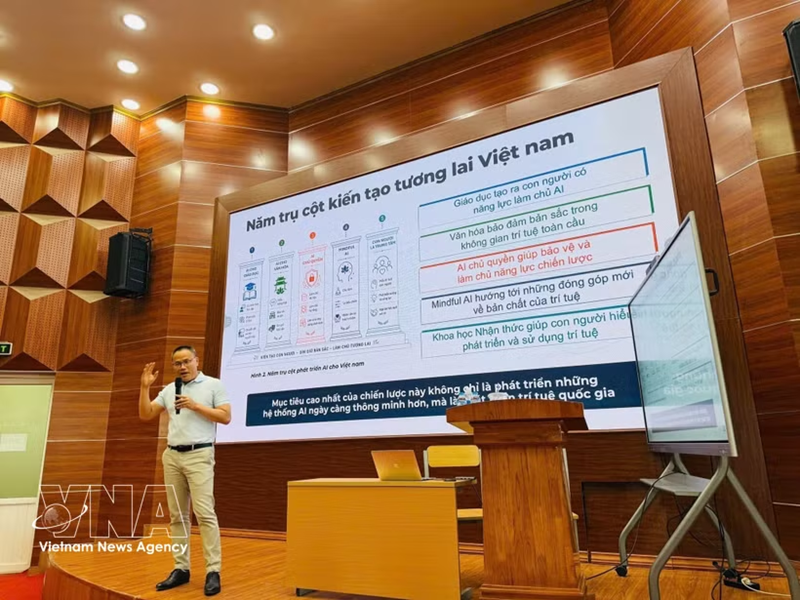
He identified mutually reinforcing strategic directions for AI: AI for education, AI for culture, sovereign AI, “mindful AI,” and human-centered AI underpinned by cognitive science.
AI should help personalize STEM education while strengthening human intelligence rather than replacing it. In culture, AI can help preserve and transmit Vietnamese language, history, knowledge and values, while creating data infrastructure that enables future AI systems to better understand Viet Nam.
For sovereign AI, Viet Nam should selectively master strategically important capabilities, particularly control over strategic data, essential systems and decision-making. “Mindful AI” could bring AI together with neuroscience, cognitive science, psychology and philosophy of mind to explore new principles for AI inspired by a deeper understanding of natural intelligence.
Finally, cognitive science could serve as a cross-cutting foundation for education, helping people understand and master AI rather than become dependent on it, the expert said.
To implement Resolution No.23, Tam proposed immediately selecting major national AI challenges and forming cross-border research teams to tackle them; connecting OV scientists with young researchers through mentorship, internships, co-supervision and research collaboration; and developing shared and cumulative research infrastructure covering data, computing resources, evaluation standards, tools and research environments.
If pursued consistently, Tam said, these efforts could gradually turn the intellectual resources of Vietnamese people worldwide into an integral part of the country’s national intellectual capacity.
Source: VNA