He made the request at a working session with the Party Central Committee's Commission for Policy and Strategy on October 1 on promoting the combined strength of the personnel working at academies and research institutes in strategic advisory work.
General Secretary and President To Lam commended the commission, the Viet Nam Academy of Science and Technology (VAST) and the Viet Nam Academy of Social Sciences (VASS) for their active contribution to the preparation of important policies and projects. He also attributed these achievements partly to officials at the commission, research institutes, universities and Vietnamese intellectuals abroad.
    |
 |
|
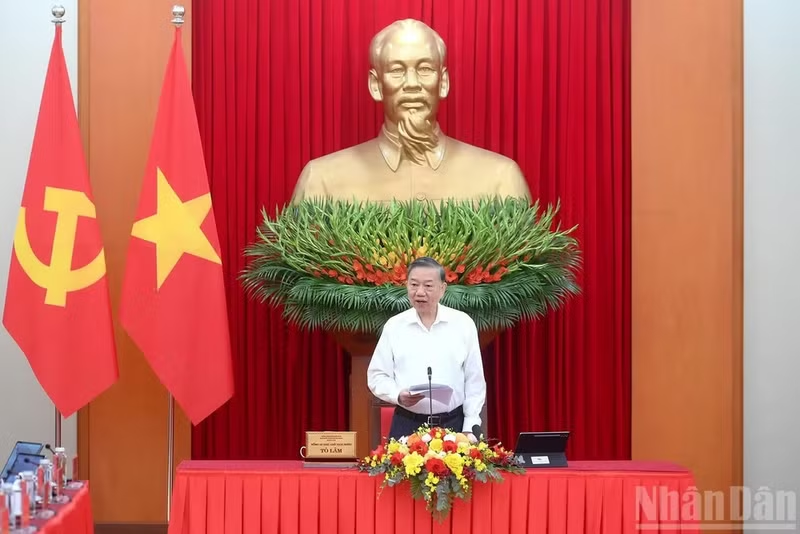
General Secretary of the Communist Party of Viet Nam Central Committee and President To Lam speaks at the working session with the Party Central Committee's Commission for Policy and Strategy on October 1, 2026. (Photo: NDO) |
The volume of reports or projects is not a comprehensive measure of advisory quality, he stressed, noting what's more important is that whether research helps identify issues early, correctly understand their causes, select appropriate policies and resolve difficulties in reality.
He noted substantial research potential of the country, but it has yet to be organized into a common strength. The commission should connect the resources of the two academies, research institutes under ministries and sectors, universities, businesses as well as domestic and overseas experts with the central leadership’s advisory requirements.
It is important to accurately identify problems, mobilize the right people early on, and incorporate research findings into decision-making at the right time, he added.
The goal is to build strong research, forecasting and strategic advisory capacity. The commission should be responsible for identifying issues, setting research requirements, integrating evidence and formulating advisory options. Meanwhile, the two academies should bring into full play their capacity in conducting in-depth research, analyzing data, making forecasts, giving feedback.
Research teams must be organized around strategic issues, bringing together experts from the two academies, research institutes of ministries and sectors, universities, and businesses, with responsibilities and expected outputs clarified, he said.
Research assignments should clearly define questions, deadlines and requirements while respecting scientific independence, he said, adding that for major projects, scientists should join from the drafting stage.
Scientists should have access to the necessary information while maintaining confidentiality and scientific integrity and taking responsibility for their recommendations, the top leader said.
He requested flexible ways to mobilize talent, including interdisciplinary and rapid-response teams, part-time experts and time-limited secondments. Vietnamese experts abroad and international experts should be engaged in specific tasks while data, confidentiality and national interests must be protected during cooperation expansion.
He also stressed the need for long-term research on trends over 10–20 years and also for rapid responses to emerging developments, supported by data, models, expert networks and analytical tools.
However, artificial intelligence should be used as a supporting tool while human remain responsible for assessments and recommendations, he noted.
Research, General Secretary and President To Lam said, should be measured by its contribution to decision-making: identifying issues early, providing new evidence, making accurate forecasts and improving policy options.
He asked relevant agencies to build a coordination mechanism, strengthen their capacity, improve expert remuneration, remove institutional and infrastructure obstacles, and prepare regular and ad hoc strategic reports.
Decision quality depends on how early issues are identified, how clearly options are understood and how well their consequences are anticipated, the leader stressed.
Source: VNA