In his article, Van affirmed that throughout its history of nation building and defence, the Vietnamese people have always valued peace, humanity, and righteousness, taking sincerity, loyalty, and trust as the foundation in relations with other nations. Throughout different revolutionary periods, people-to-people diplomacy has contributed to gaining international support for the cause of national liberation and reunification, while helping heal the wounds of war, break the blockade and embargo, and pave the way for the normalisation of relations with several countries and deep international integration.
The 14th National Party Congress opened a new stage of national development with a long-term vision, clear goals, and high political determination, creating a foundation for the country to move forward strongly and steadily in the era of national rise. In this context, Van wrote, people-to-people diplomacy continues to play its role as one of the three pillars of Vietnam's comprehensive and modern diplomacy, alongside Party diplomacy and State diplomacy.
    |
 |
|
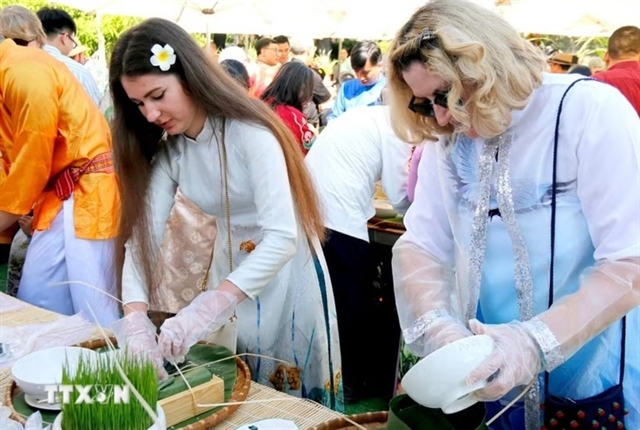
International tourists, dressed in traditional Vietnamese ethnic costumes, enthusiastically participate in making Banh chung (traditional Vietnamese rice cakes) during the Lunar New Year of the Horse 2026. |
With its advantages of broad partnerships, flexible and close forms, people-to-people diplomacy has contributed to consolidating the social foundation of relations between Vietnam and other countries; enhancing understanding and trust; mobilizing international resources for development; promoting the image of Vietnam and its people; and participating in protecting national interests early and from afar.
The irreplaceable value of people-to-people diplomacy lies in its ability to reach places that formal diplomacy finds difficult to access. As the country enters a new era of development, the reform of people-to-people diplomacy stems not only from the rapid and complex changes in the international situation but also from an internal requirement to fully unleash the strength of the people, the strength of national unity, and the strength of the times, thereby contributing to building the overall strength of Vietnamese diplomacy.
According to the official, the strength of people-to-people diplomacy lies first and foremost in the strength of trust. Relations between nations are only truly sustainable when supported by the understanding, goodwill, and support of their people. The flexibility of people-to-people channels allows access to various social forces, open exchange on differing issues, the delivery of Vietnam's message in a relatable way, and the understanding of public opinion for research and advisory purposes.
Along with significant achievements gained over the recent times, people-to-people diplomacy still faces numerous limitations, some of which are particularly evident in the new context. The integration of friendship activities with development cooperation and resource mobilisation is uneven; the network of partners is not truly diverse, and access to new forces – especially the younger generation, academics, experts, and influential figures abroad – remains limited. The capacity for presence and leadership in the digital space is weak, even though this has become a crucial area for public opinion mobilization. Research, forecasting, database development, and the quality of personnel have also not kept pace with requirements.
Notably, digital technology, artificial intelligence, and social media are profoundly changing the way public opinion is influenced, with information transmitted quickly but also easily distorted and manipulated. This presents both challenges and new opportunities for people-to-people diplomacy.
The demand for rapid and sustainable national development places a more direct task on people-to-people diplomacy in leveraging resources, knowledge, technology, markets, and international networks; building national soft power; and enhancing the country's self-reliance, self-strengthening, as well as international standing.
The reform of people-to-people diplomacy must be carried out synchronously in terms of thinking, content, forces, partners, and organizational methods, shifting from an operation-based mindset to a strategic mindset; from a reactive and short-term to proactive and long-term approach; from a piecemeal approach to a systematic approach; and from an emphasis on quantity to an emphasis on quality, impact, and ripple effect.
To strongly innovate people-to-people diplomacy to promote the all-round strength of Vietnamese diplomacy, the deputy minister proposed six priorities. First, he stressed the need to continue raising awareness and responsibility of the entire political system regarding people-to-people diplomacy.
Second, it is necessary to clearly define the focuses and priorities, and link people-to-people diplomacy with the country's strategic priorities. According to the official, activities must directly serve the maintenance of a peaceful and stable environment; protect independence and sovereignty; promote socio-economic development; and enhance Vietnam's international standing and prestige. Friendly exchanges should be linked to concrete cooperation in economy, trade, investment, science and technology, innovation, digital transformation, education, culture, and green development.
Thirdly, Van suggested building a sustainable, multi-layered, multi-sectoral partnership network; and simultaneously improve the quality of participation in multilateral people's mechanisms.
Fourth, he underscored the importance of creating a substantive breakthrough in providing information for external service and digital diplomacy through people-to-people channels. Pro-actively designing messages tailored to each audience group, conveyed through authentic and vivid stories, he wrote, will help present the country's image naturally and reliably in the digital space.
Fifth, the official noted innovating the evaluation process, and considering measuring effectiveness as a mandatory step in the overall process. According to him, it is necessary to gradually build a set of criteria and a database to monitor and evaluate the impact and reach of people-to-people diplomacy, instead of focusing on quantity and form.
Sixth, he noted the need to perfect the coordination mechanism to ensure the cohesion between Party diplomacy, State diplomacy, and people-to-people diplomacy. These three pillars have different roles, methods, and strengths, but are unified in their goal of protecting national interests, serving national development, and enhancing Vietnam's position, he affirmed, adding that coordination is needed from the policy formulation stage, partner selection, and activity organization, to result evaluation.
The official concluded by emphasising that innovating people-to-people diplomacy requires political determination, strategic thinking, synchronized coordination, and the creativity and pro-activity of all levels, sectors, localities, and people's organisations. This is not simply about innovating the form of organization and activities, but more profoundly, about innovating thinking and methods to maximise the effectiveness of people-to-people diplomacy.
Under the leadership of the Party and the unified management of the State, people-to-people diplomacy will continue to be a sustainable bridge of friendship, an important channel for converging resources, spreading soft power, and protecting national interests, contributing to building the overall strength of Vietnamese diplomacy in the new era of development, added Van.
Source: VNA