The discussion on the draft Law on Protection of Important Works Related to National Security took place at a plenary sitting chaired by National Assembly President Tran Thanh Man.
Addressing the draft law, Major General Nguyen Thanh Trung, Political Commissar of the Ho Chi Minh City Military Command and a deputy representing Ho Chi Minh City, agreed with the proposed classification of facilities based on their importance and the potential consequences of operational disruptions or sabotage.
    |
 |
|
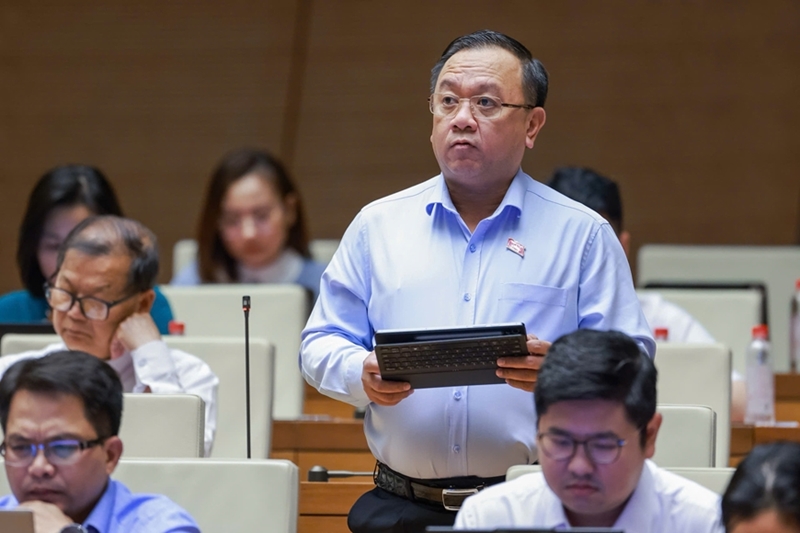
Major General Nguyen Thanh Trung, Political Commissar of the Ho Chi Minh City Military Command, speaks at the event. |
However, he noted that the importance of a facility depends not only on its size and investment value but also on its strategic location, connectivity and role in the national defense system.
He proposed further clarifying the criteria for assessing the importance of facilities based on three factors: strategic location, interdependence with related systems and the consequences of operational disruptions.
He also called for a mechanism to regularly review and update the list of protected facilities in line with scientific and technological advances and national defense requirements in the new situation.
Regarding coordination mechanisms for protecting important facilities in national defense, security and civil defense situations, Major General Nguyen Thanh Trung acknowledged that the draft law clearly defines the responsibilities of security forces, management agencies and local authorities.
However, he stressed the need for clearer coordination mechanisms when a facility faces several types of threats or incidents simultaneously.
For example, a major energy facility could suffer a cyberattack while also experiencing a fire or explosion, causing widespread power outages. Such an incident would involve not only facility protection but also cybersecurity, fire prevention and firefighting, civil defense and potentially national defense operations.
Under the Law on Civil Defense, disaster and incident response and recovery must be organized through command, coordination and responsibility-assignment mechanisms appropriate to different levels of civil defense emergencies.
Meanwhile, the draft law primarily focuses on the management and protection of important facilities related to national security.
The deputy therefore raised the question of how coordination, transitions between response arrangements and command structures should be organized in complex situations involving overlapping responsibilities, while ensuring unified command and avoiding duplication.
He proposed further clarifying the principles of coordination among relevant forces to ensure consistency with the Law on Civil Defense, the Law on National Defense and other relevant legislation.
Regarding the balance between national security requirements and the legitimate rights and interests of citizens and socio-economic development, Major General Nguyen Thanh Trung noted that many important facilities are located in urban areas, industrial parks, seaports and densely populated areas.
Although establishing restricted areas, protected zones and security corridors is necessary, such measures could also affect production, business activities and people's daily lives.
He therefore recommended supplementing or clarifying the principles for assessing potential impacts and selecting protection measures proportionate to the level of risk, while ensuring the legitimate rights and interests of affected organizations and individuals.
Also speaking at the plenary sitting, Major General Luong Dinh Hung, Deputy Commander for Legal Affairs of the Viet Nam Coast Guard and a deputy representing Nghe An province, proposed clarifying the Ministry of National Defense's responsibilities in protecting important facilities related to national security.
He suggested that the drafting agency consider adding provisions requiring the Ministry of National Defense to direct its agencies and units to coordinate in protecting such facilities in border areas, at sea, on islands and on the continental shelf.
These responsibilities should also include coordination in airspace control and countermeasures against unmanned aerial vehicles (UAVs) entering the airspace of protected facilities without authorization.
According to the deputy, certain facilities related to national security are located in areas with specific geographical and security characteristics or serve dual-use purposes without being classified as defense facilities or military zones.
Examples include oil and gas drilling rigs, offshore oil and gas ports, artificial island facilities, submarine fiber-optic cables and important facilities located within border belts.
He emphasized the need to clearly define responsibilities and coordination mechanisms among the Ministry of National Defense, the Ministry of Public Security and other ministries in protecting these facilities.
Such provisions would help ensure comprehensive coverage and clearly delineate the responsibilities of relevant agencies, organizations and forces in the state management of the protection of facilities critical to national security in these special areas.
Translated by Minh Anh