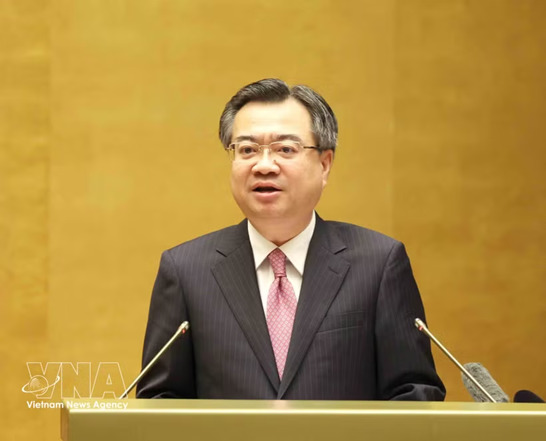
Addressing a national conference to disseminate and implement resolutions adopted at the third plenum of the 14th Party Central Committee on July 29, Nghi outlined the core directions, goals and implementation road-map of the resolution, which was issued on July 28.
    |
 |
|
Politburo member, Secretary of the Party Central Committee, Chairman of the Party Central Committee's Commission for Policies and Strategies Nguyen Thanh Nghi speaks at the national conference to disseminate and implement resolutions adopted at the third plenum of the 14th Party Central Committee on July 29. |
According to the official, the Party Central Committee said that after four decades of Doi moi (renewal), Vietnam has made historic achievements, including becoming an upper middle-income country in 2025. However, the current development model has yet to meet the requirements for fast and sustainable development amid profound global changes and the country's new strategic ambitions, particularly its goal of achieving double-digit economic growth.
The resolution therefore establishes a comprehensive framework for transforming Vietnam's development model through 2030, 2035 and 2045, with a vision to 2050, focusing on five guiding principles.
The first affirms the Party's comprehensive, absolute, and direct leadership, the State's role as a development facilitator, the strength of the great national unity bloc, and the supervisory, social criticism and consensus-building roles of the Vietnam Fatherland Front and other socio-political organizations; while identifying the renewal of development model and the creation of a comprehensive development ecosystem as strategic tasks for advancing socialism in Vietnam and realizing the nation’s development aspirations.
The second identifies institutional reform and innovation in national organization, governance and operations as the breakthrough needed to create new development capacity. Under the new development model, Vietnam will be self-reliant, innovative, humane, sustainable and globally integrated, with people at the center of development. Science and technology, innovation, digital transformation and artificial intelligence are designated as the main growth drivers, while higher productivity and more efficient resource allocation serve as core principles.
The remaining principles stress modern national governance based on the effective interaction of the State, the market and society; mobilizing all resources; strengthening strategic autonomy; and using institutional innovation, governance effectiveness, public service quality and problem-solving capacity as key performance indicators.
The resolution sets the targets of completing the foundations of the new development model by 2030, largely completing the transition to a self-reliant, innovative, people-centered, sustainable and globally integrated development model by 2035 and fully establishing the new model by 2045.
Looking ahead to 2130, Vietnam envisions becoming a highly developed socialist nation that is civilized, modern, rich in cultural identity, and distinguished by strong innovation capacity and enduring vitality.
To achieve these goals, it identifies a series of tasks and solutions.
Institutional reform and national governance are placed at the center, with priorities including improving the Party’s leadership and governance capacity, Party building, organizational and personnel work, and reforming to the implementation of the Party’s resolutions. It also focuses on building a development-oriented State, renewing the relationship between the State, the market and society, developing a legal framework that is clear, practical, coherent, stable, easy to implement and adaptable to change, establishing controlled regulatory sandbox mechanisms, advancing digital government, shared data and digital platforms, streamlining the political system for greater efficiency and effectiveness, and piloting the socialist commune- and ward-level governance model.
Economic measures include building a new growth model driven by productivity, innovation, science and technology, digital and green transformation, renewing traditional growth drivers and utilizing emerging growth engines. It also prioritizes modernizing infrastructure, reforming markets and the financial system, optimizing resource allocation, advancing industrialization and ecological agriculture, developing competitive industries and businesses, and positioning urban areas and the maritime economy as key engines of growth.
Other priorities cover social development, culture and human development, environmental protection, national defense and security, and foreign affairs, with an emphasis on modern governance, social resilience, high-quality education and healthcare, cultural development, green growth, climate adaptation, and proactive international integration.
According to Nghi, the Politburo has also adopted an action program comprising 51 key tasks and solutions and 40 major targets, with a clear implementation road-map and responsibilities assigned to relevant agencies.
Source: VNA